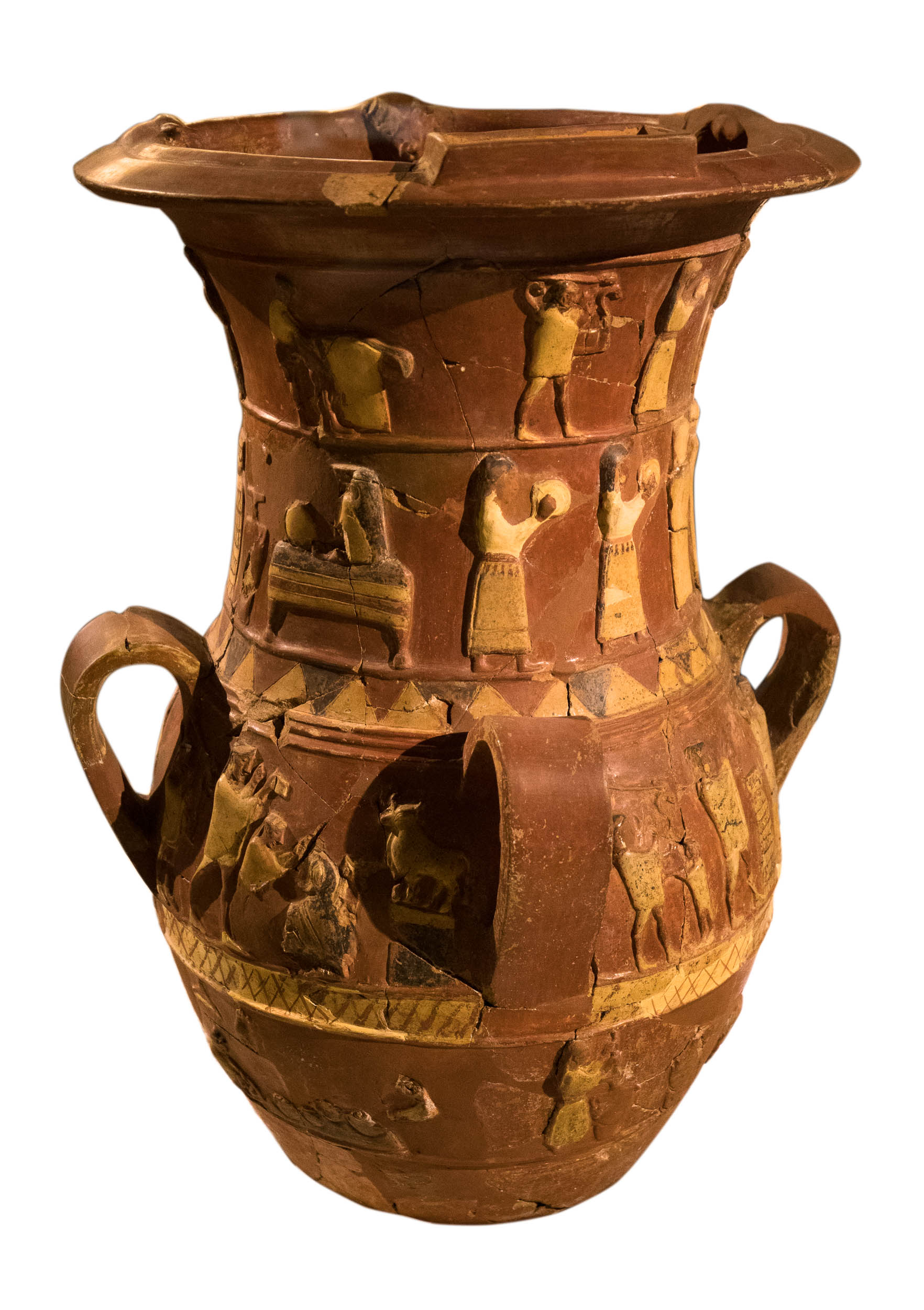
The Inandik Vase offers an intriguing look into the religious world of the Hittites. Vases such as this one can be dated to a relatively narrow window of time, between the 17th and 16th centuries BC, when the Hittite kingdom was just beginning to emerge as one of the major powers in the Ancient Near East.
This particular vase was found at Inandik, not far from the Hittite capitol of Hattusa. It was found in a rural shrine situated on a hill top outside of the city. The sides of the vase probably depict the purulli festival celebrated at spring time. It may also have marked the beginning of the New Year. The purulli festival was primarily concerned with the fertility of the land and the health of the king and queen – the two being inextricably linked together in the minds of the Hittites. Here is how one ancient Hittite text describes the purulli festival:
“For the Weather-god the mighty festival of the beginning of the year, the festival of heaven and earth, has arrived. All the gods have gathered and come to the house of the Weather-god. If any god has sorrow in his soul, let him dispel the evil sorrow from his soul. At this festival eat and drink and be satisfied! Pronounce the life of the king and queen! Pronounce [the life] of heaven and earth, [pronounce the life] of the crops! (Gurney 1977, 39)
The Inandik Vase was used to hold the wine for the festival. It has an elaborately molded rim with a square receptacle into which liquid was poured. The liquid then flowed through the rim and out through the spouted mouths of the bulls attached to the interior of the rim.
The Procession
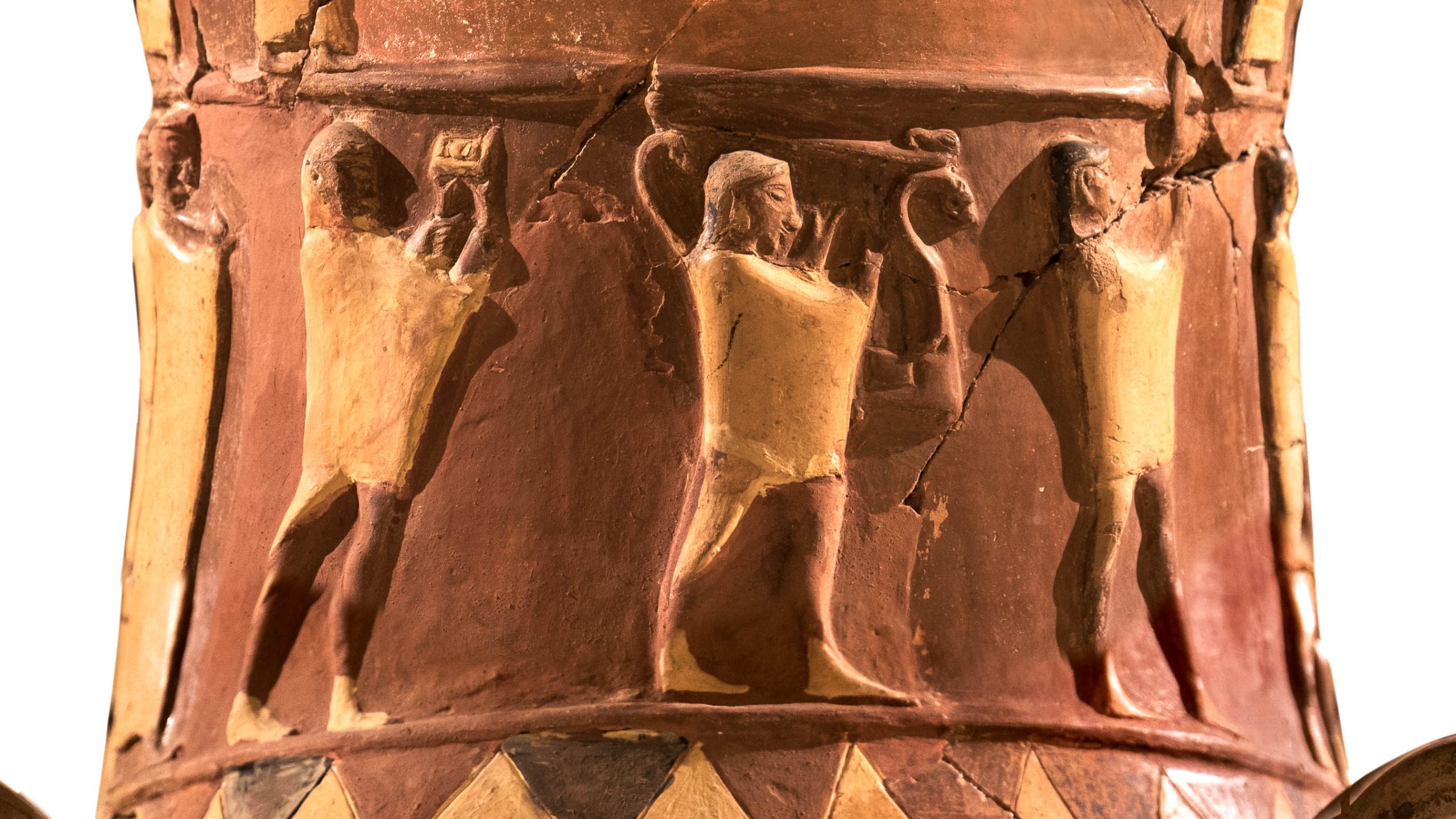


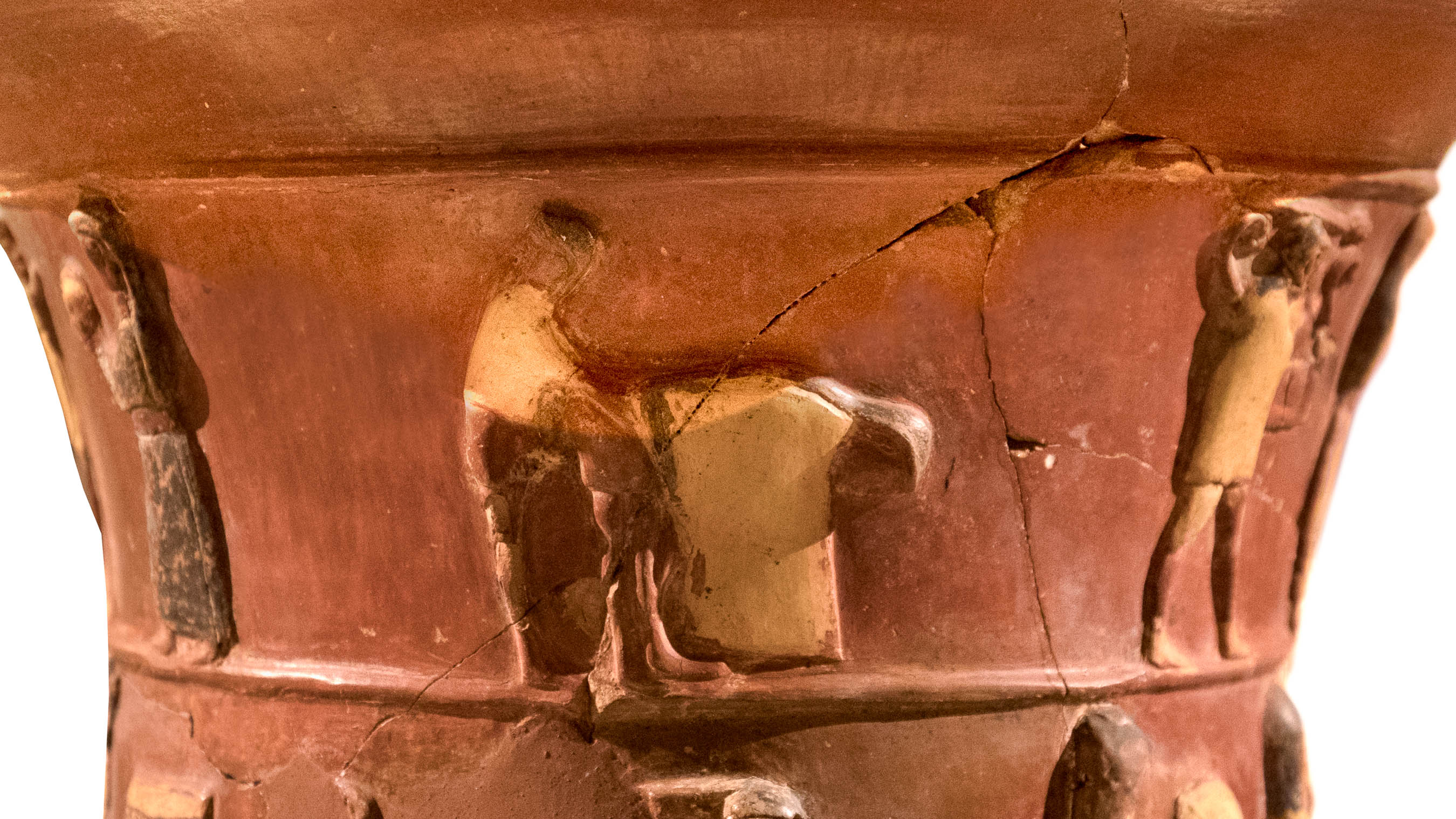
The upper frieze of the vase depicts a procession in which the women carry flat drums or cymbals while the men play lutes and lyres. Acrobats are shown jumping rope. Leading the procession are two sword-bearers. This frieze also shows a couple engaged acts of a sexual nature, seemingly in public.
There is an intriguing connection between the scenes depicted on our vase and a text uncovered in Mesopotamia. The text was written for a king named Iddin-Dagan whose reign (c. 1910 – 1890 BC) is nearly contemporary with our vase. It describes a New Years festival celebrated by the king. The text begins with a description of priests, musicians and acrobats walking in a procession to the temple of Inanna.
The male prostitutes comb their hair (?) before her,
They walk before the pure Inanna.
They decorate the napes of their necks with colored bands (?),
They walk before the pure Inanna…
The soothing harp which they had held, they place at their side.Their right side they adorn with women’s clothing
They walk before the pure Inanna
to the great lady of heaven, Inanna, I would say: “Hail!”
With jump ropes and colored cords they compete before her,
They walk before the pure Inanna.
To the eldest daughter of Su’en,
Inanna, I would say: “Hail!” (60-66)The ascending kurgarra priests grasped the sword,
They walk before the pure Inanna.
The one who covers the sword with blood, he sprinkles blood,
They walk before the pure Inanna.
He pours out blood on the dais of the throne room.
The tigi drum, the shem drum, the ala instrument, they make loud noise…. (68-79)
The text refers to a procession that includes musicians carrying harps and drums; priests carrying swords; acrobats jumping rope, and male prostitutes who are wearing women’s clothing. This matches with what is depicted on our vase although we have no way of knowing whether the men depicted on our vase were male prostitutes or not. It is noteworthy, however, that cross-dressing eunuchs were chosen as priests of the cults of Atargatis and Artemis in later periods. (See: Statue of Artemis) It is probable that such practices date back to the period of our vase.
Outside the Temple
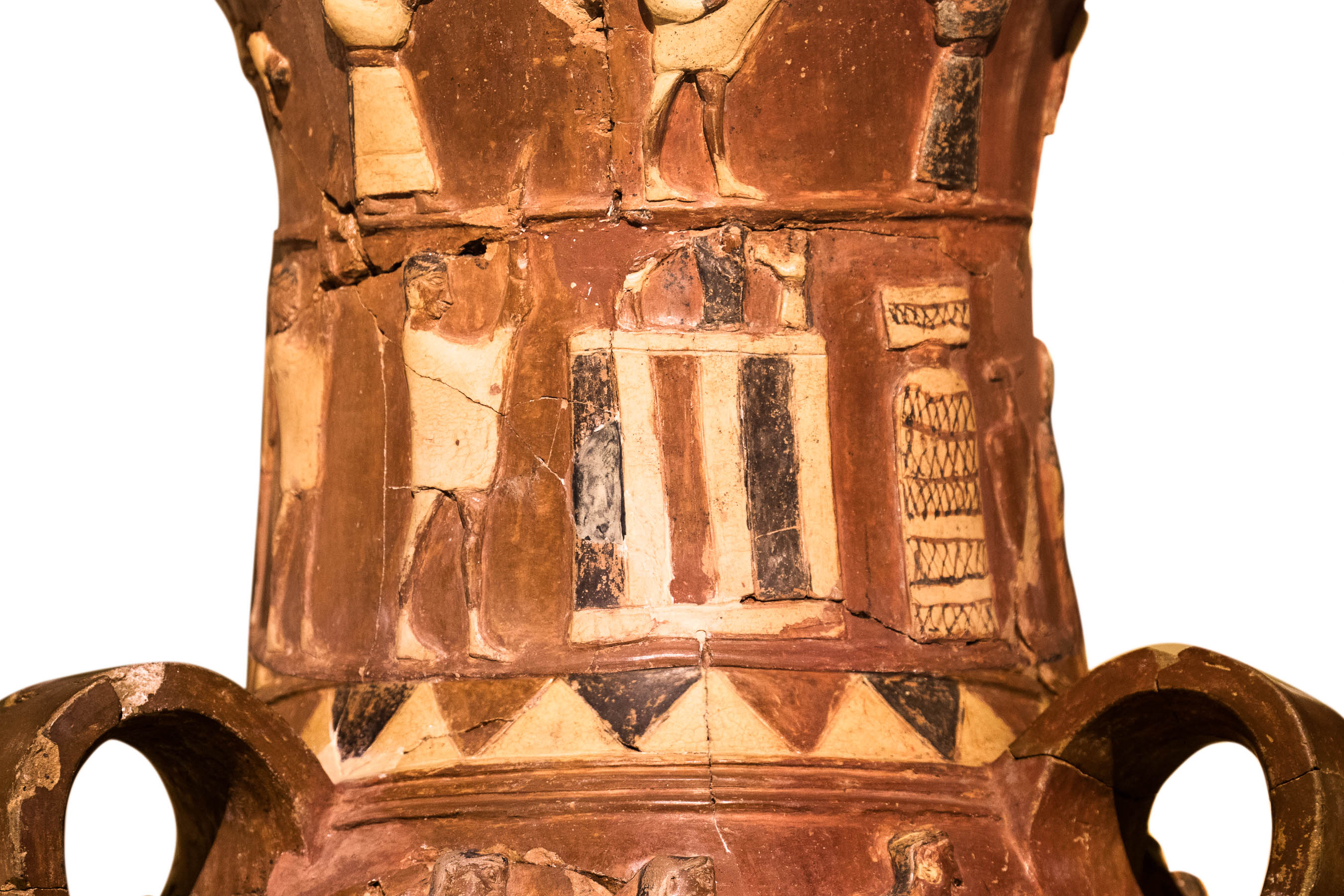
The sword-bearers who lead the procession are standing before a temple which is depicted here with vertical stripes. Three figures stand on the roof of the temple with their arms raised in a gesture of adoration. The temple seems to be a tall one judging by its proportions.
Once again, we may refer back to the Iddin Dagan text which mentions offerings made from the rooftop of a rural temple called the Badurra.
In the pure places of the steppe, at its good places,
On the roof, the high roof, on the roof of the Badurra,
On the “platforms of mankind,”
They make offerings to her… (190)
Inside the Temple
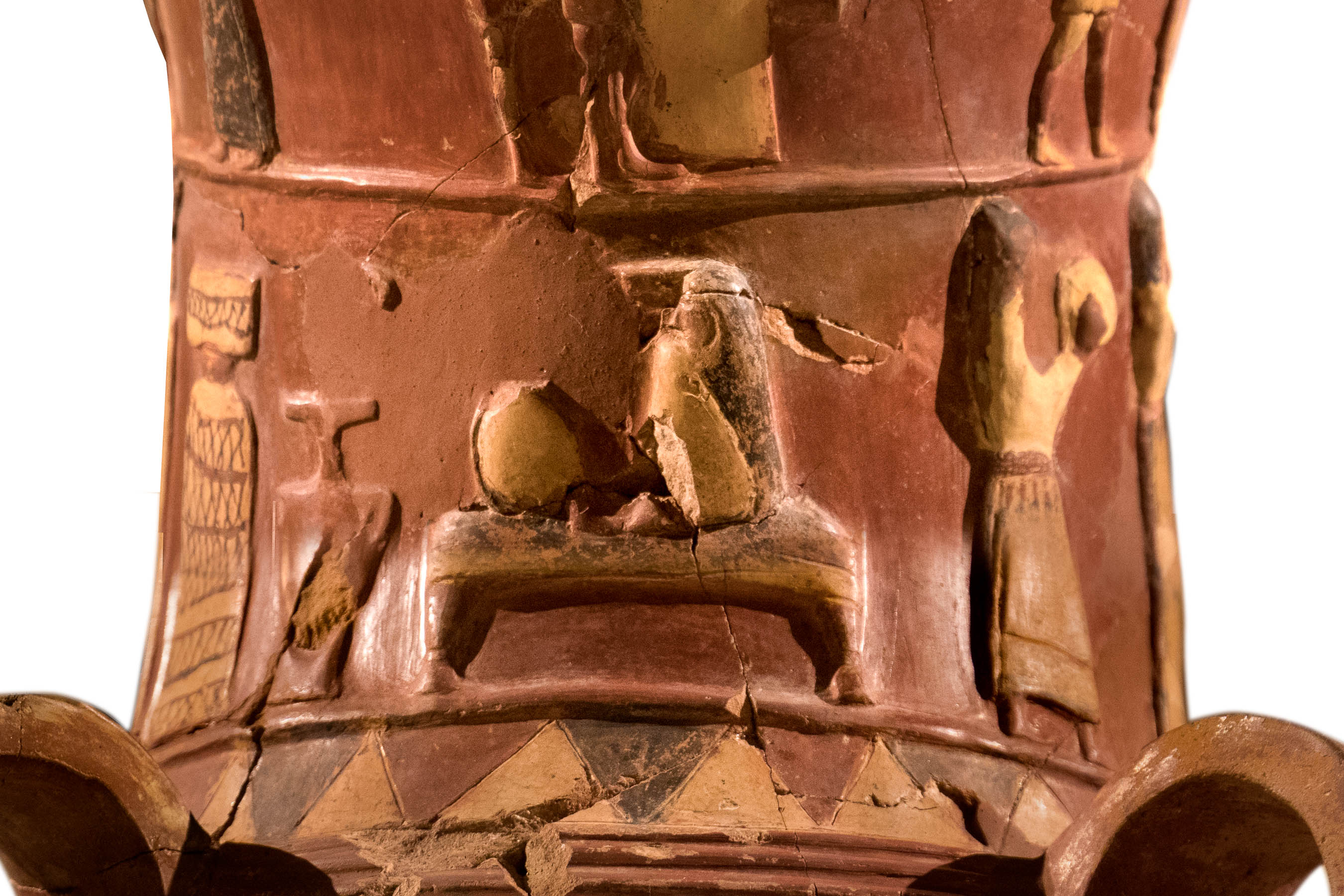
The next scene brings us inside the temple where there is a bed, an altar and a vase. The vase that is shown standing in the temple is actually the same type as our Inandik Vase which suggests that the vase occupied a central place in the cult. Two figures are seated on the bed, one of which can be identified as a woman. The other figure is broken.
This may represent a sacred marriage like that which is described in the Iddin-Dagan text.
She [Innana] makes love with him on her bed…
(She says) to Iddin-Dagan: “You are surely my beloved.”
Rituals such as this one presumably involved the king and a priestess of Innana (who may also have been the queen-consort). These rituals were believed to have ensured the fertility of the land although there were undoubtedly purely sensual motivations involved as well.
The Sacrifice

The next scene depicts a bull being sacrificed to the Weather-god, who is depicted as a bull standing on a pedestal.
The Libation
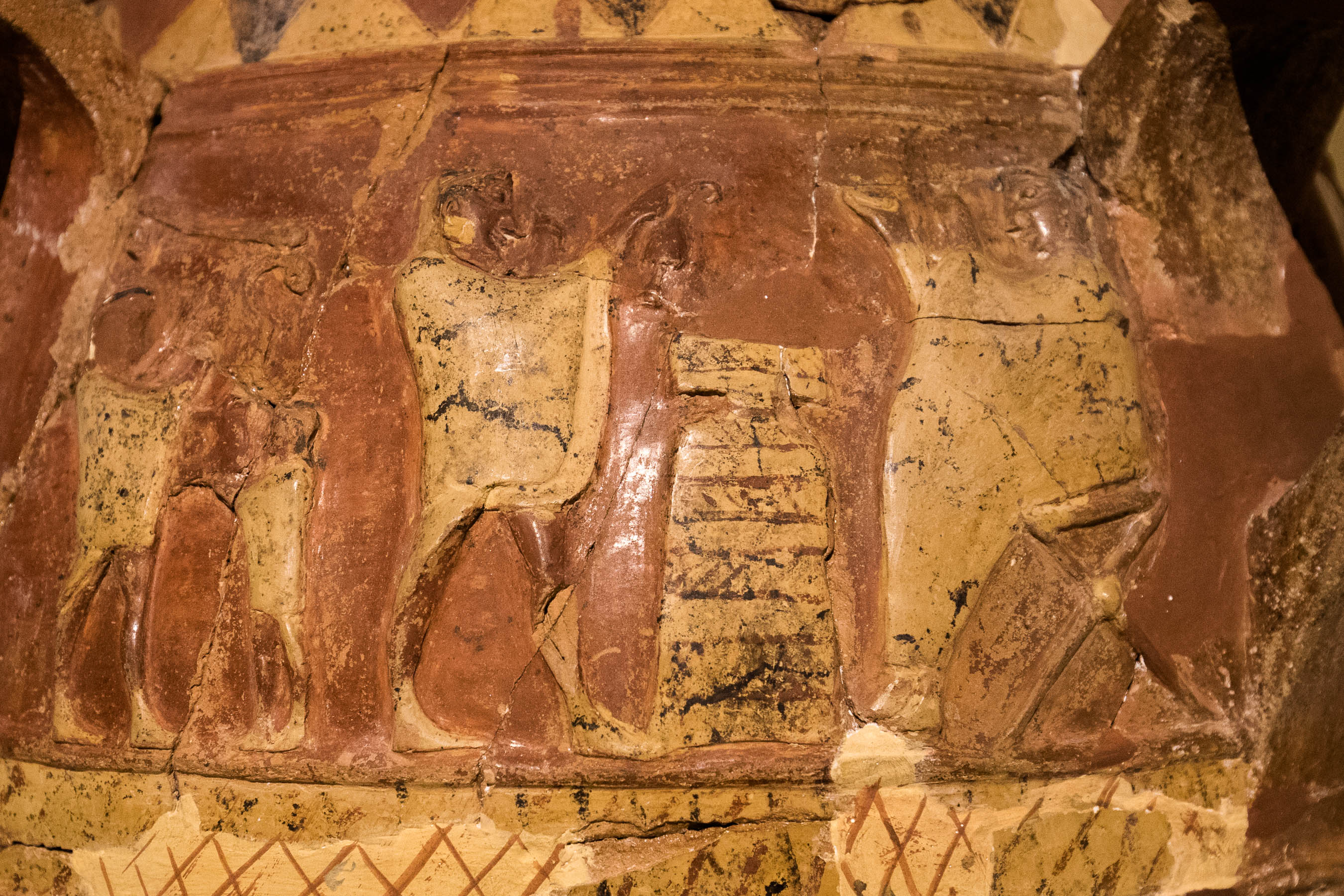
In another scene, a man pours out a libation on an altar to a goddess seated on a stool.
Preparations for the Feast

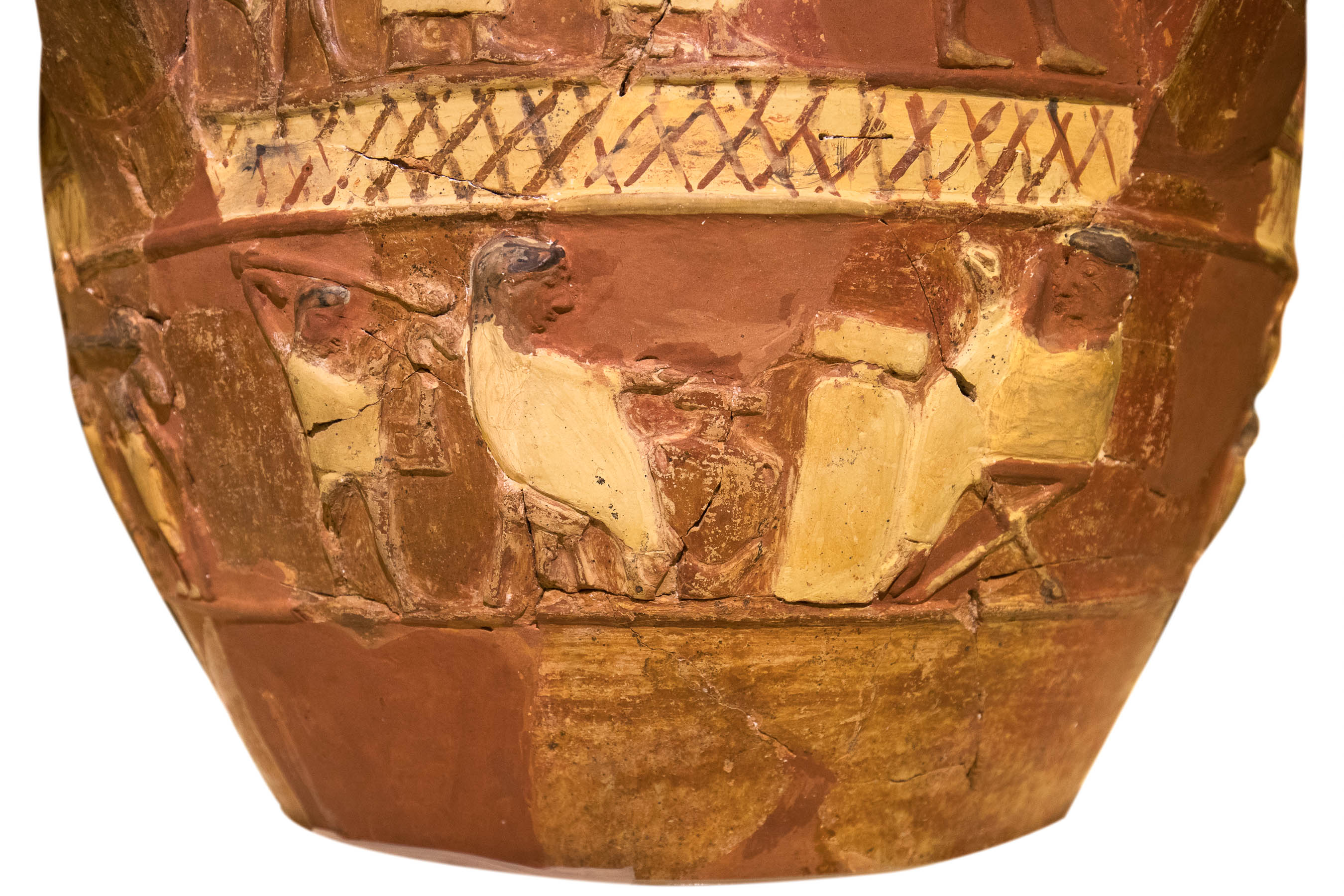
Once a portion of the meat and drink has been offered to the gods, the rest is taken for the preparation of a feast. The vase is mostly broken at this point, but we can still make out two women baking bread and another mixing wine.
The Feast
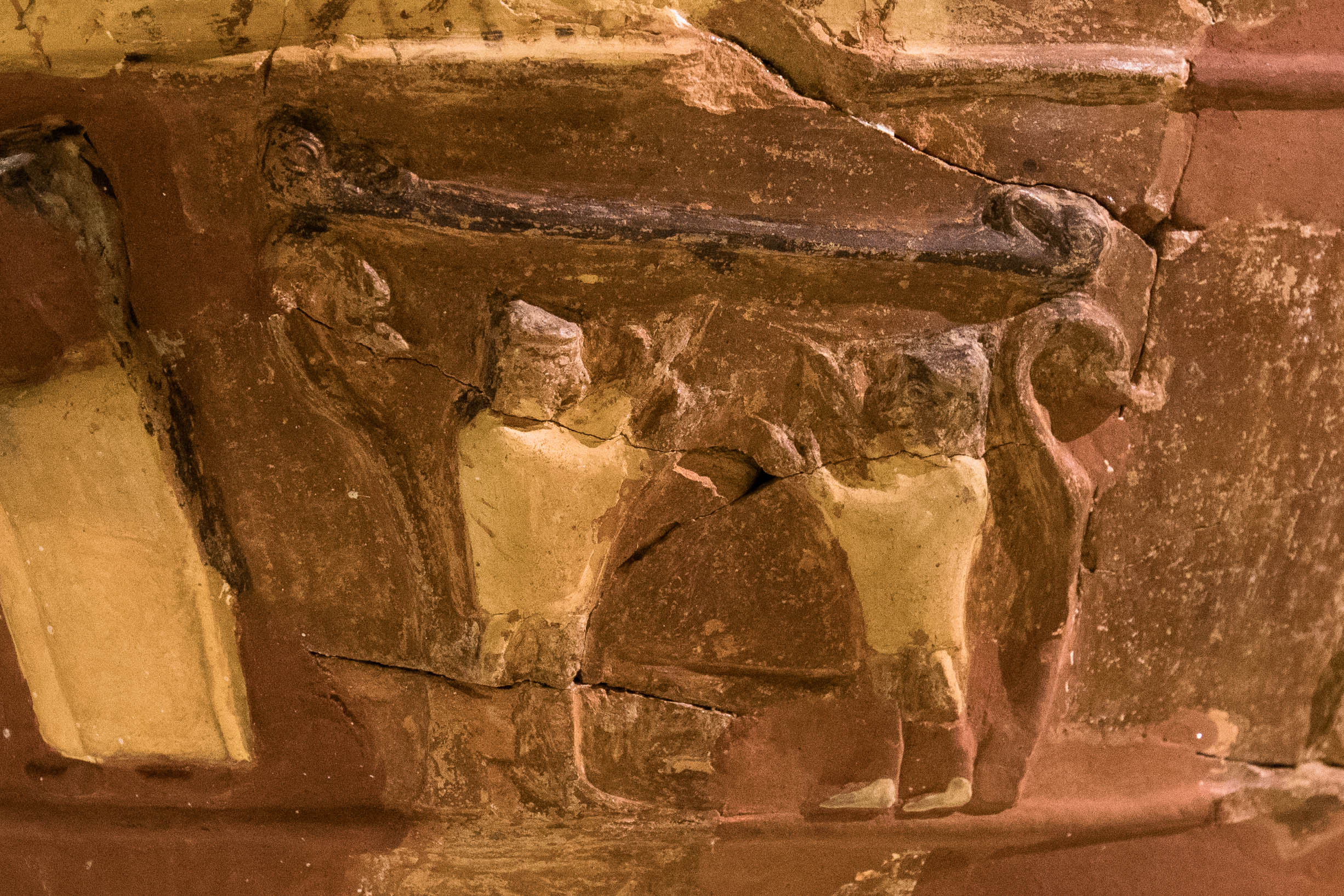
A man and a woman (or a god and goddess?) are seated before a vase of wine and a table with meat while a man plays a harp nearby. A massive two man harp is depicted in the same register.
Here again, we might turn to the Iddin Dagan Festival Text for illumination. It concludes with a description of a feast accompanied by stringed instruments.
The stringed instrument, the source of the joy of mankind
(With these) the musicians play her a song which rejoices the heart.
The king stretches forth his hand in eating and drinking,
Ama’ushumgalanna [the king] stretches forth his hand in eating and drinking.
The palace is festive, the king is joyous,
The people spend the day in plenty.
Ama’ushumgalanna [the king] stands in great joy.
May he spend long life on the radiant throne!
Whether one agrees that the Inandik vase represents the same ritual as that described in the Iddin Dagan Festival Text, there certainly are some interesting parallels between the two. Furthermore, the Inandik vase provides some insight into the controversy surrounding the high places that comprises an important theme in the Old Testament.
The High Places
Many of the Hittite festivals, such as the purulli festival described above, were performed at cult centers located in the countryside, usually in a grove, by a spring, or on a hill-top. The Hittites erected stone pillars in these places which they called ‘huwashi-stones’. Our vase was found in one such rural shrine on the top of a low-rising hill.
In Deuteronomy, the Israelites are commanded to break down the standing stones of the Canaanites and to cut down their groves. Likewise, Gideon was required to tear down the high place of Baal and Asherah before he went to battle with the Midianites. In the final days of the Judean kingdom, the prophet Jeremiah lamented that the people were worshiping on the high places.
“Have you seen what she did, that faithless one, Israel, how she went up on every high hill and under every green tree, and there played the whore? (Jer. 3:6 ESV)
Jeremiah characterized the festivals associated with the high places as a deception and a ‘tumult’ – a word that is perhaps more accurately translated as ‘orgy’.
Surely, the hills are a deception, a tumult on the mountains. Surely, in the LORD our God Is the salvation of Israel. (Jer. 3:23 NAS)
These prophets saw something inherently contradictory in the worship performed in the high places and that which God requires of us.
He has told you, O man, what is good; and what does the LORD require of you but to do justice, and to love kindness, and to walk humbly with your God? (Mic. 6:8 ESV)
Gurney, O. R. (1977). Some aspects of Hittite religion. Oxford ; New York, Oxford University Press for the British Academy.
The Feast

A man and a woman (or a god and goddess?) are seated before a vase of
wine and a table with meat while a man plays a harp nearby. A massive
two man harp is depicted in the same register.

The entrance to the temple courtyard.
Here again, we might turn to the Iddin Dagan Festival Text for illumination. It concludes with a description of a feast accompanied by stringed instruments.
The stringed instrument, the source of the joy of mankind
(With these) the musicians play her a song which rejoices the heart.
The king stretches forth his hand in eating and drinking,
Ama’ushumgalanna [the king] stretches forth his hand in eating and drinking.
The palace is festive, the king is joyous,
The people spend the day in plenty.
Ama’ushumgalanna [the king] stands in great joy.
May he spend long life on the radiant throne!
Whether one agrees that the Inandik vase represents the same ritual as that described in the Iddin Dagan Festival Text, there certainly are some interesting parallels between the two. Furthermore, the Inandik vase provides some insight into the controversy surrounding the high places that comprises an important theme in the Old Testament.
The High Places
Many of the Hittite festivals, such as the purulli festival described above, were performed at cult centers located in the countryside, usually in a grove, by a spring, or on a hill-top. The Hittites erected stone pillars in these places which they called ‘huwashi-stones’. Our vase was found in one such rural shrine on the top of a low-rising hill.
In Deuteronomy, the Israelites are commanded to break down the standing stones of the Canaanites and to cut down their groves. Likewise, Gideon was required to tear down the high place of Baal and Asherah before he went to battle with the Midianites. In the final days of the Judean kingdom, the prophet Jeremiah lamented that the people were worshiping on the high places.
“Have you seen what she did, that faithless one, Israel, how she went up on every high hill and under every green tree, and there played the whore? (Jer. 3:6 ESV)
Jeremiah characterized the festivals associated with the high places as a deception and a ‘tumult’ – a word that is perhaps more accurately translated as ‘orgy’.
Surely, the hills are a deception, a tumult on the mountains. Surely, in the LORD our God Is the salvation of Israel. (Jer. 3:23 NAS)
These prophets saw something inherently contradictory in the worship performed in the high places and that which God requires of us.
He has told you, O man, what is good; and what does the LORD require of you but to do justice, and to love kindness, and to walk humbly with your God? (Mic. 6:8 ESV)
Gurney, O. R. (1977). Some aspects of Hittite religion. Oxford ; New York, Oxford University Press for the British Academy.
The Inandik Vase offers an intriguing look into the religious world of the Hittites. Vases such as this one can be dated to a relatively narrow window of time, between the 17th and 16th centuries BC, when the Hittite kingdom was just beginning to emerge as one of the major powers in the Ancient Near East.
This particular vase was found at Inandik, not far from the Hittite capitol of Hattusa. It was found in a rural shrine situated on a hill top outside of the city. The sides of the vase probably depict the purulli festival celebrated at spring time. It may also have marked the beginning of the New Year. The purulli festival was primarily concerned with the fertility of the land and the health of the king and queen – the two being inextricably linked together in the minds of the Hittites. Here is how one ancient Hittite text describes the purulli festival:
“For the Weather-god the mighty festival of the beginning of the year, the festival of heaven and earth, has arrived. All the gods have gathered and come to the house of the Weather-god. If any god has sorrow in his soul, let him dispel the evil sorrow from his soul. At this festival eat and drink and be satisfied! Pronounce the life of the king and queen! Pronounce [the life] of heaven and earth, [pronounce the life] of the crops! (Gurney 1977, 39)
The Inandik Vase was used to hold the wine for the festival. It has an elaborately molded rim with a square receptacle into which liquid was poured. The liquid then flowed through the rim and out through the spouted mouths of the bulls attached to the interior of the rim.
The Procession
The upper frieze of the vase depicts a procession in which the women carry flat drums or cymbals while the men play lutes and lyres. Acrobats are shown jumping rope. Leading the procession are two sword-bearers. This frieze also shows a couple engaged acts of a sexual nature, seemingly in public.
There is an intriguing connection between the scenes depicted on our vase and a text uncovered in Mesopotamia. The text was written for a king named Iddin-Dagan whose reign (c. 1910 – 1890 BC) is nearly contemporary with our vase. It describes a New Years festival celebrated by the king. The text begins with a description of priests, musicians and acrobats walking in a procession to the temple of Inanna.
The male prostitutes comb their hair (?) before her,
They walk before the pure Inanna.
They decorate the napes of their necks with colored bands (?),
They walk before the pure Inanna…
The soothing harp which they had held, they place at their side.Their right side they adorn with women’s clothing
They walk before the pure Inanna
to the great lady of heaven, Inanna, I would say: “Hail!”
With jump ropes and colored cords they compete before her,
They walk before the pure Inanna.
To the eldest daughter of Su’en,
Inanna, I would say: “Hail!” (60-66)The ascending kurgarra priests grasped the sword,
They walk before the pure Inanna.
The one who covers the sword with blood, he sprinkles blood,
They walk before the pure Inanna.
He pours out blood on the dais of the throne room.
The tigi drum, the shem drum, the ala instrument, they make loud noise…. (68-79)
The text refers to a procession that includes musicians carrying harps and drums; priests carrying swords; acrobats jumping rope, and male prostitutes who are wearing women’s clothing. This matches with what is depicted on our vase although we have no way of knowing whether the men depicted on our vase were male prostitutes or not. It is noteworthy, however, that cross-dressing eunuchs were chosen as priests of the cults of Atargatis and Artemis in later periods. (See: Statue of Artemis) It is probable that such practices date back to the period of our vase.
Outside the Temple
The sword-bearers who lead the procession are standing before a temple which is depicted here with vertical stripes. Three figures stand on the roof of the temple with their arms raised in a gesture of adoration. The temple seems to be a tall one judging by its proportions.
Once again, we may refer back to the Iddin Dagan text which mentions offerings made from the rooftop of a rural temple called the Badurra.
In the pure places of the steppe, at its good places,
On the roof, the high roof, on the roof of the Badurra,
On the “platforms of mankind,”
They make offerings to her… (190)
Inside the Temple
The next scene brings us inside the temple where there is a bed, an altar and a vase. The vase that is shown standing in the temple is actually the same type as our Inandik Vase which suggests that the vase occupied a central place in the cult. Two figures are seated on the bed, one of which can be identified as a woman. The other figure is broken.
This may represent a sacred marriage like that which is described in the Iddin-Dagan text.
She [Innana] makes love with him on her bed…
(She says) to Iddin-Dagan: “You are surely my beloved.”
Rituals such as this one presumably involved the king and a priestess of Innana (who may also have been the queen-consort). These rituals were believed to have ensured the fertility of the land although there were undoubtedly purely sensual motivations involved as well.
The Sacrifice
The next scene depicts a bull being sacrificed to the Weather-god, who is depicted as a bull standing on a pedestal.
The Libation
In another scene, a man pours out a libation on an altar to a goddess seated on a stool.
Preparations for the Feast
Once a portion of the meat and drink has been offered to the gods, the rest is taken for the preparation of a feast. The vase is mostly broken at this point, but we can still make out two women baking bread and another mixing wine.
The Feast
A man and a woman (or a god and goddess?) are seated before a vase of wine and a table with meat while a man plays a harp nearby. A massive two man harp is depicted in the same register.
Here again, we might turn to the Iddin Dagan Festival Text for illumination. It concludes with a description of a feast accompanied by stringed instruments.
The stringed instrument, the source of the joy of mankind
(With these) the musicians play her a song which rejoices the heart.
The king stretches forth his hand in eating and drinking,
Ama’ushumgalanna [the king] stretches forth his hand in eating and drinking.
The palace is festive, the king is joyous,
The people spend the day in plenty.
Ama’ushumgalanna [the king] stands in great joy.
May he spend long life on the radiant throne!
Whether one agrees that the Inandik vase represents the same ritual as that described in the Iddin Dagan Festival Text, there certainly are some interesting parallels between the two. Furthermore, the Inandik vase provides some insight into the controversy surrounding the high places that comprises an important theme in the Old Testament.
The High Places
Many of the Hittite festivals, such as the purulli festival described above, were performed at cult centers located in the countryside, usually in a grove, by a spring, or on a hill-top. The Hittites erected stone pillars in these places which they called ‘huwashi-stones’. Our vase was found in one such rural shrine on the top of a low-rising hill.
In Deuteronomy, the Israelites are commanded to break down the standing stones of the Canaanites and to cut down their groves. Likewise, Gideon was required to tear down the high place of Baal and Asherah before he went to battle with the Midianites. In the final days of the Judean kingdom, the prophet Jeremiah lamented that the people were worshiping on the high places.
“Have you seen what she did, that faithless one, Israel, how she went up on every high hill and under every green tree, and there played the whore? (Jer. 3:6 ESV)
Jeremiah characterized the festivals associated with the high places as a deception and a ‘tumult’ – a word that is perhaps more accurately translated as ‘orgy’.
Surely, the hills are a deception, a tumult on the mountains. Surely, in the LORD our God Is the salvation of Israel. (Jer. 3:23 NAS)
These prophets saw something inherently contradictory in the worship performed in the high places and that which God requires of us.
He has told you, O man, what is good; and what does the LORD require of you but to do justice, and to love kindness, and to walk humbly with your God? (Mic. 6:8 ESV)
Gurney, O. R. (1977). Some aspects of Hittite religion. Oxford ; New York, Oxford University Press for the British Academy.
The Feast
A man and a woman (or a god and goddess?) are seated before a vase of
wine and a table with meat while a man plays a harp nearby. A massive
two man harp is depicted in the same register.
The entrance to the temple courtyard.
Here again, we might turn to the Iddin Dagan Festival Text for illumination. It concludes with a description of a feast accompanied by stringed instruments.
The stringed instrument, the source of the joy of mankind
(With these) the musicians play her a song which rejoices the heart.
The king stretches forth his hand in eating and drinking,
Ama’ushumgalanna [the king] stretches forth his hand in eating and drinking.
The palace is festive, the king is joyous,
The people spend the day in plenty.
Ama’ushumgalanna [the king] stands in great joy.
May he spend long life on the radiant throne!
Whether one agrees that the Inandik vase represents the same ritual as that described in the Iddin Dagan Festival Text, there certainly are some interesting parallels between the two. Furthermore, the Inandik vase provides some insight into the controversy surrounding the high places that comprises an important theme in the Old Testament.
The High Places
Many of the Hittite festivals, such as the purulli festival described above, were performed at cult centers located in the countryside, usually in a grove, by a spring, or on a hill-top. The Hittites erected stone pillars in these places which they called ‘huwashi-stones’. Our vase was found in one such rural shrine on the top of a low-rising hill.
In Deuteronomy, the Israelites are commanded to break down the standing stones of the Canaanites and to cut down their groves. Likewise, Gideon was required to tear down the high place of Baal and Asherah before he went to battle with the Midianites. In the final days of the Judean kingdom, the prophet Jeremiah lamented that the people were worshiping on the high places.
“Have you seen what she did, that faithless one, Israel, how she went up on every high hill and under every green tree, and there played the whore? (Jer. 3:6 ESV)
Jeremiah characterized the festivals associated with the high places as a deception and a ‘tumult’ – a word that is perhaps more accurately translated as ‘orgy’.
Surely, the hills are a deception, a tumult on the mountains. Surely, in the LORD our God Is the salvation of Israel. (Jer. 3:23 NAS)
These prophets saw something inherently contradictory in the worship performed in the high places and that which God requires of us.
He has told you, O man, what is good; and what does the LORD require of you but to do justice, and to love kindness, and to walk humbly with your God? (Mic. 6:8 ESV)
Gurney, O. R. (1977). Some aspects of Hittite religion. Oxford ; New York, Oxford University Press for the British Academy.