
All that is left of the great temple of Ra at Heliopolis. The site is now located in the neighborhood of Al-Matariyyah, Cairo.
Heliopolis was once the main attraction for visitors Egypt. Homer, Solon, Pythagoras and Plato are all said to have visited there, although the historical basis for some of these claims is questionable. The name means “the city of the sun” in Greek— so named after the temple that once once stood on the spot dedicated to Ra, the sun god. For size and importance it was rivaled only by the temple of Amun at Thebes.
The temple at Heliopolis was built on a high mound that rose above the surrounding flood plain. The name of this mound was On or Ono—which means ‘pillars’, no doubt due to the obelisks erected on the mound. According to the book of Genesis, Joseph married a daughter of a high priest of On named Asenath. Their two sons, Manasseh and Ephraim would become progenitors of two of the twelve tribes of Israel.
Almost nothing of the temple has been recovered. This is partly because the modern suburbs of Cairo now cover the site and partly due to the fact that the ruins now lie below the water table. Senusret I (1971–1926 BC) was the first to raise an obelisk at Heliopolis. A great many more obelisks were erected at Heliopolis during the New Kingdom period but only the obelisk erected by Senusret I remains standing. It is remarkable to think that this tall pillar has been standing in the same spot for 4000 years!
The Obelisk
There is evidence than an obelisk was erected at Heliopolis during the Old Kingdom period. But rather than a tall slender needle, it may have taken the form of a short, squat pillar capped with a pyramid. The pillar was called the benben stone, probably after the Egyptian word wbn which means “to shine”.1Hoffmeier, 10 The pyramid capping the pillar was probably gilded with gold and silver that shone brightly with the first light of the rising sun.
Starting with the Middle Kingdom the obelisk assumed the long, needle-like shape we now associate with Egyptian obelisks. Their bases are often inscribed with baboons since these creatures make a howling racket in the early morning hours (like roosters) and were therefore associated with the rising sun.

carved with the cartouche of Narmer. These animals were associated with sun worship in Egypt from an early period.
Neues Museum, Berlin. arcThe obelisks were made from red granite quarried at Aswan and then transported down the river on huge barges. One can still see a roughly hewn obelisk lying in the quarry at Aswan that belonged to Queen Hatsheput. It was never completed due to a defect in the rock. If it had been completed, it would have stood 137′ (47 m) tall which would have made it the tallest in Egypt. As it stands, the record for the tallest obelisk goes to Thutmose III (1479–1426 BC), the son of Queen Hatsheput (1481 – 1472 BC), whose obelisk stands 105 feet (32 m) tall. The obelisk of Sesostris I standing at Heliopolis is a more modest 68′ (20.7 m) tall.
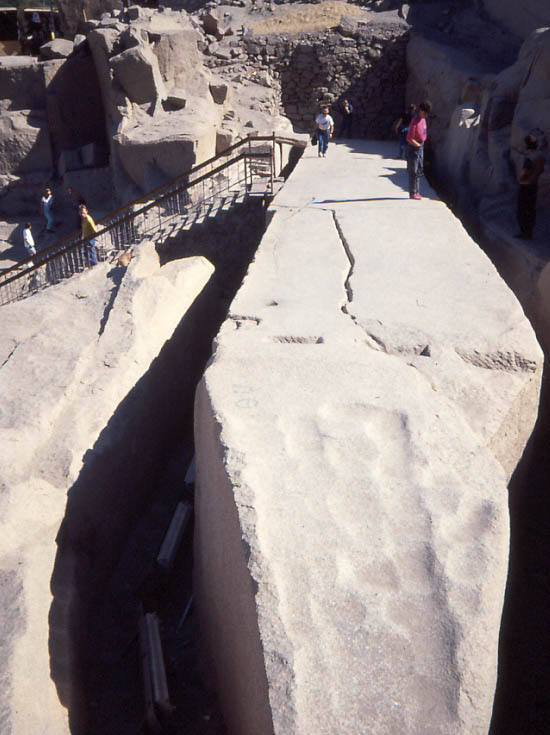

found in a quarry near Aswan. The obelisk was cut during the reign of Hatshepsut and then abandoned. The hollowed out cups on the surface of the stone are thought to have been created with hard stone pounders – perhaps hinting at the method of cutting these obelisks.
It has been suggested that these granite obelisks was quarried from the rock using hard dolorite pounders. In other words, they took a hard round stone and hammered it against the granite – pulverizing rock. I cannot think of a more unenviable job than this one. The evidence for this comes from the shallow, cup-like indentations that can be seen on the unfinished obelisk that look like to have been created by a round blunt object.
This may provide a partial theory for the creation of an obelisk, but it is difficult to envision how an army of men with round stones could create such a finely worked, slender, needle of granite of such monumental proportions.
The Heliopolitan Cosmogony
If you were to ask a priest serving in the temple of Re at Heliopolis how the world began, he would explain to you that it all began when a mound of sand emerged out of Nun, the primordial sea. This was the very same mound upon which the temple or Re was constructed at Heliopolis. Re-Atum was the next to emerge out of the primordial sea, the patron god of Heliopolis. The Egyptians called Atum the ‘All’ or the ‘One’ since everything that exists is but an extension of Atum. According to one ancient text, Atum begot himself by “joining his seed with his body to create his egg within his secret self”. 2Romer 2001, 143 The creator, having created himself, spat forth Shu and Tefnut (dry air and moist humidity). They in turn give birth to Geb and Nut (earth and sky), who give birth to two divine couples: Osiris and Isis, Seth and Nephthys. These nine gods formed the Ennead—the Nine—who were thought to be necessary to the proper functioning of the universe. The material world was considered to be a physical manifestation of these gods.
The End of Heliopolis
What happened to Heliopolis? According to Strabo, the Roman geographer, Heliopolis was demolished by Cambyses, a king of Persia. Alternatively, the prophet Jeremiah prophesied that the Babylonian king, Nebuchadnezzar, would destroy Heliopolis.
He [Nebuchadnezzar] will also shatter the obelisks of Heliopolis, which is in the land of Egypt; and the temples of the gods of Egypt he will burn with fire. (Jer. 43:13 NAS)
Cambyses had such a bad reputation with later historians that they tended to attribute every destruction to him which may explain why Strabo attributed the destruction of Heliopolis to him. It is quite likely that Nebuchadnezzar did indeed destroy Heliopolis just as he had destroyed the temple in Jerusalem. Heliopolis would have lain directly in the path of the invading Babylonians who attacked Egypt in 568 BC, just 20 years after the destruction of Jerusalem.
Heliopolis was rebuilt and retained its place as the most important religious center in Egypt until Alexandria gradually took its place during the Hellenistic period. Many of the obelisks of Heliopolis were removed to Alexandria, and from there, were carried to Rome as booty. Today, Rome has more obelisks than Egypt, while several others have been erected in Paris, London and New York.

Johnston, G. H. (2008). “Genesis 1 and Ancient Egyptian Creation Myths.” Bibliotheca Sacra 165 178-194.
Hoffmeier, J. K. Akhenaten and the origins of monotheism.
All that is left of the great temple of Ra at Heliopolis. The site is now located in the neighborhood of Al-Matariyyah, Cairo.
Heliopolis was once the main attraction for visitors Egypt. Homer, Solon, Pythagoras and Plato are all said to have visited there, although the historical basis for some of these claims is questionable. The name means “the city of the sun” in Greek— so named after the temple that once once stood on the spot dedicated to Ra, the sun god. For size and importance it was rivaled only by the temple of Amun at Thebes.
The temple at Heliopolis was built on a high mound that rose above the surrounding flood plain. The name of this mound was On or Ono—which means ‘pillars’, no doubt due to the obelisks erected on the mound. According to the book of Genesis, Joseph married a daughter of a high priest of On named Asenath. Their two sons, Manasseh and Ephraim would become progenitors of two of the twelve tribes of Israel.
Almost nothing of the temple has been recovered. This is partly because the modern suburbs of Cairo now cover the site and partly due to the fact that the ruins now lie below the water table. Senusret I (1971–1926 BC) was the first to raise an obelisk at Heliopolis. A great many more obelisks were erected at Heliopolis during the New Kingdom period but only the obelisk erected by Senusret I remains standing. It is remarkable to think that this tall pillar has been standing in the same spot for 4000 years!
The Obelisk
There is evidence than an obelisk was erected at Heliopolis during the Old Kingdom period. But rather than a tall slender needle, it may have taken the form of a short, squat pillar capped with a pyramid. The pillar was called the benben stone, probably after the Egyptian word wbn which means “to shine”.1Hoffmeier, 10 The pyramid capping the pillar was probably gilded with gold and silver that shone brightly with the first light of the rising sun.
Starting with the Middle Kingdom the obelisk assumed the long, needle-like shape we now associate with Egyptian obelisks. Their bases are often inscribed with baboons since these creatures make a howling racket in the early morning hours (like roosters) and were therefore associated with the rising sun.
carved with the cartouche of Narmer. These animals were associated with sun worship in Egypt from an early period.
Neues Museum, Berlin. arcThe obelisks were made from red granite quarried at Aswan and then transported down the river on huge barges. One can still see a roughly hewn obelisk lying in the quarry at Aswan that belonged to Queen Hatsheput. It was never completed due to a defect in the rock. If it had been completed, it would have stood 137′ (47 m) tall which would have made it the tallest in Egypt. As it stands, the record for the tallest obelisk goes to Thutmose III (1479–1426 BC), the son of Queen Hatsheput (1481 – 1472 BC), whose obelisk stands 105 feet (32 m) tall. The obelisk of Sesostris I standing at Heliopolis is a more modest 68′ (20.7 m) tall.
found in a quarry near Aswan. The obelisk was cut during the reign of Hatshepsut and then abandoned. The hollowed out cups on the surface of the stone are thought to have been created with hard stone pounders – perhaps hinting at the method of cutting these obelisks.
It has been suggested that these granite obelisks was quarried from the rock using hard dolorite pounders. In other words, they took a hard round stone and hammered it against the granite – pulverizing rock. I cannot think of a more unenviable job than this one. The evidence for this comes from the shallow, cup-like indentations that can be seen on the unfinished obelisk that look like to have been created by a round blunt object.
This may provide a partial theory for the creation of an obelisk, but it is difficult to envision how an army of men with round stones could create such a finely worked, slender, needle of granite of such monumental proportions.
The Heliopolitan Cosmogony
If you were to ask a priest serving in the temple of Re at Heliopolis how the world began, he would explain to you that it all began when a mound of sand emerged out of Nun, the primordial sea. This was the very same mound upon which the temple or Re was constructed at Heliopolis. Re-Atum was the next to emerge out of the primordial sea, the patron god of Heliopolis. The Egyptians called Atum the ‘All’ or the ‘One’ since everything that exists is but an extension of Atum. According to one ancient text, Atum begot himself by “joining his seed with his body to create his egg within his secret self”. 2Romer 2001, 143 The creator, having created himself, spat forth Shu and Tefnut (dry air and moist humidity). They in turn give birth to Geb and Nut (earth and sky), who give birth to two divine couples: Osiris and Isis, Seth and Nephthys. These nine gods formed the Ennead—the Nine—who were thought to be necessary to the proper functioning of the universe. The material world was considered to be a physical manifestation of these gods.
The End of Heliopolis
What happened to Heliopolis? According to Strabo, the Roman geographer, Heliopolis was demolished by Cambyses, a king of Persia. Alternatively, the prophet Jeremiah prophesied that the Babylonian king, Nebuchadnezzar, would destroy Heliopolis.
He [Nebuchadnezzar] will also shatter the obelisks of Heliopolis, which is in the land of Egypt; and the temples of the gods of Egypt he will burn with fire. (Jer. 43:13 NAS)
Cambyses had such a bad reputation with later historians that they tended to attribute every destruction to him which may explain why Strabo attributed the destruction of Heliopolis to him. It is quite likely that Nebuchadnezzar did indeed destroy Heliopolis just as he had destroyed the temple in Jerusalem. Heliopolis would have lain directly in the path of the invading Babylonians who attacked Egypt in 568 BC, just 20 years after the destruction of Jerusalem.
Heliopolis was rebuilt and retained its place as the most important religious center in Egypt until Alexandria gradually took its place during the Hellenistic period. Many of the obelisks of Heliopolis were removed to Alexandria, and from there, were carried to Rome as booty. Today, Rome has more obelisks than Egypt, while several others have been erected in Paris, London and New York.
Johnston, G. H. (2008). “Genesis 1 and Ancient Egyptian Creation Myths.” Bibliotheca Sacra 165 178-194.
Hoffmeier, J. K. Akhenaten and the origins of monotheism.