[ahtimeline-event-heading]
The rule of Gilgamesh is mentioned in just a single line of an ancient list of Mesopotamian kings known as the Sumerian King List (more on this later).
Gilgamesh, whose father was an invisible being, the lord of Kulaba, ruled for 126 years.
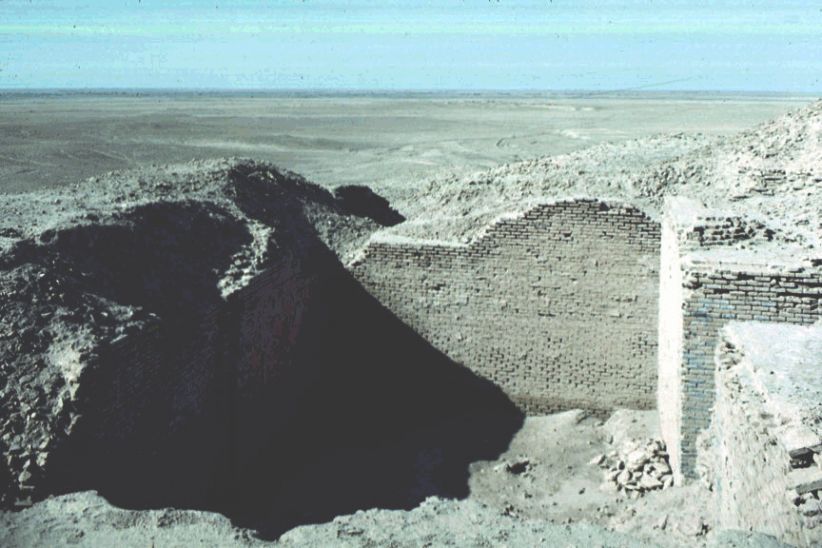
He will become the subject of much story telling as we will see when we study the Epic of Gilgamesh. However, despite these fanciful stories about Gilgamesh, there is reason to believe that he was a real king of Uruk who built its great walls and the temples, the remains of which can still be seen today.
Uruk
We know that Uruk became the largest and most powerful city in southern Mesopotamia at a very early period, reaching upwards of 40,000 – 50,000 people by the end of the Chalcolithic period.
[comparison of city sizes]
This city was probably roughly contemporary with the first dynasty in Egypt established by Narmer. And it was perhaps Gilgamesh who ruled over Uruk during this time of growth and expansion as the Epic of Gilgamesh declares:
He achieved a long journey, weary and worn. All his toil he engraved on a stone stela.
Of ramparted Uruk the wall he built,
Of hallowed Eanna, the pure sanctuary.
Behold its outer walls, whose cornice is like copper,
Peer at the inner wall, which none can equal! (Epic of Gilgamesh)
Thus we might think of Gilgamesh and Narmer as two, roughly contemporary kings, whose reigns are mostly shrouded in the mists of time.
[ahtimeline-event-heading]
The rule of Gilgamesh is mentioned in just a single line of an ancient list of Mesopotamian kings known as the Sumerian King List (more on this later).
Gilgamesh, whose father was an invisible being, the lord of Kulaba, ruled for 126 years.
He will become the subject of much story telling as we will see when we study the Epic of Gilgamesh. However, despite these fanciful stories about Gilgamesh, there is reason to believe that he was a real king of Uruk who built its great walls and the temples, the remains of which can still be seen today.
Uruk
We know that Uruk became the largest and most powerful city in southern Mesopotamia at a very early period, reaching upwards of 40,000 – 50,000 people by the end of the Chalcolithic period.
[comparison of city sizes]
This city was probably roughly contemporary with the first dynasty in Egypt established by Narmer. And it was perhaps Gilgamesh who ruled over Uruk during this time of growth and expansion as the Epic of Gilgamesh declares:
He achieved a long journey, weary and worn. All his toil he engraved on a stone stela.
Of ramparted Uruk the wall he built,
Of hallowed Eanna, the pure sanctuary.
Behold its outer walls, whose cornice is like copper,
Peer at the inner wall, which none can equal! (Epic of Gilgamesh)
Thus we might think of Gilgamesh and Narmer as two, roughly contemporary kings, whose reigns are mostly shrouded in the mists of time.