
with the Colosseum in the background.
In the summer of 64 AD a fire blazed through Rome, destroying half the city. According to the Roman historian Tacitus (c. 56-120 AD), a rumor was then circulating in Rome that Nero had purposefully started the fire in order to acquire land for a new palace. In order to allay suspicion he blamed the fire on the Christians. It remains an open question whether Nero did indeed light the blaze but Romans had good reason for suspicion. Not only did Nero use the fire as an excuse to persecute the Christians, he also used it as an opportunity to confiscate land for his Domus Aureus (“Golden House”).
The new palace was the embodiment of decadence. Suetonius says that one of its rooms was set up with a mechanism in its ceiling that misted scented water and scattered rose petals on the banqueters below. None of this pleased the average Romans. It was especially galling for those whose land had ben confiscated so that Nero could have his artificial lakes and manicured gardens, right in the middle of Rome.
The extant accounts of Nero’s reign are filled with shocking accounts of scandal. The final straw came when the emperor, obsessed with the theatre, chose not to remain a spectator, but insisted on performing as well. The spies he had placed in the audience looking for the slightest hint of disapproval no doubt contributed to the thunderous applause he received at the end of each performance. But the average Roman was seething beneath surface. Many could have identified with the final courageous words spoken by the old Roman soldier, Subrius Flavus, who, having been caught in a conspiracy to murder Nero “embraced the glory of a full confession.” In response to Nero’s interrogation, Flavus replied,
“I hated you,” he replied; “yet not a soldier was more loyal to you while you deserved to be loved. I began to hate you when you became the murderer of your mother and your wife, a charioteer, an actor, and an incendiary.”1Tacitus, The Annals, 15.67
The failed assassination attempt resulted in a purge which lasted two years. The servile Roman Senate eventually gathered enough courage to condemn Nero in absentia, but only after it had become clear that the Roman military and the Praetorian guard were in full rebellion. Nero either took his own life or convinced one of his freedman to do it for him.
The period of chaos which followed became known in Roman histories as the “year the Four Emperors” as opposing factions in Rome and the provinces sought to place their man on the throne. It soon became apparent, however, that no one could rule Rome without the approval of the Praetorian Guard. This elite band of soldiers, chosen to protect the emperor, had essentially usurped the power of the emperor. The Guard finally chose one of their own, an old soldier named Vespasian, who was then occupied with putting down a violent uprising in the small province of Judea. Upon his appointment, Vespasian transferred command to his son, Titus, and hurried back to Rome. Titus would continue to wage war against the Jews in Judea until, in 70 AD, after a seven month siege, he breached the inner defenses of Herod’s temple and burned it to the ground.
The spoils gathered from the small but wealthy province of Judea provided the resources necessary to undertake one of Rome’s most ambitious building projects—the Colosseum. The Latin term colosseus was traditionally used with reference to giant statues, like those found in Egypt, or the famous statue of Helios which stood in Rhodes. One of the seven wonders of the ancient world, the statue of Helios was the original Colossus. But Roman emperors also began constructing ‘colossal’ statues of themselves—the most famous being a statue erected by Nero in the courtyard of his Domus Aureus. After his overthrow, the statue was converted into a statue of Helios, the sun-god, instead. Its location next to the new amphitheater constructed by Vespasian and Titus gave the amphitheater its name—the Colosseum.
Rather than confiscate more land from the Romans, Vespasian chose to tear down the notorious and unpopular palace constructed by Nero and use the land for his new arena. Thus instead of rose petals and roast, suckling pig—the sumptuous fare of a select few—now all of Rome could have the pleasure of watching as criminals, captives, and Christians were torn limb from limb by wild beasts.
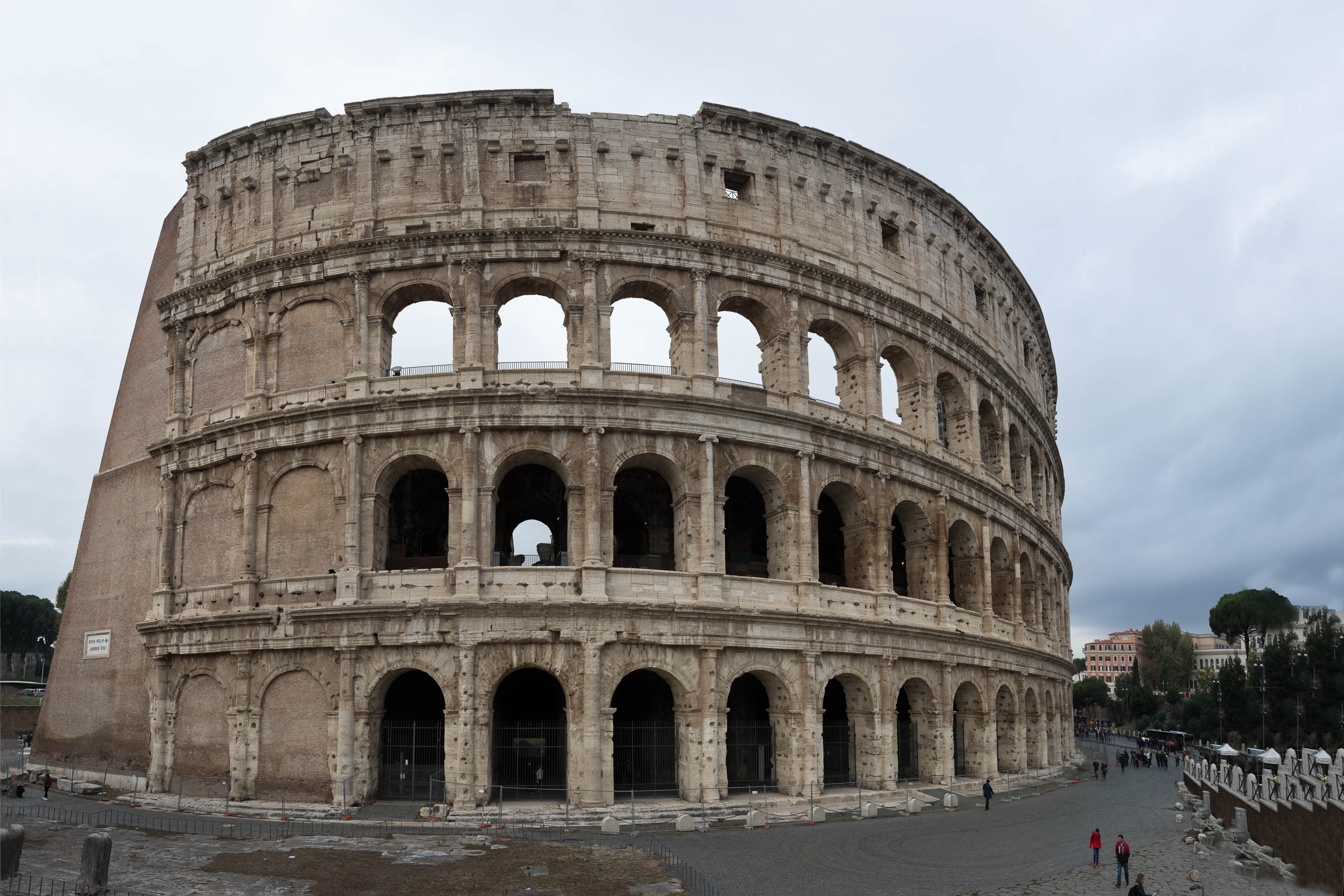
Each tier used a different order of architecture: Doric, Ionian, and Corinthian.
Origins
The origins of the Roman spectacles go back to an ancient funerary custom in which the ghost of the deceased was provided sustenance by the blood of sacrificial victims sprinkled on the ground.2“It is said that these sacrifices were intended to provide him who had gone to the other world with servants and companions, as the offering of a horse gave him a steed, or else that, in case of violent death, they were meant to appease the shade of a victim who claimed vengeance” (Cumont 1959, 51). One particularly chilling example of a funerary sacrifice comes from Suetonius, who recounts how the Romans, having put down a revolt in the Italian province of Umbria, marched three hundred of Perugia’s leading citizens outside of the city walls and slaughtered them on Caesar’s altar. This mass sacrifice was performed on the Ides of March, the day of Caesar’s death.3Suetonius, Aug. 15
The Romans turned these funerary rites into games performed in honor of the deceased. With time the bloody spectacles took on a life of their own and became a source of entertainment in their own right. One indicator of just how popular the games became comes from an incident that occurred in 160 BC when a group of spectators watching a performance of Hecyra written by the famous Roman playwright, Terence, upon hearing that the gladiatorial games were about to begin, emptied the theatre in the middle of the performance.4Carcopino 2003, 231 Thus it is clear that by the 2nd century BC the games had become the favorite form of entertainment in Rome.
By the 1st century BC, senatorial candidates vied for office by sponsoring games which featured “spectacular scenes of carnage.”5Carcopino 2003, 231 Although the Roman senate passed a law forbidding anyone seeking office from sponsoring games in the two years prior to running for office, the games nevertheless became an essential part of Roman politics. When Julius Caesar campaigned for the office of quaestor, he sponsored elaborate gladiatorial games the likes of which had never been seen before in Rome. These games were paid for with money borrowed from Crassus, Rome’s richest man. In return, Crassus could count on Caesar’s political support. This came in very useful for Rome’s wealthiest landlord. The above example illustrates how, during the final years of the Republic, only the extremely wealthy or those with wealthy patrons could afford to run for office.
The games would continue to be an important means of controlling the masses during the Imperial period. Thus Carcopino writes that “the emperors, deliberately pandering to the murderous lust of the crowds, found in gladiatorial games the most sure, if also the most sinister, of their instruments of power.”6Carcopino 2003, 232
Construction
The Colosseum is an example of Roman architecture at its finest. Arches, stairways, and corridors were carefully incorporated into the structure in order to passively direct the sea of spectators. Seating was largely determined by social class. Those of senatorial and equestrian rank accessed their seats through the innermost corridors of the Colosseum. From these lavishly decorated, marble-clad halls and private rooms, one had only to ascend a short distance to front row seats. Behind the senators sat the equestrians, and behind them, the citizens of Rome, who were further divided by rank and position into different sections. Slaves and poor people had to climb to the uppermost sections of the Colosseum where there was only standing room. All told, the Colosseum could hold more than 50,000 people.

The structure incorporated a vast network of underground chambers and elevators for the transportation of people and animals to the arena floor.
The construction of the Colosseum required a great deal of unskilled labour. We know next to nothing about the nameless multitudes who toiled to move dirt, quarry stone, slake lime, feed and drive transport animals, load and unload materials, and man the capstans and treadmills.7Ulrich 2014, 199 A large number of these labourers were undoubtedly slaves. Their lives flitted by like shadows, filled with hardship and sorrow, although a few fortunate souls may eventually have gained their freedom.8A study by Homer-Dixon and Frecker estimates that the construction of the Colosseum required 44 billion kilo-calories of energy. By today’s metrics, this much energy would be measured in barrels of oil needed to operate equipment but in the Roman era, energy was measured by the amount of cultivated land needed to supply food for men and beasts. In this case, it is estimated that 55 square kilometers of land for five years.
The Games
As time went by, the games in the Colosseum became more and more elaborate. The Res Gestae (‘Record of Deeds’) of the divine Augustus already hints at what would follow:
Twenty-six times I provided for the people, in my own name or in the names of my sons or grandsons, hunting spectacles of African wild beasts in the circus or in the Forum or in the amphitheatres; in these exhibitions about 3,500 animals were killed. Roughly 135 African lions appeared in each of these venationes [hunting spectacles].
This is bloodshed on an almost inconceivable scale but it pales in comparison to the 100 days of games sponsored by Titus at the dedication of the Colosseum, in 80 AD, during which over 3000 men are said to have engaged in combat in just a single day.


Roman mosaics from the Villa Romana del Casale in Sicily which depict the capture of wild animals in Africa and their transportation to Rome. Sicily was a staging point for animals sent to the Colosseum.
Not to be outdone, the emperor Trajan sponsored 123 days of games during which 11,000 animals were killed. As might be expected, the slaughter of so many animals eventually resulted in a scarcity of wild animals and even the extinction of the North African elephant. By the third century AD, the price of big cats was set at 600,000 sesterces apiece (nearly 4 million pounds today). Such high prices for animals ultimately forced emperors to reduce the number of animals killed during the games. When the emperor Philip the Arab sponsored games for the celebration of the Roman millennium in 248 AD, he could only muster 32 elephants, 10 elk, 10 tigers, 60 tame lions, 30 tame leopards, 10 hyenas, 6 hippopotami, 1 rhinoceros, 10 wild lions, 10 giraffes, 20 wild asses and 40 wild horses.9Bomgardner 2007, 215
In the final analysis, despite the magnificence of its construction, the Colosseum represents an incredible amount of wasted energy and stands as a monument to an incalculable amount of suffering, both animal and human.

This mosaic depicts a bound prisoner being eaten by wild beasts. Large numbers of Christians were killed this way during the reign of Diocletian (late 3rd – early 4th century AD). From the Sollertiana Domus (2nd century AD).
The Gladiators
The amphitheatre was full of spectators by the time the Emperor entered with his train of senators and magistrates. It came as something of a relief when the crowd roared their approval. For if the people were unhappy, they could remain silent, or even boo and jeer his arrival. The circus was one of the few places where the opinion of the masses could still be expressed. After the Emperor took his seat, the gladiators presented themselves before the Emperor and declared, “Hail Caesar, we who are about to die salute you.” In order to be sure that no secret arrangements had been made beforehand between combatants, lots were cast to determine how they should be paired off. Sometimes special pairings were made, such as the two Nubians chosen by Nero to fight each other, or the dwarf and the woman who fought each other in the games of Diocletian. It was also common for pairs of gladiators to be armed with different kinds of equipment. The favorite pairing was a gladiator armed with a short sword and a small round shield (murmillo or secutor) and a man carrying a trident and a net (retarius).

Symmachus and Maternus are fighting, cheered on by their owners, the Lanistae. Maternus has a crossed-out O beside his name symbolizing his death at the hand of Symmachus, who is referred to in the inscription as a fortunate man (3rd century AD).
An electric charge passed through the crowd the moment the two gladiators locked in combat. An overseer stood by with a whip in hand, ready to whip the contestants into a murderous rage if they did not fight with sufficient energy,. The Colosseum was filled with shouts of “habet! that’s got him!”, or “verbera! strike!”10Carcopino 2003 As the opponents began to tire, one would gain the upper hand. The defeated man might then drop his weapon and grasp the victors thigh. It was now up to the victor to determine the man’s fate. He was obligated to consult the emperor who in turn often consulted the crowd. If the people waved handkerchiefs and shouted “Mitte! Let him go!” then the emperor lifted his thumb and the man was spared. However, if the people decided that the man deserved death, then the amphitheatre was filled with shouts of “Iugula! Slay him!” Some were spared but many were killed. Ultimately, people went to the amphitheatre to watch people die.

The secutor Astyanax and the retiarius Kalendio fight to the death. VICIT is written next to the name of Astyanax, while a crossed out O appears next to Kalendio. VICIT stands for victory while the O stands for obit which means ‘death’ in Latin.
Bomgardner, D. L.
The story of the Roman amphitheatre.
London, New York: Routledge, 2000.
Carcopino, J. R. M.
Daily life in ancient Rome: the people and the city at the height of the empire.
: Yale University Press, 2003.
Cumont, F. V. M.
After life in Roman paganism.
New York: Dover Publications, 1959. Link
Ulrich, R. B, C. K. Quenemoen.
A companion to Roman Architecture.
: Wiley Blackwell, 2014.