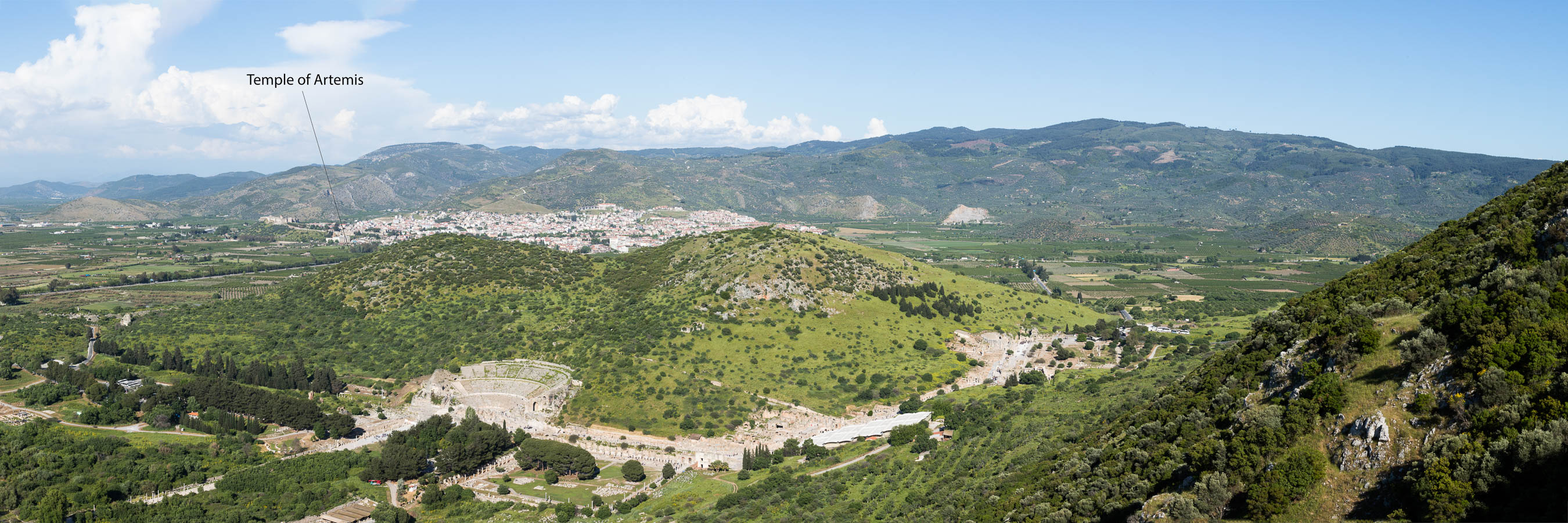
The origins of Ephesus can be traced back as far as the Bronze Age where it appears in Hittite cuneiform texts as “Apasa.” The city disappears from the historical record at the close of the Late Bronze Age only to reemerge again in the 11th century BC as a city settled by the Ionian Greeks. Ephesus was originally located on the flood plain of the Marnas River, next to the Mediterranean Sea, but it was relocated by Lysimachus, a former general in Alexander the Great’s army, in 294 BC due to the silting up the harbour. By moving the city closer to the coast and to slightly higher ground, Lysimachus purchased another eight centuries of life for the city. According to Livy, the new harbor at Ephesus was capable of holding eighty-nine warships. This is hard to believe for anyone visiting Ephesus today since that harbor is entirely silted up and the city is now approximately four miles inland.
The size and location of the port at Ephesus made it an important link between Asia and the West. According to Herodotus, a passenger could depart Ephesus and arrive in Susa three months later via an overland road which connected the two cities.


Ephesus was moved in order to maintain a functioning harbour. However, the Temple of Artemis remained anchored to its traditional location. The moving coastline is depicted with two shades of blue.
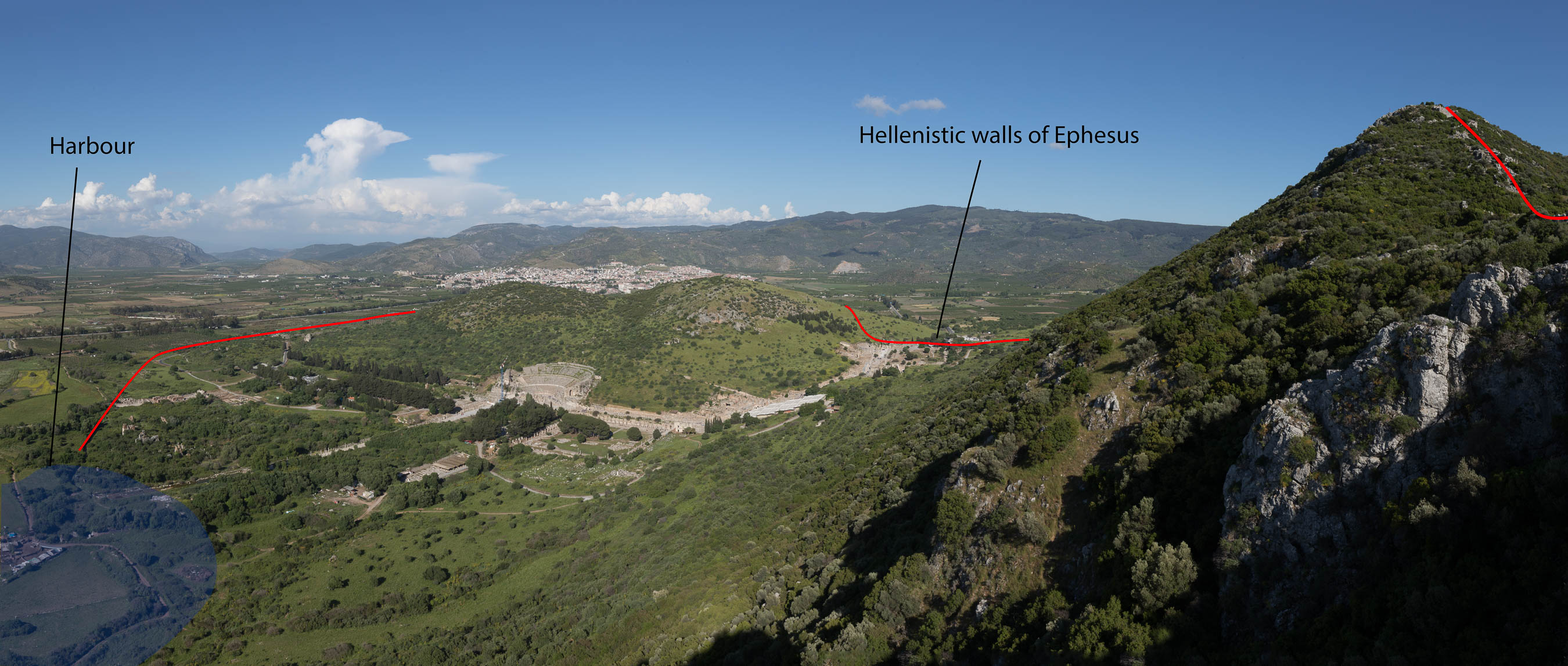
traced with a red line. The location of the harbour during the 1st century AD is shaded in blue.

Although Ephesus was once located on the shoreline, it is now located seven kilometers distant due to the continual deposition of silt by the Cayster River. The wall of Ephesus is in the foreground with the modern shoreline in the distance.


built by Lysimachus in the 3rd century AD.
The Temple of Artemis
Although Lysimachus succeeded in relocating the city of Ephesus closer to shore, the great Temple of Artemis remained rooted to its traditional spot several miles further inland. It seems that cities are easier to move than temples! The origins of this temple probably go back to the Late Bronze Age. Greek and Roman authors attributed its foundation to the Amazons, a mythical tribe of female warriors who maintained a completely female population by sleeping with foreign men once a year, and giving up for adoption all of their male children.
The temple of Ephesus was enlarged by Croessus, king of the Lydians, in the 6th century BC. It’s two architects were brought from Crete, an island renowned for its artistic production. The temple of Ephesus was the first Greek temple to be built entirely of marble. The temple was destroyed by a lone arsonist named Herostratus in 356 BC, on the same day, it is claimed, that Alexander the Great was born. The perpetrator confessed under torture that his only motive was to gain a name for himself. The Ephesian council condemned his memory and forbade anyone from mentioning his name ever again but several ancient historians, who were not Ephesian, recorded his name nonetheless. Thus we know the name of the destroyer of the temple but not of the two Cretan architects who built it! “Herostratic fame” has entered the modern English dictionary as a term for someone who seeks fame at any cost.
When the Ephesians began work on a new temple, they chose to build it in the same spot even though the ground had by then become soft and marshy. Despite the unsuitable location, they constructed the new temple on a far grander scale than anything that preceded it. One contemporary Greek poet was so impressed by its size that he thought it should be ranked first among the “seven wonders of the world.”
I have set eyes on the wall of lofty Babylon on which is a road for chariots, and the statue of Zeus by the Alpheus, and the hanging gardens, and the colossus of the Sun, and the huge labour of the high pyramids, and the vast tomb of Mausolus; but when I saw the house of Artemis that mounted to the clouds, those other marvels lost their brilliancy, and I said, “Lo, apart from Olympus, the Sun never looked on aught so grand”. (Antipater of Sidon)
Despite the temple’s magnificence, its poor location and soft foundations ensured that it would not survive very long. In contrast to the Parthenon, which was built on solid rock and may be still be visited to this day, the Temple of Artemis eventually collapsed and its remnants sank into the marsh. Its whereabouts remained an unsolved mystery until the British architect, John Turtle Wood, found it on December 31, 1869 after seven years of searching and four years of digging. Wood had to dig through eight meters of alluvial sediment before he found the remnants of the temple. Today, just a single restored pillar marks the spot where the temple once stood.

A pond, covered with scum, marks the place where one of the Seven Wonders of the World dazzled the eyes of mankind.1Ervine 1938, 383

The temple was a forest of towering columns.
Eurydice and Orpheus
One particularly well preserved column drum recovered by John Turtle Wood now stands in the British Museum. It is carved with what is believed to be the figure of Eurydice, flanked by Mercury—the messenger god, holding a caduceus made with intertwining serpents, and Thanatos—the winged god of death, carrying a sword. According to Greek myth, Eurydice died after being bitten by a snake. Her distraught husband, Orpheus, used his great skill on the lyre to put Cerebus—the guardian dog of the underworld—to sleep. Orpheus also played his lyre for Hades and Persephone—the king and queen of the underworld—who were so pleased by the performance that they agreed to allow Eurydice to follow Orpheus back to the land of the living, but on one condition, Orpheus must not look back to see if Eurydice was following him as he departed the underworld. Of course Orpheus agreed to these terms but when he did not hear any footsteps behind him on his return to the land of the living, he was consumed with a desire to look back and see if his beloved was following. He caught just a glimpse of her fair face before she disappeared, never to be seen or heard from again. Overwhelmed with grief, Orpheus played a song on his lyre, lamenting the loss of his wife.

One of the few preserved column drums from the Temple of Artemis on display today in the British Museum. Eurydice at center is flanked by Mercury (right) and Thanatos (left).
Ervine, S. J. “John Turtle Wood, Discoverer of the Artemision 1869.” Isis 28, no. 2 (1938): 376-384. Link
Murphy-O’Connor, J.
St. Paul’s Ephesus : Texts and Archaeology.
Collegeville, Minn.: Liturgical Press, 2008.
Rogers, G.M.
The Mysteries of Artemis of Ephesos : Cult, Polis, and Change in the Graeco-Roman World.
New Haven: Yale University Press, 2012. Link