… the Professor’s tone represented that of worldly society at large, where a cold skepticism smothers what it can of our spiritual aspirations, and makes the rest ridiculous. I detested this kind of man, and all the more, because a part of my own nature showed itself responsive to him (Nathaniel Hawthorne, The Blithedale Romance).
On a wintery Berlin evening in the year 1902 the famous German Assyriologist Freidrich Delitzsch stood in the beautiful and prestigious Singakademie to give an address. All the notables of Berlin high society were in attendance, including the Kaiser Wilhelm II. The topic for the evening was the Bible and Babylon, the ruins of which were just then being brought to light by a German archaeological expedition. The lecture proved to be a significant cultural moment, not because of anything Delitzsch said about Babylon, but about the Bible. Delitzsch began by pointing out that ancient Palestine was steeped in Babylonian thought. Such could be proved by the Biblical narratives themselves, the origins of which Delitzsch thought could be traced back to “the purer and more original”1Gunkel 2009, 39; the expression was modified in later published editions of the text. Babylonian myths.2Delitzsch 1906, 38 ff. Even the name Yahweh was known in Babylon many centuries before Moses.3Delitzsch 1906, 64 Indeed, Yahweh was none other than Marduk, the dragon slayer, in another dress.4Delitzsch 1906, 43 ff. The Sabbath day also originated with ancient Babylon.5Delitzsch 1906, 37-38 Thus the lecture continued with Delitzsch comparing and contrasting the Bible with ancient Babylon.
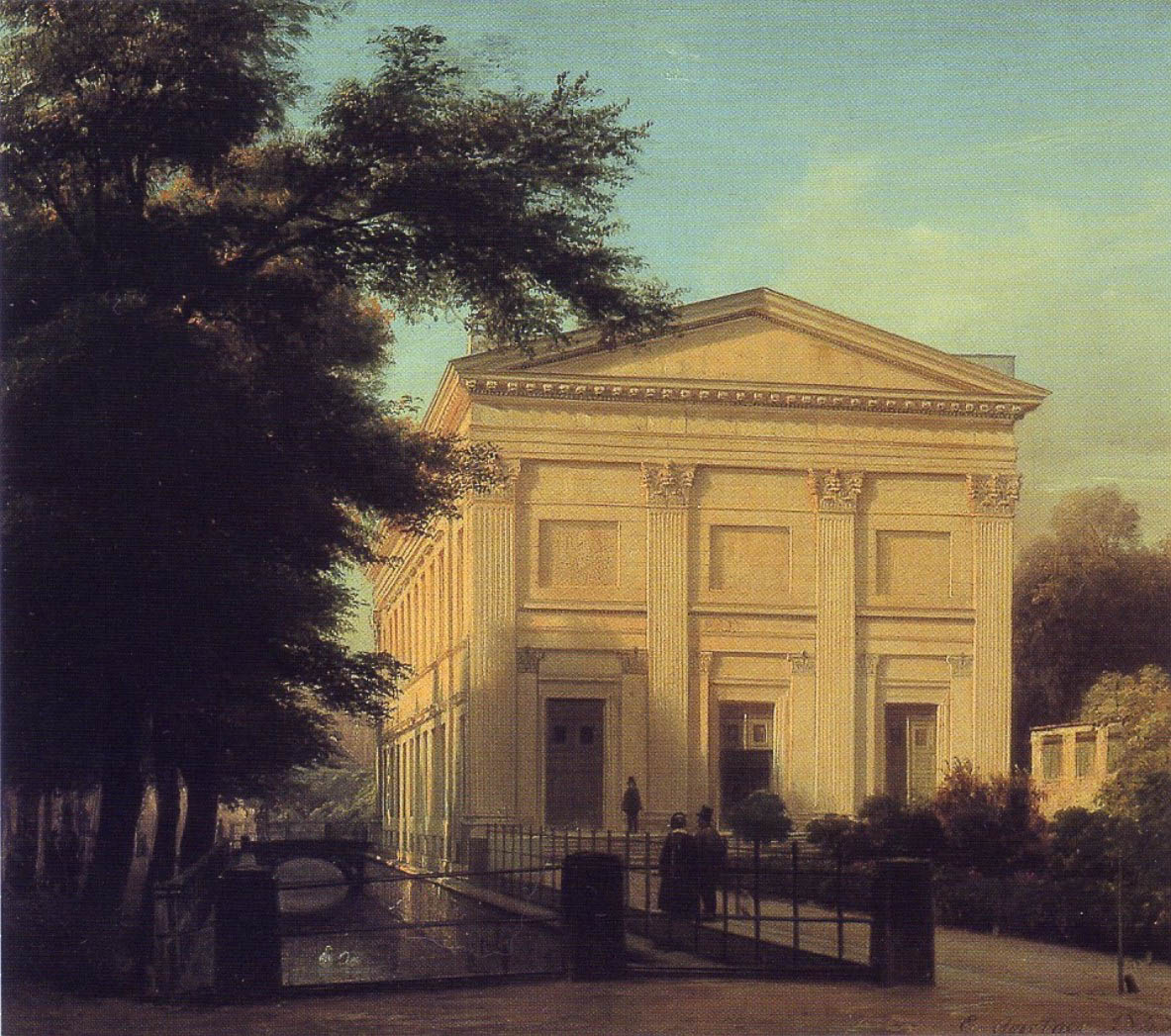
The famous music hall in Berlin where Delitzsch delivered two lectures, published under the title Babel und Bibel.
A year later, in February 1903, the Kaiser invited Delitzsch to give another lecture in the Singakademie, this time with the empress also in attendance. Once again Delitzsch took the opportunity to compare the Bible with ancient Babylonian literature. But this time he was even more stridently antagonistic towards the Bible. The Biblical injunctions against idols, he argued, revealed a complete lack of understanding of what the Babylonians actually believed about them. And the Babylonians harbored monotheistic conceptions about God superior to the narrow exclusivity of Israel’s God.6Delitzsch 1906, 70; also Shavit et al. 2007, 233
Delitzsch was one of Germany’s foremost scholars. And so his opinions carried a lot of weight. But Delitzsch’s influence extended further abroad also. Two of America’s most influential Assyriologists, Paul Haupt (1858-1926) and Hermann Hilprecht (1859-1925), had studied under Delitzsch at the University of Leipzig before founding Assyriology departments at John Hopkins University and the University of Pennsylvania respectively. A number of other American scholars wrote their doctorates under his supervision.7Gilbert Mitchell (1846-1920), Nathaniel Schmidt (1862-1939), John Punnett Peters (1852-1921), Morris Jastrow (1861-1921), Richard James Horatio Gottheil (1862-1936), Carl William Belser, Maurice Price, and Felix Adler were all Americans who studied at German universities and then returned to teach Assyriology or Semitics at places like Cornell, Columbia, the University of Michigan, and the University of Chicago. With the exception of Schmidt and Adler, all of these men studied at the University of Leipzig during Friedrich Delitzsch’s tenure there. See: Burke O. Long, Planting and Reaping Albright : Politics, Ideology, and Interpreting the Bible (University Park, Pa.: Pennsylvania State University Press, 1997).
By 1905 approximately 60,000 copies of Delitzsch’s published lectures had sold worldwide. The controversy which ensued produced 1,650 articles and 28 pamphlets in written in response to Delitzsch—just in Germany alone.8Marchand 1996, 224 The lectures were, according to C. H. W. Johns in his introduction to the English edition of Babel und Bibel, “a historic event.”9C. H. W. Johns from the Introduction to Delitzsch 1903, xvi Delitzsch had effectively employed the new discipline of Assyriology to deconstruct the Bible. Although pastors sought to reassure their flock, how could they argue with someone who read cuneiform? As one observer put it, Delitzsch’s critics all seemed to be armed with blunderbusses and halberds while Delitzsch blasted away with one of those new steel cannons rolling out of Krupp’s factories in ever increasing numbers.10Alfred Jeremias from Delitzsch 1906, 139

One of Germany’s foremost Assyriologist, Delitzsch is famous for the Babel und Bibel controversy.
Although the Kaiser had been Delitzsch’s biggest promoter, now he sought to distance himself from the professor’s comments. In a letter to Admiral Hollman intended for publication the Kaiser openly criticized Delitzsch. But his letter to Hollman read more like an eulogy for Christian civilization than a rebuke of the professor. The common people needed to have faith, the Kaiser wrote, and the professor “unquestionably shattered or at least undermined for these people their faith.”11Delitzsch 1906, 122 This was perhaps no exaggeration. The prominent German theologian Alfred Harnack observed that, “today it is the talk of the streets that the Old Testament no longer amounts to much.”12Delitzsch 1906, 126

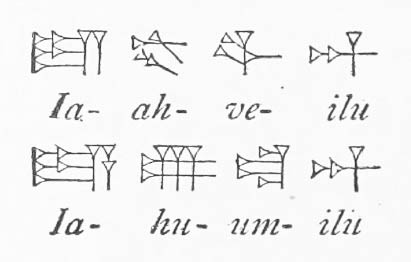
Purported by Delitzsch to preserve the name Yahweh, written in cuneiform long before it was supposed to have been revealed to Moses. It is now known to be a misreading of the text.
In 1905 Delitzsch delivered his third and final lecture. This time he compared Babylonian and Hebrew poetry in order to sho “how similar was the poetical form of religious songs of the two lands.”13Delitzsch 1906, 187 He would also compare the conceptions of Yahweh found in the Bible with those of other nations in order to prove that the national gods of Moab and Ammon, Milchom and Chemosh, did not differ substantively from Yahweh.14Delitzsch 1906, 224 Delitzsch even likened the god Assur, the Assyrian god of gods, to Yahweh! Delitzsch concluded this final lecture with an appeal to the Christian ideal of a universal and all encompassing faith built upon spirit and truth.
Progress
Although couched in Christian language, Delitzsch’s appeal was directed to Germans who were at that time turning in increasing numbers to a religion of progress whose philosophical foundations were laid down by Johann Fichte a century earlier. “Yours is the greater destiny, to found the empire of spirit and reason, and to annihilate completely the crude physical force that rules the world,” Fichte declared in an address to the German people in 1807.15Fichte and Moore 2008, xxiii Often labelled “the father of German nationalism” Fichte was really a cosmopolitan at heart and an enthusiastic supporter of the French revolution. Even as late as 1799, after the Reign of Terror and the disastrous rule of the Directorate, Fichte could write, “It is clear that from now on only the French Republic can be the fatherland of the man of integrity, that only to it can he devote his energies; for from now on not only the dearest hopes of humanity but even its existence depends upon its victory.”16Fichte and Moore 2008, xi Fichte would support the French revolutionaries throughout the Reign of Terror. It wasn’t until the Directorate fell under the spell of Napoleon that Fichte turned his back on France and “the nameless one”—Fichte’s term for Napoleon. In his Addresses to the German Nation Fichte declared that it was now up to the German people to carry the torch of progress.
Johann Fichte ascended to the prestigious chair of philosophy at the University of Berlin. He was succeeded by Georg Hegel. Arguable the century’s most influential German philosopher, Hegel built on Fichte’s legacy, arguing that certain processes at work in history had culminated in the advent of modern philosophy.17Hegel and Gray 1970, 311 The path forward, Hegel believed, was through the Greeks. They had introduced mankind to the philosophy of the mind.18“In Hegel’s opinion, the Jewish religion was very slightly superior to the religions of the heathen, nay, in more than one respect was even positively inferior to some of them. In his view, the religion of intellectual individuality, or free subjectivity, passes through three stages – ‘the Jewish religion of sublimity (unity), the Greek religion of beauty (necessity), and the Roman religion of purposefulness (reason)'” (Kegel 1924, 25). Now the time had come for Germany to go a step further and introduce the world to the philosophy of the spirit. Thus the race of Teutons would bring to fruition the project begun by Descartes and usher in a new age that would outshine the golden age of Athens.19Hegel and Gray 1970, 311
Hegel was not the only German fascinated by ancient Greece. Ever since J.J. Winkelmann’s published his magisterial work The History of Art in Antiquity in 1764 influential German poets and literary figures had begun to treat Greek culture as a religious alternative to Christianity. Honored by Goethe as “the first great pagan of his time,” Winkelmann is generally credited with founding the cultural movement known as philhellenism—“the love of all things Greek”. “This was not simply a movement,” observes Legaspi, “it was a faith.”
To its proponents, it entailed the monumental task of replacing Christianity with a new form of life derived from an imaginative engagement with Greek antiquity. To say this is to indicate the kind of personal, intellectual, and creative investment that characterized philhellenists and inspired them to create journals, pioneer new forms of literature, undertake Mediterranean pilgrimages, adopt looser sexual mores, and abandon respectable careers.20Legaspi 2010, 56
With this backdrop in place, we return now to Julius Wellhausen, the author of the Prolegomena to the History of Israel and Friedrich Delitzsch, who, as we have seen, delivered the influential Babel und Bibel lectures. He considered his own work to be the continuation of a project initiated by Julius Wellhausen.
Wellhausen (and Delitzsch again)
Wellhausen’s big idea was that the Bible was comprised of documents edited together at a late date. While it is true that the idea of “documents” did not originate with Wellhausen, the use of the “documentary hypothesis” to apply an evolutionary paradigm to Scripture may be traced to him. Thus Wellhausen argued that most of the laws of the Pentateuch were a priestly invention written down in post-exilic times and were therefore completely disconnected from the life and times of ancient Israel. The primitive aspects of the earliest texts of the Old Testament, according to Wellhausen, represent a more authentic expression of ancient Israelite religion compared with later texts, which bear “a prophetic taint.”21Kegel 1924, 37 Thus Wellhausen suggested that the accusation of drunkenness leveled against Hannah at the tabernacle in Shiloh was in keeping with the nature of that feast.22Wellhausen 1885, 72 Only later did the festivals and rituals of ancient Israel come under the control of a priestly class who imposed a rigid set of laws on the people.23Wellhausen 1885, 78 By assigning the Mosaic law to a late period, Wellhausen effectively turned the Old Testament on its head. If the early religion of Israel continued the religious practices of the Canaanites, its late manifestation was a priestly invention.
In the introduction to his final work The Great Delusion published in 1920, Friedrich Delitzsch credits Julius Wellhausen with being the first to demonstrate that the Old Testament is “a tangle of untruthful historical traditions and unscrupulous perversions of every kind.”24Kegel 1924, 16 Delitzsch concluded this work by recommending that German schools replace the Old Testament with Wilhelm Schwaner’s Germanen-Bibel, a compilation of thoughts about God, eternity, and immortality gleaned from the works of famous German writers. Delitzsch’s political slant is more evident in this book than in his lectures. Whereas in his first lecture he suggested that the wife of the Assyrian king Sardanapalus was an Aryan woman with golden locks of hair (how he was able to argue this from a stone relief is hard to say), in his final work he argues that Jesus might not have been Jewish at all, but a proselyte to Judaism, and that Jesus, the good Samaritan, and the Magi might have come from Aryan stock.
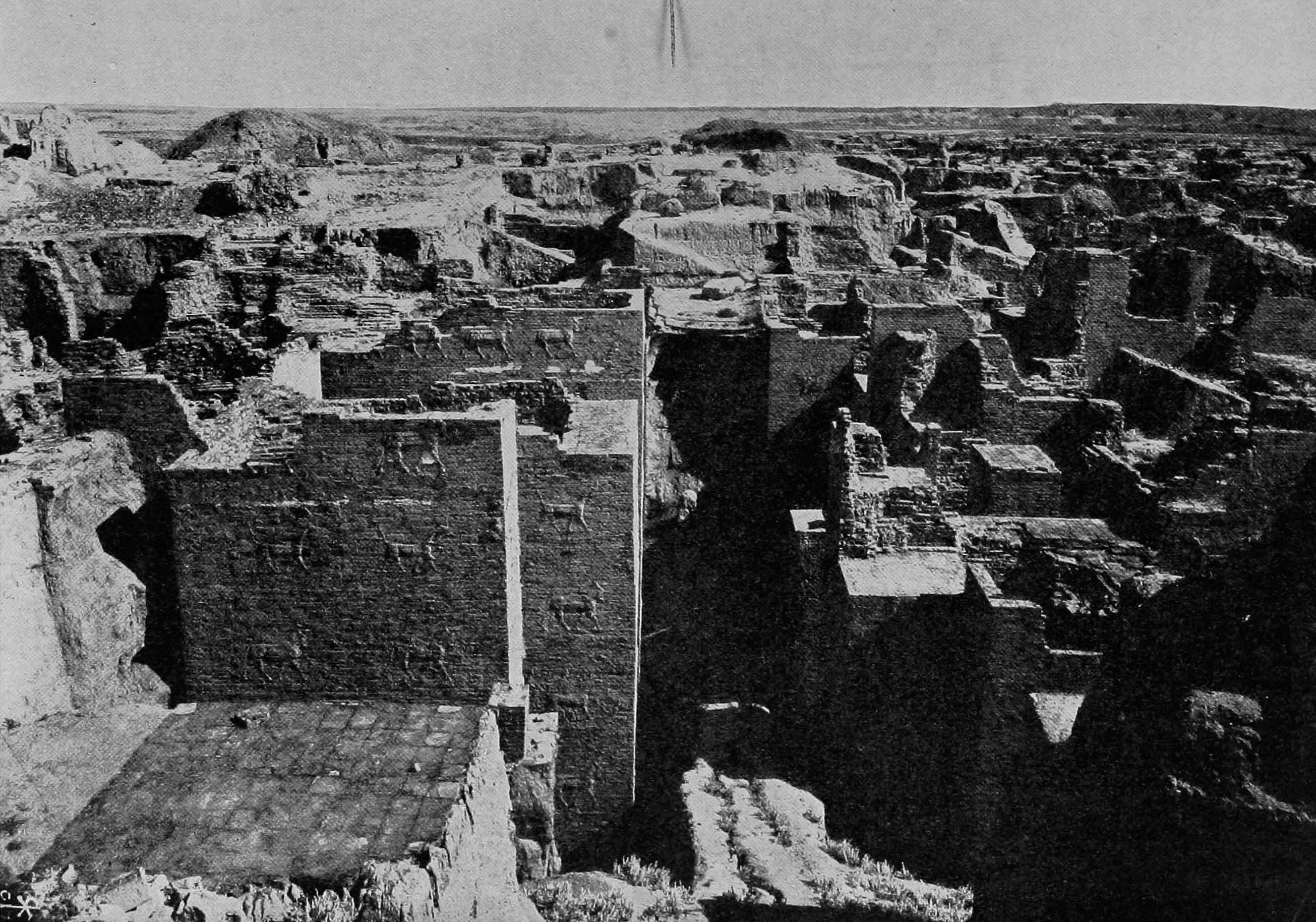
Excavated by a German expedition led by Robert Koldewey, the ruins of Babylon were brought to light during the period 1899-1914. Delitzsch delivered his three lectures during the same period. The gate is on display in the Pergamon Museum in Berlin.
There are no Differences
A lot of water of water has passed under the bridge since Delitzsch’s day. And a lot of blood too. You won’t find many today arguing that Jesus was Aryan, that Yahweh was an old Babylonian deity, or that the Babylonians invented the Sabbath week (all of these claims are either unsubstantiated or have been proven false.) However, the central thrust of Delitzsch’s program (“How great the similarity between all things in Babel and Bible!”25Delitzsch 1906, 91) is echoed in countless monographs today. But the locus for comparison has shifted from Mesopotamia to Ugarit, where a large archive of “Canaanite” texts were uncovered. Summarizing general trends in contemporary Biblical scholarship, Mark Smith notes that the period 1970-1985 saw a turn away from the distinction between “Canaanite” and “Israelite” in the biblical guild.26Smith 2001, 197 Elsewhere Smith states that there may be some commentators who still try to create the false dichotomy of “ours” versus “theirs”, Canaanite versus Israelite, but these scholars have not kept up with the times. This type of categorization is “old news” although some commentators have “missed their newspaper delivery.”27Mark Smith in Younger 2007, 4
In similar fashion the archaeologist William Dever dismisses attempts to distinguish between “Israelite” and “Canaanite” noting that it is “an almost exclusively Christian enterprise (and largely Protestant at that).” Attempts to maintain such distinctions results in a bias that “precludes any honest scholarship.”28Dever 2002, 19 Susan Ackermann goes a step further, arguing that all of the sins of Judah recorded in the prophetic and historical books of the Bible (necromancy, child sacrifice, the death cult, etc.) were once inherent aspects of YHWH worship.
The phenomenon of popular religion with which I have been concerned in this study is typically labelled (as above) “synchretistic,” “foreign,” “pagan,” “Canaanite.” But it is not. Most of the manifestations of popular religion which I have described are native to the west Semitic sphere and even to Israel, and they are indigenous in the practice of Yahwistic religion.29Ackerman 1992, 214-215
Mark Smith makes essentially the same argument:
The worship of Baal and Asherah was not so much a case of Israelite syncretism with religious practice of its Canaanite neighbors, as some biblical passages depict it, as it was an instance of old Israelite religion.”30Smith 2002, 7
Ever since Wellhausen published his Prolegomena to the History of Israel, scholars have scoured the Biblical text for vestiges of old Canaanite beliefs. Even the religious reforms of Hezekiah and Josiah, which have traditionally been understood as attempts to reinstate an orthodox faith, are seen as evidence for a native folk religion which the “religious and political establishment” actively sought to suppress.31Dever 2002, 13 The prophets were an elite, highly literate group, whose words could hardly have been understood by “the folk.” “If the oracles of prophets like Isaiah had originally been ‘sermons’ delivered in public,” writes Dever, “people in the countryside would scarcely have understood them.”32Dever 2005, 70 These were simple farmers, uneducated peasants, whose religious practices were informed “not by the canonical literary tradition and its late, ‘orthodox’ ideals, but rather by centuries-old religious myths and rituals, many of them going back to Canaanite Bronze Age traditions.”33Dever 2005, 60
The general consensus today is that the religious beliefs of the average Israelite living during the Iron Age could hardly be distinguished from those of the surrounding peoples. Thus Biblical monotheism is considered to be a late development that did not take root until the exilic and post-exilic periods (6th – 5th centuries BC) and only among a small group of Judaeans returning to their ancestral homeland. The theology of the Old Testament may be interesting from the perspective of “history of religions” but is of limited value for understanding the folk religion that existed in Israel during the Iron Age.
Be Appalled!
Although we do not have detailed biographical information for the writing prophets of the 8th – 7th centuries BC, what may be gleaned from the text suggests that most of them came from the countryside. Amos was a shepherd from Tekoa; Micah was a prophet from Moreshet-Gat; Jeremiah was a priest from Anathoth—all rural villages. Nor does it appear as though Isaiah was a regular at the court. When he brought a message to King Ahaz at the beginning of his prophetic career, he delivered it from outside the walls of Jerusalem. And later, when Sennacherib threatened Jerusalem, Hezekiah sent messengers to speak with Isaiah but there is no record of the two ever having communicated directly.
None of the aforementioned prophets were welcomed in the cities where they prophesied. Indeed, it may be argued that there is no ancient text more critical of kingship, or of urban culture in general, than the Bible. Babylon, Nineveh, Sodom, Tyre, Samaria, Jerusalem; none escape the prophet’s censure. The Biblical prophets do not look like an elite group connected to a royal court but seem rather to have been one of the folk, who, according to Dever, were all unabashed pagans!
Of course, it is not difficult to find references in the Bible to “canaanitish” religious practices in the countryside, but the “the people of the land” also acted in defense of religious orthodoxy. Their support for the Davidic dynasty made it among the most stable and longest lasting of any royal dynasty in the ancient world. And it was the “people of the land” who tore down the temple of Baal after the wicked queen Athalia was overthrown (2 Kings 11:18). Likewise, during the Maccabean period, it was the rural areas outside of Jerusalem who opposed the Hellenizing faction in the city. There is no reason why a similar cultural dynamic could not have prevailed during the Iron Age as well.
In any case, it is doubtful whether the picture painted by Dever of an impoverished and uneducated countryside is true to life even though we may never know for certain what degree of literacy prevailed there. Ancient Israel produced the most profound and beautiful texts in the ancient world. That such a remarkable literary output arose among an ignorant and unappreciative population hardly seems plausible. But we will save a more in-depth investigation into “folk religion” for later. For now it must be admitted that whenever the Judean prophets of the 8th-6th centuries BC spoke of idolatrous worship, they perceived it to have been a major departure from the faith and traditions of Israel. Consider, for example, the cry of Jeremiah:
Be appalled, O heavens, at this; be shocked, be utterly desolate, declares the LORD, for my people have committed two evils: they have forsaken me, the fountain of living waters, and hewed out cisterns for themselves, broken cisterns that can hold no water (Jer. 2:7-13).
To use a modern parallel, consider the outcry that would surely ensue if the president of the United States announced that he would not be attending St. John’s Episcopal Church but the local Hindu temple instead. Although there are undoubtedly a great many Episcopal churches today whose theology is closer to Hinduism than Christianity, and most American presidents are not devout Christians, they nevertheless feel they must flash their Christian credentials in order to get elected. The question is, then, to what degree did Israelites living in the Iron Age share a historical, cultural, and religious awareness that rendered the words of the prophets intelligible, even if they did not always heed them? And if they did share a common religious heritage, of what was its nature?
Archaeology and the Religion of Ancient Israel
A newcomer to the field of archaeology may be forgiven for assuming that the archaeological evidence overwhelmingly supports the views of Dever, Ackermann, and Smith expressed above. And this is indeed the claim.
…it would not be misleading to say that the real religions of ancient Israel consisted precisely of all the things that the prophets condemned, all of them incidentally illustrated by archaeological discoveries, as we shall see.34Dever 2005, 67)
But the archaeological evidence clearly and definitively points in the opposite direction. Although it cannot be proved that the Israelites knew and obeyed all 613 laws of the Pentateuch, there are four in particular which lend themselves to archaeological investigation.
- The command to worship Yahweh only (Ex. 20:3, Deut. 6:14)
- The ban on making idols (Exod. 20:4-5)
- The command to destroy and abandon Canaanite places of worship (Num. 33:52, Exod. 23:24, Deut. 7:5, 12:3-4).
- The ban on necromancy and other rituals connected to the underworld
We will consider each of these under the following headings: text, image, temple, tomb. It will be seen that the culture of ancient Israel was quite different from those of surrounding peoples. These differences may clearly be discerned in the archaeological record.
The Third Order
But even if it were possible to prove that the ancient Israelite folk were all Bible-believing fundamentalists (hypothetically speaking of course) we are nevertheless confronted by the question epistemology. Dever doubts that Protestant scholars are capable of understanding the complex religious matrix of ancient Israel. Pressing home the point, Dever cites the Harvard professor of Jewish Studies, Jon Levenson, who characterizes the Protestant approach to the Old Testament as a search for “historical certitude” and the “systematization of religious beliefs.” In contrast, Jewish scholars have tended to take the same approach to the Hebrew Scriptures as non-Jews “not because of faith, but because of the lack of it, not in hopes of defining a theology, but of finding a replacement for theology.”35Levenson 1987, 290; see also Dever 2005, 21-22 The total lack of “biblical theologies” among Jewish scholar who, according to Dever, lie closest to the stream of tradition that flows from the Hebrew scripture, makes Christian Old Testament theology “an enormous piece of hutzpah.”36Dever 2002, 23
Where historical investigation is concerned, Old Testament theology is parochial, elitist, excessively rationalistic, dogmatic, ultimately sterile when it comes to grasping the actual variety and vitality of religious belief and practice in ancient Israel. It produces only a chimera, a dangerous illusion.37Dever 2002, 23; A former evangelical minister who converted to Judaism, one cannot help but wonder if Dever’s attack on Protestant scholarship is not a little personal. In an interview with the editor of the Biblical Archaeological Review, Dever recounts his journey from Christianity to Judaism: “Living in the Holy Land, I became extremely cynical about religion. I began to think, more or less, maybe like all of you, that I had no talent for religion, that faith might be a matter of temperament as well as training… I never had a pious bone in my body. And I realized I was never really a believer… That’s when I converted to Judaism. (laughs) I did it precisely because you don’t have to be religious to be a Jew. And I’m perfectly comfortable where I am (See BAR April 2027).”
Indeed, in a remarkable piece of scientific positivism, Dever writes:
As an archaeologist and an anthropologist, and thus a historian, I shall argue that philosophy and theology are distractions. These disciplines may well be legitimate and interesting in their own right; but they get us nowhere in the inquiry into ancient folk religion. Indeed, they are barriers to understanding, because they are later, modern constructs forced back upon ancient Israel’s thought-world and the behavior of most folk who were part of it.38Dever 2005, 8
The myth of academic neutrality is precisely this, that a methodologically rigorous approach, unshackled from theology or philosophy, provides the surest path to understanding. But as the French scientist and mathematician Blaise Pascal observed, science properly conducted cannot be separated from matters of the heart. Pascal divided the realm of knowledge into three orders: nature, intellect, and charity.39T. S. Eliot in the Introduction to Pensees, 1958, xix The order of nature requires rigorous experimentation, the order of intellect demands sound reasoning, and the order of charity requires spiritual understanding and intuition. Each must be given their due and none can be treated to the exclusion of the others. Although often overlooked or intentionally set aside, the order of charity is the most important of the three for it is where we get first principles such as ‘number’ and ‘language’ without which it is impossible to reason or think logically. Our understanding of what is good and beautiful comes from this order, and the knowledge of God “from whom are all things and for whom we exist” (1 Corinthians 8:6).
If archaeology belongs to the order of body and intellect, theology and philosophy deal largely with Pascal’s third order—the order of charity. Although it may be possible to maintain some level of objectivity by confining oneself to the first two orders, none can study archaeology without bringing theology and philosophy to the subject. This is especially true for the archaeology of ancient Israelite religion, so intertwined is it with Christianity, but it applies to ancient religions in general. For though one is not likely to find a devotee of Baal sacrificing on Carmel today, there is a sense in which a modern man, an Ugaritist, who appears to be a neutral arbiter of the truth, may keep a massebah in the closet next to his television.
Conclusion
The goal for what follows is twofold: 1) to show that “Old Testament theology” is an important aid to understanding the archaeology of ancient Israel, and 2) to make some connections between ancient and modern religion in order to show the continuity between them. I have divided the book into four sections, each dedicated to a certain type of archaeological evidence. We will begin in Pascal’s first order, with something dug out of the ground, before moving to a discussion of its interpretation and what theological and philosophical significance may be derived from it. Is it possible to draw a line between a Judaean ostracon, the theology of the name YHWH, and Hawking’s donut-shaped cosmos? Or between an ancient cosmogony, the Mosaic ban on idolatry, and Goethe’s Faust? I believe it is possible and may help us see that there is no place of neutrality in our quest for truth.
I should like to conclude by stating up front that I am not writing for academics and scholars but for you, my fellow travelers. I have nevertheless sought to include as many references as possible so that you may retrace my steps if you wish. I hope what follows may be of some benefit to you in your journey along life’s way.
When I had journeyed half of our life’s way, I found myself within a shadowed forest, for I had lost the path that does not stray. Ah, it is hard to speak of what it was, that savage forest, dense and difficult, which even in recall renews my fear: so bitter – death is hardly more severe! But of the good to treat, which there I found, Speak will I of the other things I saw there. (Dante, Inferno 1.1-7)
Delitzsch, Friedrich.
Babel and Bible.
Chicago: The Open Court Publishing Company, 1906.
Dever, William.
“Theology, Philology, and Archaeology,” in Sacred Time, Sacred Place : Archaeology and the Religion of Israel, edited by Barry M. Gittlen.
Winona Lake, Ind.: Eisenbrauns, 2002.
Dever, William.
Does God have a Wife? Archaeology and Folk Religion in Ancient Israel.
Grand Rapids, Michigan: Eerdmans Publishing House, 2005.
Fichte, J. G., G. Moore.
Addresses to the German Nation.
Cambridge, UK ; New York: Cambridge University Press, 2008.
Hawthorne, Nathaniel.
The Blithedale Romance.
Oxford ; New York: Oxford University Press, 2009.
Hegel , Georg Wilhelm Friedrich.
On Art, Religion, Philosophy; Introductory Lectures to the Realm of Absolute Spirit.
New York: Harper & Row, 1970.
Kegel, M, M. M. C Nolloth.
Away from Wellhausen; a contribution to the new orientation in Old Testament study.
London: J. Murray, 1924.
Koldewey, Robert.
The Excavations at Babylon, translated by Agnes S. Johns.
St. Martin’s Street, London: MacMillan and Co. Limited, 1914. Link
Legaspi, Michael C.
The Death of Scripture and the Rise of Biblical Studies.
Oxford ; New York: Oxford University Press, 2010.
Long, Burke O.
Planting and Reaping Albright : Politics, Ideology, and Interpreting the Bible.
University Park, PA: Pennsylvania State University Press, 1997.
Marchand, Suzanne.
Down from Olympus : Archaeology and Philhellenism in Germany, 1750-1970.
Princeton, N.J.: Princeton University Press, 1996.
Shavit, Jacob, Mordechai Eran, Jacob Shavit.
The Hebrew Bible Reborn : From Holy Scripture to the Book of Books : A History of Biblical Culture and the Battles over the Bible in Modern Judaism. Studia Judaica : Forschungen Zur Wissenschaft Des Judentums vols.
Berlin ; New York: Walter de Gruyter, 2007.
Smith, Mark S.
The Early History of God : Yahweh and the Other Deities in Ancient Israel. The Biblical Resource Series vols.
Grand Rapids, Mich.: William B. Eerdmans Pub, 2002.
Smith, Mark S.
Untold Stories : The Bible and Ugaritic Studies in the Twentieth Century.
Peabody, Mass.: Hendrickson Publishers, 2001.
Wellhausen, Julius.
Prolegomena to the History of Israel.
Edinburgh: Adam & Charles Black, 1885. Link
Younger, K. Lawson.
Proceedings of the Symposium “Ugarit at Seventy-Five” Held at Trinity International University, Deerfield, Illinois, February 18-20, 2005 under the Auspices of the Middle Western Branch of the American Oriental Society and the Mid-West Region of the Society of the Biblical Literature.
Winona Lake, Ind.: Eisenbrauns, 2007.