
All that remains of the tombs are the stone benches upon which the body was laid. The roof and walls were cut away by ancient quarrying.
Approximately 140 rock cut tombs dating to the Iron Age period have been located in the vicinity of Jerusalem area so far. They would have belonged to the upper classes of Judean society; the poor were buried by simple inhumation (the body was buried in the ground) and were therefore lost to archaeology. Even the elite tombs were not very elaborate by ancient standards. They were simple rectangular chambers cut from the rock and furnished with one or more flat benches where the body was laid. After the flesh was destroyed, the bones were collected together and placed in a special chamber—known as a bone repository—located under one of the shelves. Tombs such as these could remain in use for centuries as the repository beneath the bench slowly filled with the bones of all who went before. Thus the the deceased was quite literally “gathered to his people.”

The Tomb of the Kings in Jerusalem is a well pereserved example of a typical Israelite rock cut tomb. The body was laid on the shelf until nothing remained except the bones. These were later collected and placed in the bone repository located under the shelf.

A number of bone repositories have been found in Judah but only one was found undisturbed. It was discovered near Jerusalem on a hill overlooking the Valley Hinnom named Ketef Hinnom (“the shoulder of Hinnom”). Quarrying operations conducted in the area during Roman times resulted in the destruction of most of the tombs in the area but one particularly large bone repository was inadvertently buried under a layer of stone chips thereby preserving it. There it remained undisturbed for several millennia until the Israeli archaeologist Gabi Barkay began to explore the area in the late 1960’s. For those interested in Biblical history, the discovery of this bone repository beneath “Chamber 25” was more significant even than the tomb of King Tutankhamen, for although it did not contain rich grave goods, it preserved something even more precious.


Chamber 25 at Ketef Hinnom was unusually large, with room for seven bodies in total. The shelves were carved with a place for the head to rest.
The burial chamber associated with the bone repository was probably hewn in the 7th century BC and remained in use until the early Persian period. Chamber 25 had seven stone benches for laying out the bodies of the deceased—considerably more than most—which typically only had three. The most important tombs only had one. A bone repository measuring 12 x 6 1/2 feet was cut from the rock beneath the largest bench. Its floor was covered with two feet of bones and debris which included many small objects.
- 300 pottery vessels
- 100 objects made of silver
- 150 beads made from semi precious stones
- 40 iron arrowheads
None of the items found in the repository called for special mention except for two tiny silver scrolls worn by the deceased around their neck.
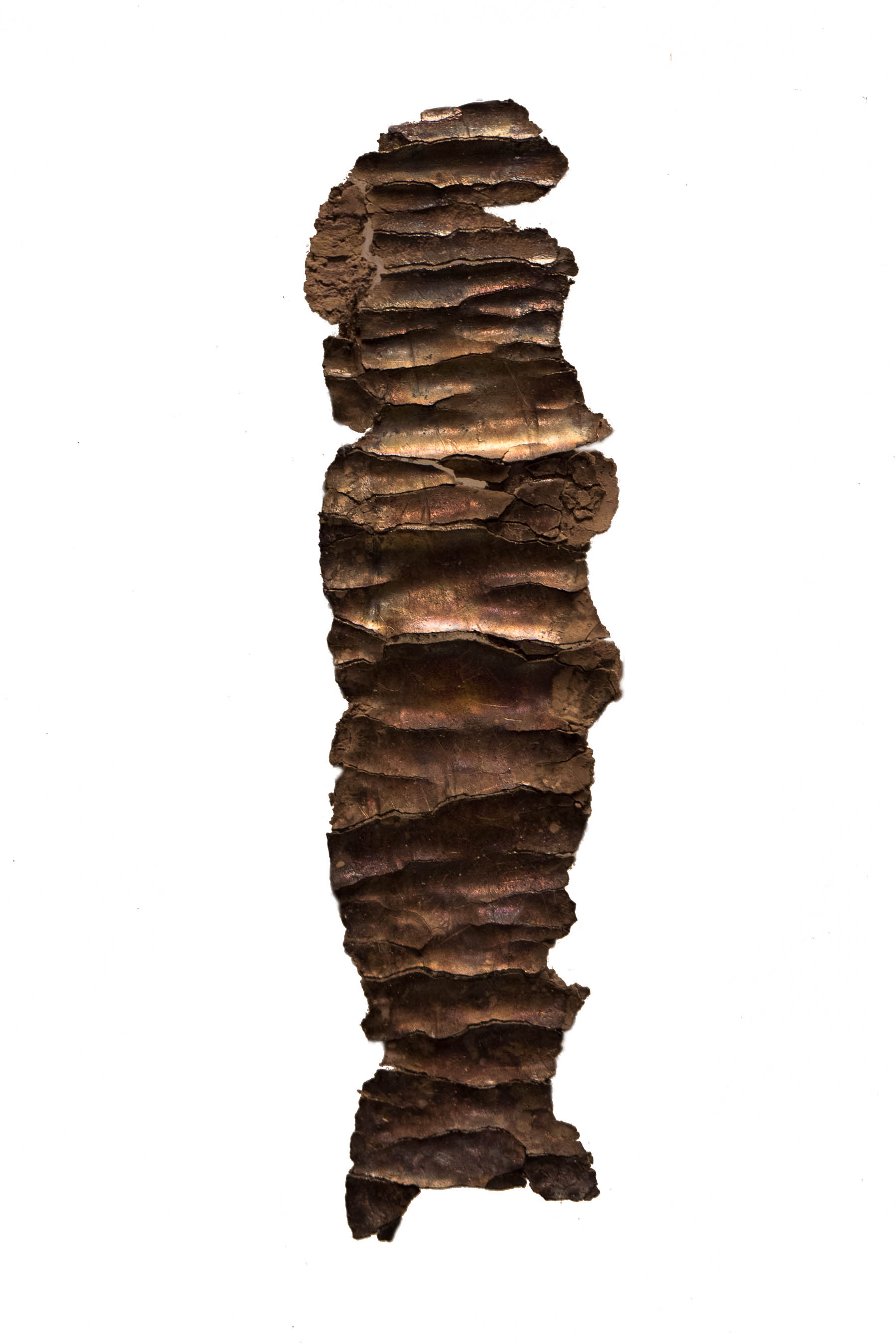

The unrolled scroll measures approximately 1 inch wide and 4 inches long. It opens with the words: YHW… the grea[t… who keeps] the
covenant and [G]raciousness toward those who love
[him] and and those who keep [his commandments…] 1Barkay 2004, 61


The smaller of the two scrolls concludes with the priestly benediction: “May Yahweh bless you, keep you. May Yahweh make his face shine upon you and grant you p[ea]ce.” 2Barkay 2004, 68
I Shall Behold Your Face
It took a team of conservationists three years to unroll the scrolls. Even after they had suceeded, the scrolls proved extremely difficult to read, so small were they and so fine was the etching. Only through the use of special photography techniques were the scrolls finally made to reveal their secrets. Dating to the 7th century BC they scrolls were written using the Paleo-Hebrew script. They were probably written in the days of Josiah and Jeremiah when the First Temple was still standing. Remarkably, they were inscribed with passages from the Bible.
The larger of the two scrolls (Ketef Hinnom I) begins with a passage from Deuteronomy.
The Scroll (Ketef Hinnom I)
Yahweh
the grea[t … who keeps]
the covenant and
[G]raciousness towards those who love [him] and those who keep [his commandments…] (Ketef Hinnom I)
The Bible
Know therefore that the LORD your God is God, the faithful God who keeps covenant and steadfast love with those who love him and keep his commandments, to a thousand generations… (Deut. 7:9 ESV)
Both scrolls conclude with the priestly benediction found in Numbers 6:24-26.
The Scroll (Ketef Hinnom II)
May Yahweh bless you, keep you. May Yahweh make his face shine upon you and grant you p[ea]ce (Ketef Hinnom II).
The Bible
The LORD bless you and keep you;
the LORD make his face to shine upon you and be gracious to you;
the LORD lift up his countenance upon you and give you peace
(Num. 6:24-26 ESV).
The silver scrolls are the earliest copies of the Biblical text ever discovered. The next oldest—the Dead Sea Scrolls—date approximately 500 years later. Obviously only a very small portion of the Bible could be inscribed on the scrolls but what has been preserved matches the Masoretic text (an 11th century AD copy of the Hebrew Bible) word for word.
The kernel of both of both scroll texts is the familiar and oft-cited passage from the Bible known as the priestly benediction. Although most often read as a blessing for life, it applies equally in death. It expresses hope that those who have passed from this life this shall see the face of God and know his peace. This hope for life after death is also expressed in many of the Psalms (Psalm 23:6, 17:13-15, 73:23-28, Job 19:23-27).
The scrolls use names and epithets familiar from the Bible, such as Restorer (Ps. 80:3), Rock (Hab. 1:12), and the Helper (Ps. 54:4). The phrase “redemption is found in the LORD” is also clearly derived from the Biblical text (Ps. 25:22).
Amulet(?)
Should the silver scrolls be designated as amulets? Although this label is often applied to them1Smoak 2010, I don’t think they should be. The scrolls read more like confessions than mantras. They express faith in God, like a cross worn around the neck, rather than functioning as a magical object capable of protecting its bearer by some innate power.
A useful comparison comes from Phoenician burials of the same period. The deceased were also buried with scrolls made of gold leaf or papyrus. But rather than a prayer or blessing, they were inscribed with a Phoenician adaption of the Egyptian Book of the Dead designed to secure passage for the deceased from this life to the next. In this case, the contrast between the Judaean and Phoenician scrolls could not be more pronounced.


Worn by the deceased around their neck, the metal canister contained tiny rolled up scrolls made of papyrus or gold leaf. They were found in tombs around Thassos, a Phoenician colony on Sardinia (7th – 6th centuries BC).


The unrolled scrolls with scenes from the Egyptian Book of the Dead. From Thassos, Sardinia (7th – 6th centuries BC). Made from papyrus or gold leaf (bottom).


A Phoenician amulet was found in a rock-cut tomb near Rabat on Malta. The bronze container, decorated with the uraeus and sun disk, held a piece of papyrus inscribed with the following text:
Laugh oh strong of heart, at your enemy, make fun of, weaken and attack the adversary. …despise him, crush him over the waters; …bring him down …over the sea, tie him, hang him (Translation courtesy of the Malta National Museum).
The purpose of the spell was to aid the deceased on their voyage to the next life.

A gold scroll discovered in 1693 in a Phoenician rock-cut tomb near Rabat, Malta displays a Phoenician adaptation of the Egyptian Book of the Dead. Although the location of the scroll is no longer known, an etching was produced by Antonio Bulifon. Like the scrolls found at Thassos, it was kept in a small pendant worn around the neck.
Many other types of amulets and figurines are found in Phoenician tombs but are almost completely absent from Judean tombs. This accords with the general Biblical prohibition against divination and also with the total absence of “spells and conjurations” in the ritual law code of the Old Testament. Yezekel Kaufmann observed that incantations are “founded on the idea that evil is an autonomous power.”2Kaufmann 1960, 107 Thus there was always the possibility that evil could be averted through magic. But in the soil of monotheism “incantation becomes prayer.”3Kaufmann 1960, 109
The LORD bless you and keep you;
the LORD make his face to shine upon you and be gracious to you;
the LORD lift up his countenance upon you and give you peace. (Num. 6:24-26 ESV)
The silver scrolls may appear as magic amulets such as were found in Phoenician tombs, their content is wholly different. If the bearer thought the scroll would protect them, it was indirectly, by way of an appeal to the LORD. The scrolls cannot therefore properly be referred to as amulets.
Barkay, Gabriel, Marilyn J. Lundberg, Andrew G. Vaughn, Bruce Zuckerman. “The Challenges of Ketef Hinnom: Using Advanced Technologies to Reclaim the Earliest Biblical Texts and Their Context.” Near Eastern Archaeology 66, no. 4 (December 2003): 162-171.
Barkay, Gabriel, Marilyn J. Lundberg, Andrew G. Vaughn, Bruce Zuckerman. “The Amulets from Ketef Hinnom: A New Edition and Evaluation.” Bulletin of the American Schools of Oriental Research, no. 334 (2004): 41–71. Link
Kaufmann, Yehezkel, Moshe Greenberg.
The Religion of Israel, translated by Moshe Greenberg.
Chicago: University of Chicago Press, 1960.
Smoak, Jeremy D. “Amuletic Inscriptions and the Background of YHWH as Guardian and Protector in Psalm 12.” Vetus Testamentum 60, no. 3 (2010): 421–32. Link
The full translation of the two scrolls:
Yahweh
the grea[t … who keeps]
the covenant and
[G]raciousness towards those who love [him] and those who keep [his commandments …
…].
the Eternal? […].
[the?] blessing more than any
[sna]re and more than Evil.
For redemption is in him.
For YHWH
is our restorer [and]
rock. May YHWH bles[s]
you and
[may he] keep you.
[May] YHWH make
[his face] shine. (Ketef Hinnom 1)1Barkay 2003, 21
[For PN, (the son/daughter of) xxxx]h/hu. May h[e]/sh[e] be blessed by Yahweh, the warrior [or: helper] and the rebuker of [E]vil: May Yahweh bless you, keep you. May Yahweh make his face shine upon you and grant you p[ea[ce. (Ketef Hinnom 2)2Barkay 2003, 28