Often overlooked, this site was once equally venerated by Herod and Constantine as Mamre, the place of Abraham’s encampment.
The life of Abraham is narrated in 13 chapters of the book of Genesis, the first of five books written by Moses and preserved in the Bible. The earliest copies of Genesis were found among the the Dead Sea Scrolls, written on parchment (animal skin) and sealed in pots that were subsequently hidden in caves along the northwest shore of the Dead Sea. Since these scrolls do not predate the 2nd century BC it may be wondered how we can know whether these books were indeed written by Moses (c. 15th century BC) and whether they preserve reliable information about the Early Bronze Age.

The Dead Sea Scrolls were found in caves on the north-western shore of the Dead Sea (foreground).
It should be stated up front that it is quite remarkable to have Biblical manuscripts which date back the 2nd century BC. Most texts written on papyrus and parchment do not last that long. The earliest fragments of Homer’s Iliad, for example, do not predate the 2nd century AD. But thank to the dry climate of the Dead Sea region, significant portions of the book of Genesis have survived from the 2nd century BC until the present day.


Left: A portion of what is known as the Great Isaiah Scroll, representative of the scrolls found in caves by the Dead Sea.
Right: Typical jar used to store the scrolls. Many of the scrolls were likely taken from the temple in Jerusalem and hidden during the Jewish Revolt of 70 AD that ultimately culminated in the destruction of Jerusalem.
The authorship of the Pentateuch is a big topic which we will look at in more detail in future chapters. The question which pertains to our present discussion is whether the book of Genesis has anything to tell us about the Early Bronze period? There are scholars who argue that the book itself has no value for the study of this period since it was, according to them, not written until the 7th or 6th centuries BC, at the earliest. If correct, then the book should reflect the traditions and geography of the Iron Age. But there is much about the book of Genesis which fits comfortably in the Bronze Age, but not in the Iron.
Abraham
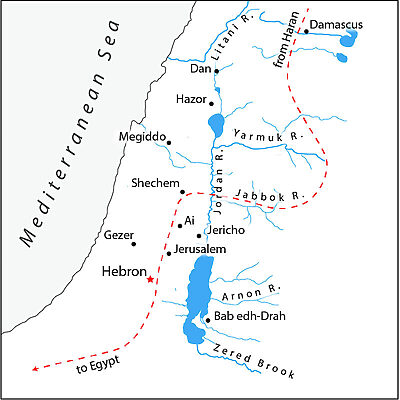
Abraham was born Abram, a typical west semitic name which means something like “elevated father.” Later his name was changed to Abraham, which means something like “father of multitudes” (Gen 17:5). Curiously, we first encounter Abraham in Ur, the famous city in southern Mesopotamia. Called by God to leave Ur for a place unknown, Abraham and his clan migrated to Haran, on the northern plains of Syria, and from there to Canaan, where he pitched his tents.
Abraham’s grandson, Jacob, is referred to in Deuteronomy 26:5 as a “wandering Aramaean,” a northwest Semitic group closely related to the Amorites, and often lumped together with them. But the Aramaean homeland was in northern Syria whereas the Amorite homeland was located in the vicinity of Jebel Bishri (“Mount Bashar”) in southern Syria. The name “Aram” may probably be traced to the name of the most important city in the region, Armi, which appears in the Ebla tablets as Ar-am-e.1Wenham 1987, comment on Genesis 10:13 The name of this city also appears in an inscription of Naram-Sin in which the king boasts of having captured “Ibla and Armanum.” Armi was probably located northeast of Ebla, on the east side of the Euphrates, although its exact location is debated.
Abraham’s closest kin lived in Paddan-aram (Aramaic. padanu “plain”), between the Euphrates and the Balikh. As you may recall, the Kranzhügel (“wreath cities”) are located directly east of Paddan-aram, between the Balikh and the Khabur, with perhaps some overlap. The name of Abraham’s brother, Nahor, may be preserved in the name of one of the leading towns in the region, known from cuneiform texts as Nahurru. Although the city disappears from the cuneiform records by the 13th century BC it is nevertheless recorded in the Bible.2Lipinski 2000, 65 Judging by what we know of the history of ancient Israel subsequent to this period, it is by no means obvious why Abraham and his descendants should have been so closely linked to Aram since, by the 10th century BC, the Aramaeans had become Israel’s greatest foe, and the Aramaean language was different enough from Hebrew to make it unintelligible.3See, for example, Isa. 36:11: “Then Eliakim, Shebna, and Joah said to the Rabshakeh, “Please speak to your servants in Aramaic, for we understand it. Do not speak to us in the language of Judah within the hearing of the people who are on the wall.” (Isa. 36:11 ESV) However, Abraham’s migration from Padan-aram to Canaan does not look out of place in the Early Bronze IV—Middle Bronze I, a period which witnessed considerable movements of peoples. No doubt Aramaic and Hebrew diverged considerably in the millennium following Abraham’s sojourn in Haran.
Although the name Aram may be traced back to the Early Bronze city of Armi, the earliest extra-Biblical reference to a people named the Aramaeans comes from Middle Assyrian documents of the 13th century BC. These refer to tribes of “ahlamu-Aramaeans” which inhabited the land west of Assyria—that is Padan-aram. The term ahlamu was reserved for nomads, barbarians, and dogs; the three apparently being indistinguishable in the eyes of Assyrian city-dwellers. Thus it may be included with other terms for nomads, including the Sumerian martu, Akkadian amurru, and Canaanite habiru. A literal translation of ahlamu-Aramaean is “wandering Aramaean,” which is exactly how Abraham’s descendants are remembered in the Bible (Deut. 26:5 ESV).

Nomadic Arab tribes, known as Bedu or Bedouin, have learned how to live in desert regions by maintaining herds of camel, goats and sheep. Bedouin may also plant small crops on marginal land. Their tents are traditionally woven from black goat hair. Doves are kept in a dovecote (foreground) which produces precious fertilizer and are also good for eating.
If city-dwellers used the term ahlamu in a derogatory sense, the authors of the Bible embrace it. It is incorrect, however, to view Abraham as an impoverished nomad, scrabbling for a meager existence. He is better understood as one of the “kings who lived in tents,” a phrase used by Assyrian chroniclers to refer to their earliest rulers. This matches the description of Abraham found in Genesis, which accords him great wealth and power. It is noteworthy however that Abraham is never explicitly referred to as a king in the Bible. He was ha-ivri (“the Hebrew” in Gen. 14:13) and his grandson was called an arami-oved (“wandering Aramaean” in Deut. 26:5). This fits with the general thrust of Biblical tradition which abases the proud and elevates the humble, and the generally negative view it takes of kings and their cities, even Israelite ones.
Mamre
Droughts and famine have always been a part of life in the southern Levant, where a successful harvest relies upon sufficient rainfall. A prolonged drought may force the inhabitants of a country to take drastic action in order to find sufficient water and food to survive. For Abraham and his nephew, Lot, it meant going down to Egypt in order to find sufficient food and fodder for their animals. Only the barest details of their journey are recounted in Genesis. We learn very little about Egypt or the pharaoh in power at the time. If Abraham’s sojourn in Egypt dates to c. 2100 BC then we may tentatively date it to the reign of Pepi II, the last pharaoh of Dynasty VI.
Upon returning to Canaan, Abraham parted ways with Lot, whose herds and flocks had begun to compete with his own. Rather than appeal to seniority and status, Abraham offered Lot the choice of land (Gen. 13:8-9). When Lot chose the well watered plain of the Jordan valley, Abraham remained in the hill country, finally settling at Mamre, near present day Hebron.
Ramat el-Khalil
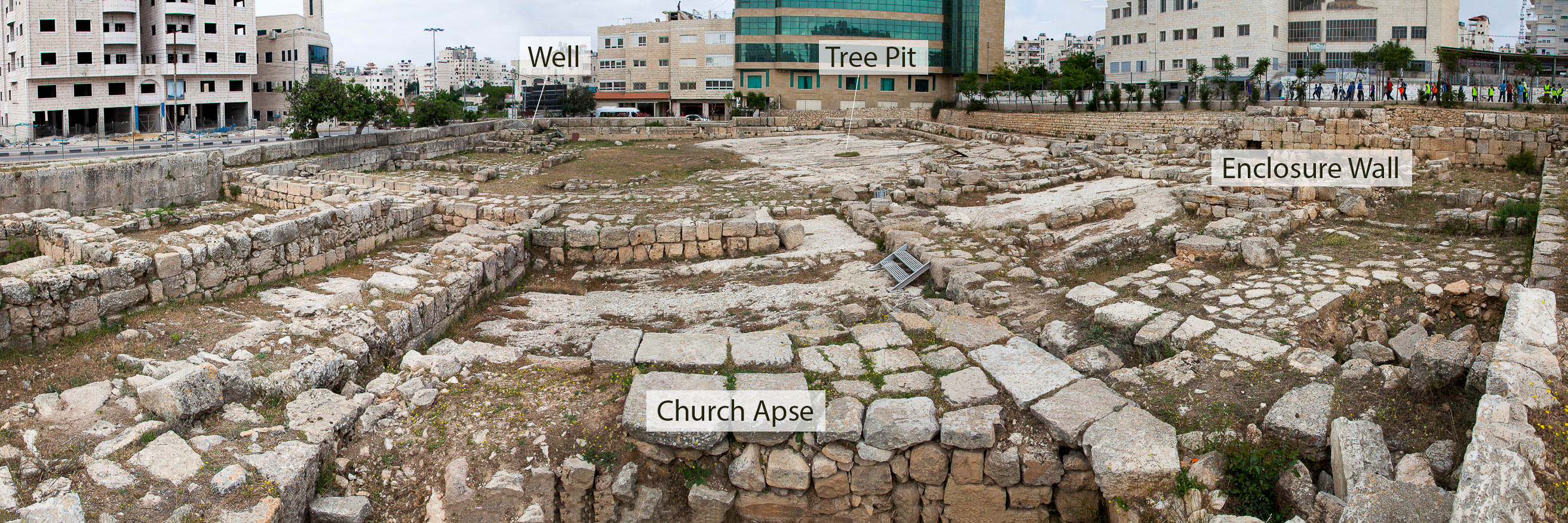
There is an ancient tradition which places Mamre at Ramat el-Khalil, in the northern suburbs of modern Hebron. One may still go there and peer down an ancient well situated inside a stone enclosure. The earliest walls visible today were constructed by Herod the Great (37—4 BC). This makes Mamre one of just three places chosen by Herod for the construction of a monument related to a Biblical place. The other two are the temple in Jerusalem and Machpelah, which we will look at in the next chapter. Herod must therefore have considered Ramat el-Khalil to be Mamre, as did the Christian Roman emperor, Constantine, who constructed a church there several hundred years later; one of only four constructed by Constantine in the Holy Land. Unfortunately, the ensuing millennia have not been kind to the site. Today, only the lower courses of stone remain.

The well was situated in the far corner of the enclosure. The walls in the foreground belong to the apse of the church constructed by Constantine (and later Arab dwellings). The outer perimeter wall was originally constructed by Herod. (See the next entry on Machpelah for more on this.)
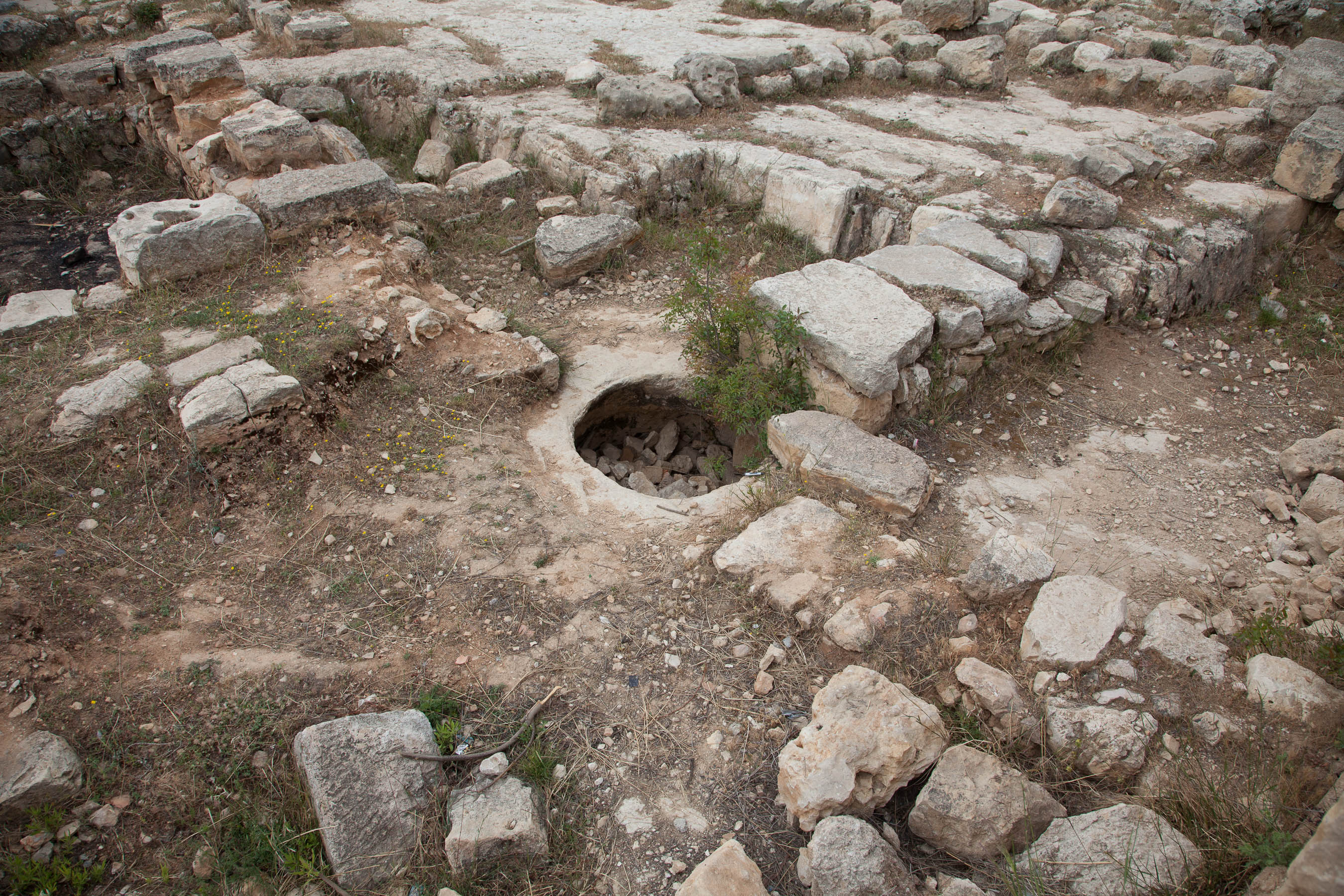
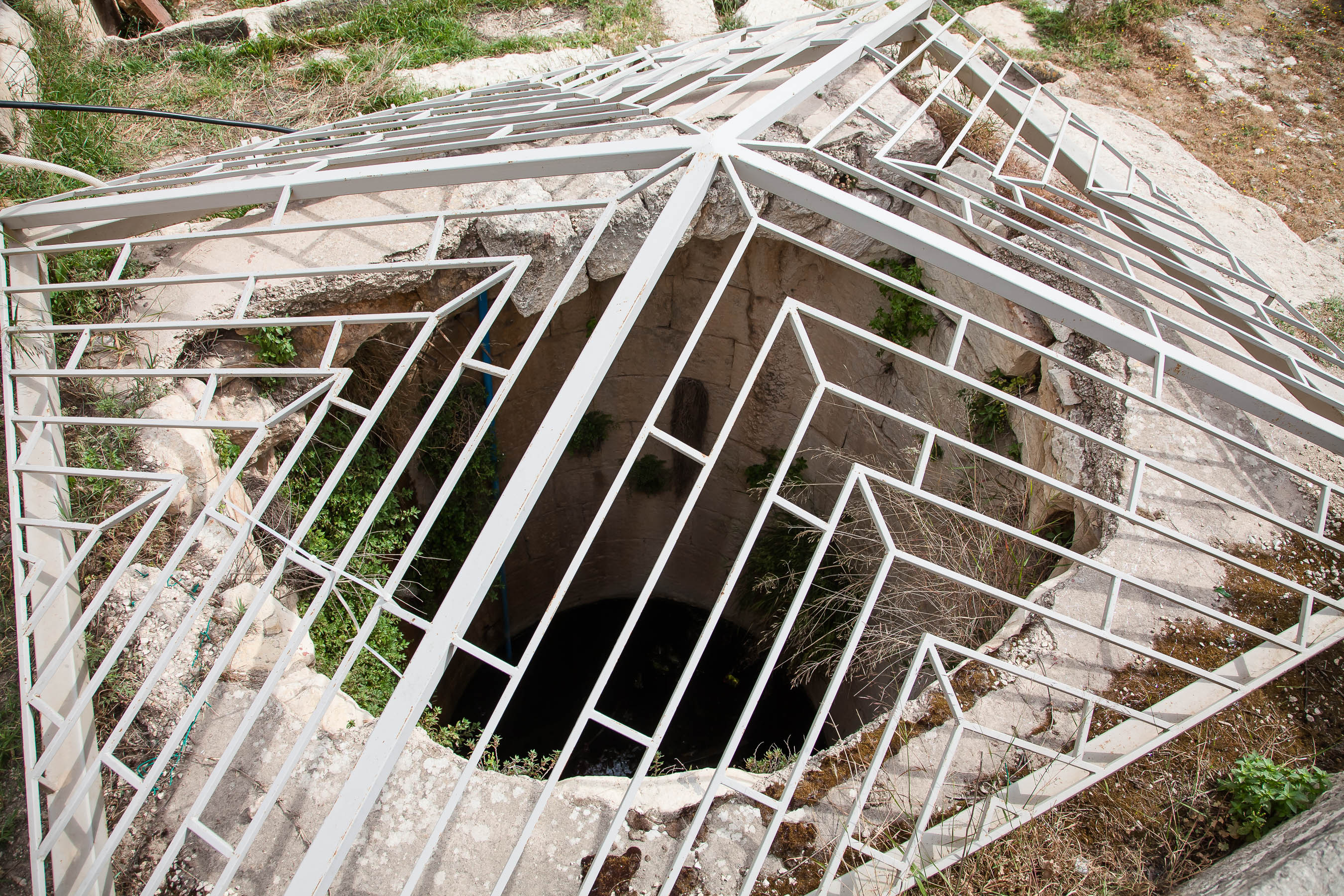
Left: A “tree pit” in the courtyard of the enclosure next to the well. The roots of oak trees are capable of breaking rock. When the tree dies, it leaves a hollow depression in the stone known as a “tree pit.” Right: An ancient well made from finely cut stone ashlars.
Oaks of Mamre
The name Mamre rarely appears in the Bible without reference to the oak trees which grew there. These were probably the Palestinian Oak, a species which may live for up to 600 years, reaching heights of 50 feet and a girth of 7 feet. Its sprawling branches makes it one of the finest shade trees available. Its strong, tough wood was useful for making yokes, spear shafts, and oars. Most trees like to grow in a forest but the oak thrives alone. Their strong trunk and tough bark are capable of withstanding the harshest elements. Conversely, their slow growth means that they are easily choked out by faster growing trees. The oaks of Mamre were likely spaced apart, their roots tapping into the water table which rises near the surface in this area. The presence of water and trees at Mamre meant that it would remain an important gathering place into the Roman Era.

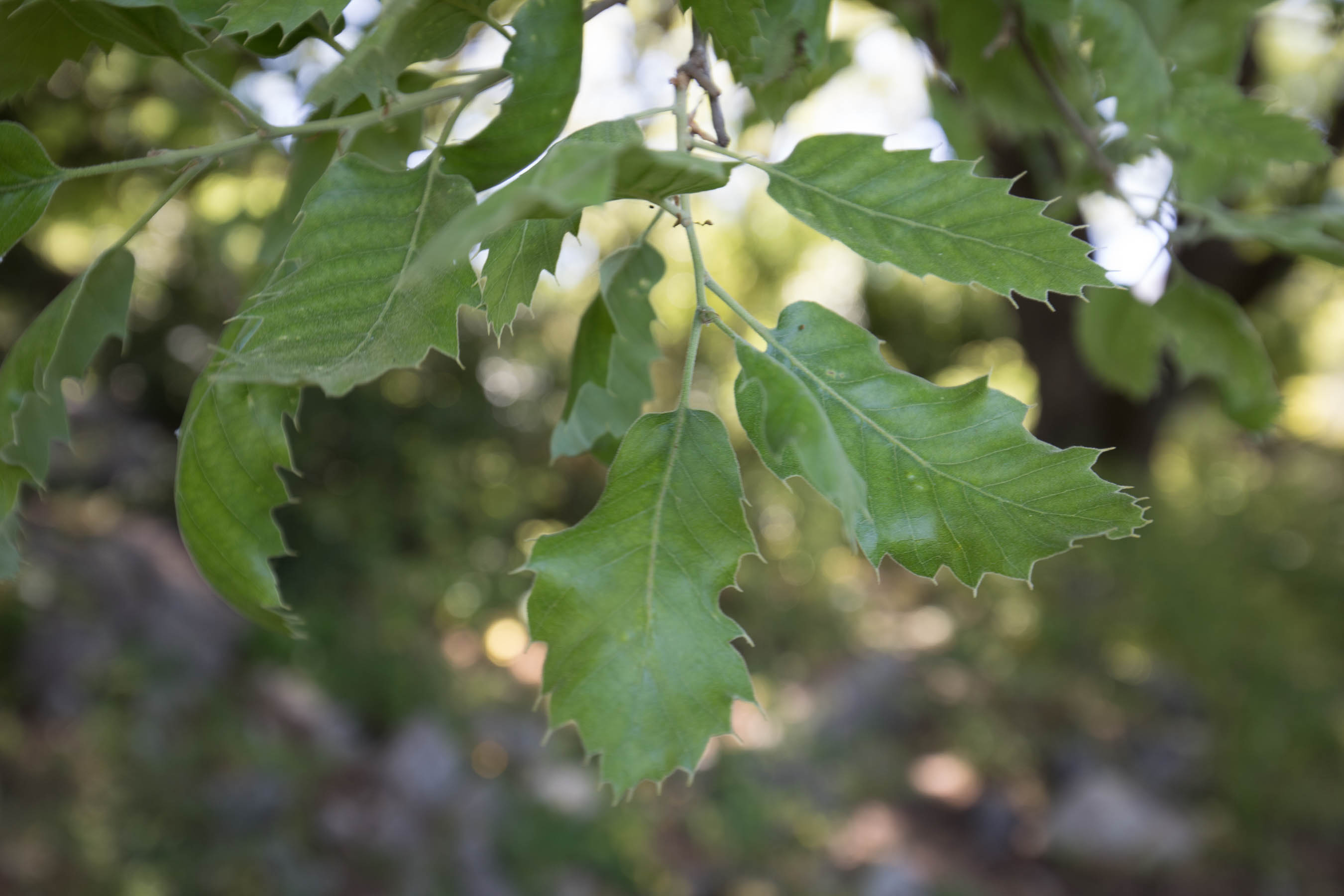
The oak is known for its spreading branches and thick canopy.
“So Abram moved his tent and came and settled by the oaks of Mamre, which are at Hebron…” (Gen. 13:18-14:1 ESV)
Father Abraham
The book of Genesis does not preserve an Abrahamic statement of faith, as it were, which is surprising given the theological controversies of later years, and the temptation which must have existed for an Israelite scribe to place a speech in the mouth of Abraham defending belief in one God and eschewing idolatry. The fact that this kind of polemic is absent from these chapters of Genesis lends credibility to their claim of antiquity. We only know Abraham’s theology by his deeds and the sacrifices which he offers to to El Elyon (“God Most High”), El Shaddai (“God Almighty”), and El Ulam (“Eternal God”). There is no need to think of these a separate deities, as some scholars have done.4Alt argued that El Elyon, El Ulam, and El Shaddai were distinct Canaanite ‘numena’, local gods, associated with three different temples that were later taken over by the Israelites (Alt 1966, 50). As we will see, the evidence points in the opposite direction. The Israelites built over Canaanite temples with residential or administrative buildings, but never with temples. The God to whom Abraham prays is not a local “Canaanite numena” but the “possessor of heaven and earth.” (Gen. 14:18-22) The book of Hebrews, written many centuries later, remembers Abraham as the father of faith whose nomadic and unsettled life was spent in pursuit of another city “whose designer and builder is God.” (Heb. 11:10) And so he is remembered to this day.
Alt, Albrecht.
Essays on Old Testament History and Religion.
Oxford: Blackwell, 1966.
“Hebron with Jeff Chadwick.” Onscript Podcast. Blackwell. October 21, 2024. Link
Kaufmann, Yehezkel, Moshe Greenberg.
The Religion of Israel, translated by Moshe Greenberg.
Chicago: University of Chicago Press, 1960.
Kitchell, Kenneth F. “New Evidence for the Cretan APIAIOI Coinage.” American Journal of Archaeology 87, no. 2 (1983): 216–20. Link
Kramer, Joel.
Where God Came Down.
Brigham City, Utah: Expedition Bible, 2020.
Lipiński, Edward.
The Aramaeans : Their Ancient History, Culture, Religion.
Leuven; Sterling, Virginia: Peeters, 2000.
Margalith, Othniel.
.
Wiesbaden: Harrassowitz, 1994.
Wenham, Gordon J.
“Genesis 1-15,” in Word Bible Commentary, edited by Bruce M. Metzer, David A. Hubbard, Glenn W. Barker, John D. W. Watts.
Dallas, Texas: Word Books, 1987.