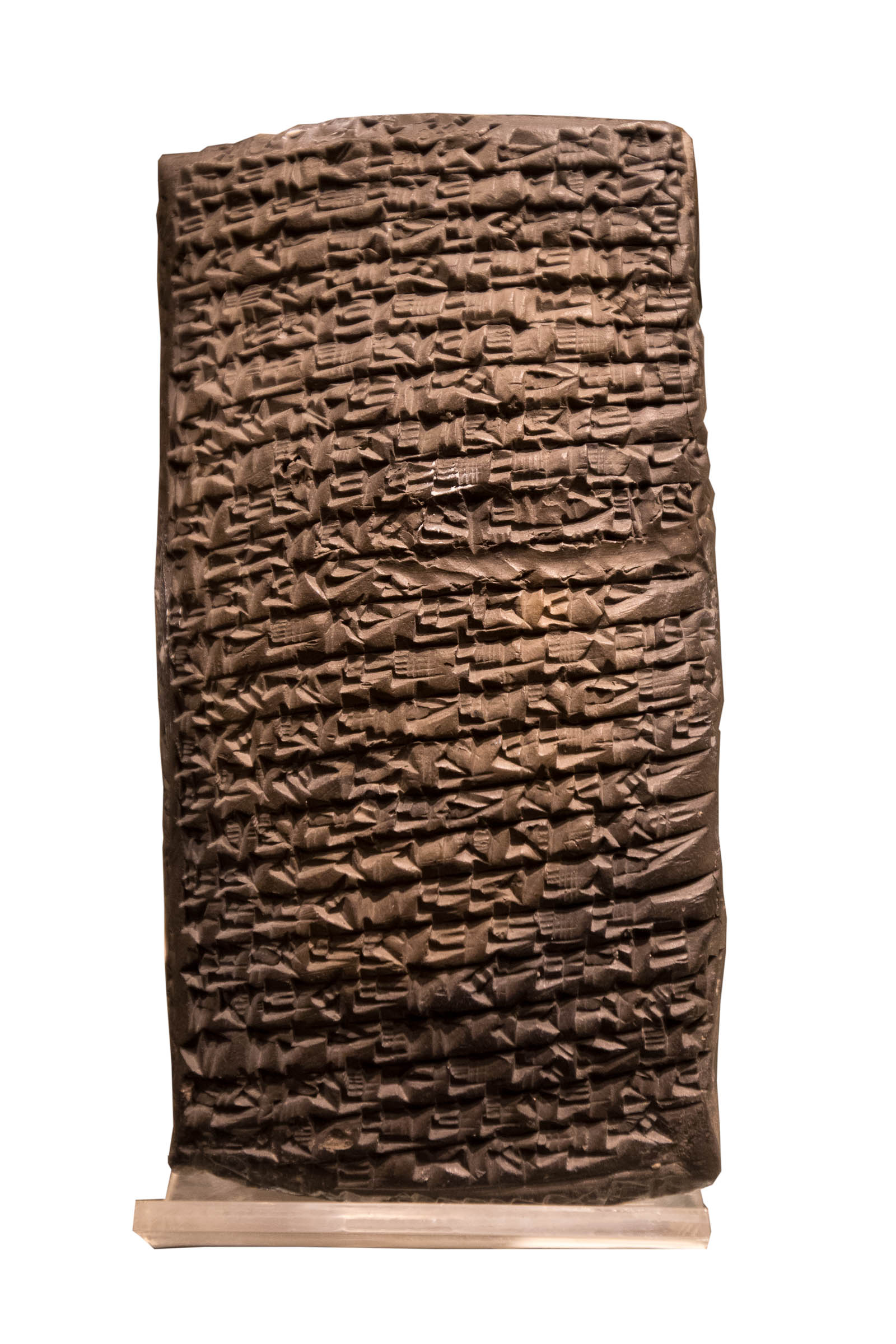
Every commercial contract has to answer a few basic questions. What kind of product is to be delivered? How much? When? To whom? The only way to reliably secure this kind of information is to write it down. It is no coincidence, therefore, that the increase in trade between Anatolia and Assyria during the first half of the Middle Bronze age, also resulted in the production of a vast quantity of such contracts inscribed on clay tablets. Known as the Cappadocian Tablets, to date, more than 20,000 tablets have been discovered at Kanesh.
To take just one tablet as an example, we have a letter written by a certain Assyrian merchant named Puzur-Assur addressed to a woman named Waqartum living in the Assyrian capital of Assur:
The fine textile which you sent me – keep producing similar textiles and send them to me with Assur-idi, and I will send you 1/2 mina of silver each. Let them comb one side of the textile, they should not shear it, its weave should be close. Compared to the last batch of textiles, you should add another mina of wool in each piece, but keep them thin! …1slightly paraphrased from Bryce 1998, 28
Woolen textiles was a major Mesopotamian export. When Achan describes the objects of spoil he took from Jericho, he lists three objects in particular: “beautiful cloak from Shinar,” “200 shekels of silver,” and “a gold bar weighing 50 shekels” (Jos. 7:21). Clearly the woolen garment was an item of great value if it could be listed next to these other items. Undoubtedly the people of Jericho traded for “cloaks from Shinar” just as the people of Kanesh did.
Debt
Wealthy merchants often employed their large pools of money for lending at interest rates ranging from 30 to as high as 180 percent. Sons and daughters were liable to be sold into slavery if the debt could not be repaid. Heavy debt burdens often became a point of contention so that a king might feel compelled to declare all debts cancelled. Lenders tried to circumvent these debt jubilees by inserting phrases into their contracts such as the following: “If the king cancels the obligation to pay debt, you will pay me my grain.”2Bryce 1998, 29
The word jubilee actually comes from the Hebrew word yobel which means ‘horn’. According to the Law of Moses, every fifty years, on the tenth day of the first month, a horn (yobel) was sounded throughout the land. All debts were to be cancelled, captives released, and ancestral land returned to its original owners. The purpose for this legislation was to prevent the accumulation of land and resources into the hands of just a few people. The year of jubilee could be thought of as the ancient equivalent of antitrust legislation designed to prevent monopolies. The Romans had similar laws which limited the amount of land that could be owned by a single family.
Rather than allow the king arbitrary power to declare a jubilee, the Pentateuch incorporates the jubilee into a festival calendar. This means that the value of land was based on the number of harvests it could produce until the next year of jubilee. It is not clear to what degree the Israelites actually implemented this law.3Jeremiah declared that the exile of his people would last for as long as they had failed to keep the sabbatical years (every seven years) and jubilees (every fiftieth year). Thus the people would remain in captivity for 70 years, one year for every seven year period in which they had not celebrate the sabbatical year. This equals a span of 490 years (490 / 7 = 70). Jeremiah’s indictment suggests that many sabbatical years were not kept. Judging by Isaiah’s fiery denunciations, it seems that the sabbaticals and jubilees was not kept in his day.
Woe to those who join house to house, who add field to field, until there is no more room, and you are made to dwell alone in the midst of the land. (Isa 5:8 ESV)
Bryce, T.
The Kingdom of the Hittites.
Oxford, New York: Clarendon Press; Oxford University Press, 1998. Link