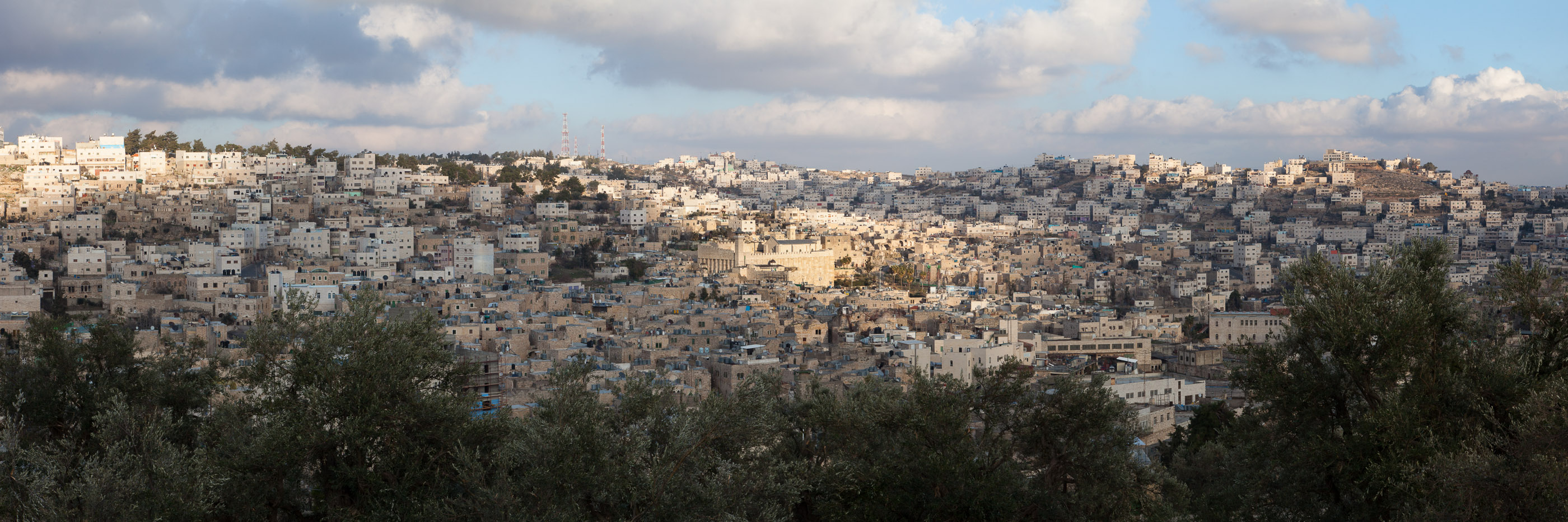
Machpelah is the large stone structure at center. This picture was taken from Tell Rumeidah (Kiriath Arba).
After the death of Sarah, his wife, Abraham sought to purchase “the cave of the field of Machpelah, east of Mamre” in order to bury her there. As was customary in those days, Abraham negotiated for the purchase of the land with its owner, Ephron the Hittite, “in the hearing of the Hittites and of all who went in at the gate of his city.” (Gen. 23:10) The dialogue between Ephron and Abraham recorded in Genesis 23 is a model of dignity and good faith.
Abraham rose and bowed to the Hittites, the people of the land. And he said to them, “If you are willing that I should bury my dead out of my sight, hear me and entreat for me Ephron the son of Zohar, that he may give me the cave of Machpelah, which he owns; it is at the end of his field. For the full price let him give it to me in your presence as property for a burying place.
“Now Ephron was sitting among the Hittites, and Ephron the Hittite answered Abraham in the hearing of the Hittites, of all who went in at the gate of his city, “No, my lord, hear me: I give you the field, and I give you the cave that is in it. In the sight of the sons of my people I give it to you. Bury your dead.”
Then Abraham bowed down before the people of the land. And he said to Ephron in the hearing of the people of the land, “But if you will, hear me: I give the price of the field. Accept it from me, that I may bury my dead there.”
Ephron answered Abraham, “My lord, listen to me: a piece of land worth four hundred shekels of silver, what is that between you and me? Bury your dead.”
Abraham listened to Ephron, and Abraham weighed out for Ephron the silver that he had named in the hearing of the Hittites, four hundred shekels of silver, according to the weights current among the merchants. So the field of Ephron in Machpelah, which was to the east of Mamre, the field with the cave that was in it and all the trees that were in the field, throughout its whole area, was made over to Abraham as a possession in the presence of the Hittites, before all who went in at the gate of his city. After this, Abraham buried Sarah his wife in the cave of the field of Machpelah east of Mamre (that is, Hebron) in the land of Canaan. (Genesis 23:7-18)
There is a remarkable building, not far from Tell Rumeida, which marks the traditional site of Machpelah.1The cave is divided into two chambers connected by a narrow passage. The layout of the caves may be reflected in the name Machpelah, which could be derived from the Hebrew root kaphal which means double. It is generally agreed that the building was constructed by Herod although there is surprisingly no literary references crediting him with its construction.2Some early scholars concluded that the building may have predated Herod (Merrill 1890, 337 ff.). However, this is unlikely. The style of masonry used for the construction of its walls is distinctively Herodian. The excellent preservation of the structure presents a striking contrast with the scanty remains preserved at Ramat el-Khalil (Mamre) despite the two structures having been constructed at around the same time. The walls of the structure, which stand to their original height, are made of giant blocks of precisely cut ashlar limestone (“squared stone”). The quality of the Herodian masonry is unrivalled in the ancient world.
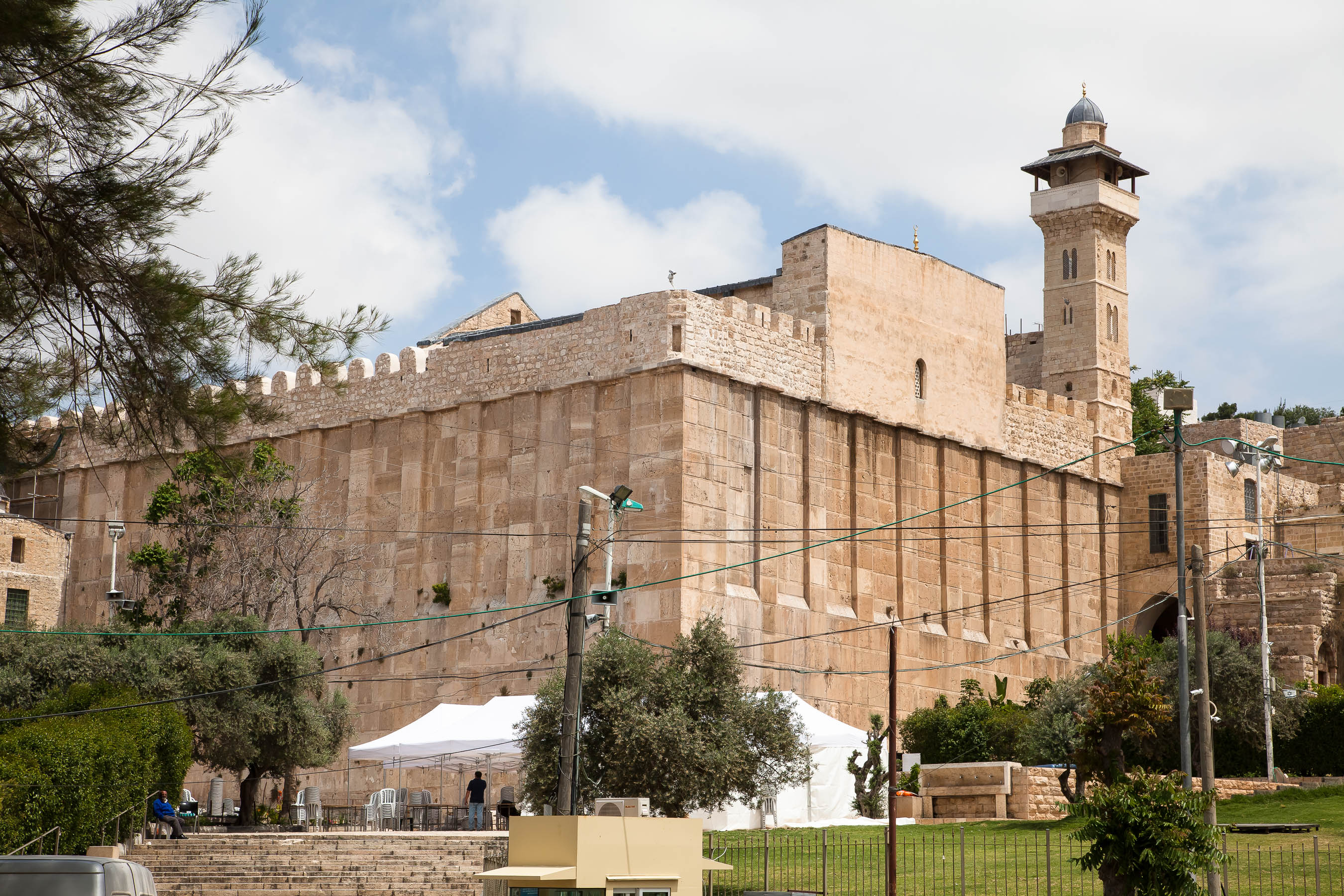
Except for the upper courses of smaller stones, the masonry of this structure belongs to the time of Herod the Great. Four minarets were added to the building by the Ayyubid ruler, Saladin. Only two of these minarets remain today.


Left: Herodion masonry uses subtle inset panels to break up the wall surface. Right: Very little of the Herodian masonry is still visible at Mamre, but you can see one of the bevelled stones used to create an inset panel like at Machpelah.
Machpelah is in a politically sensitive area today. For this reason no formal archaeological excavations have been conducted at the site. However, the passages beneath the structure were briefly explored in 1967, following the Six Day War, when the building came under temporary Israeli military control. Keen to learn about the caves beneath the structure, the Israeli general, Moshe Dayan, found a slight girl named Michal, only twelve years of age but courageous, who was willing to be lowered through a small aperture in the floor of the building, into the underground chamber below. This is, at least, how the story is told. Apparently the girl was the daughter of the head of the Shin Bet, the Israeli internal security force, and she received some training before she was lowered into the chamber!3Shragai 2021
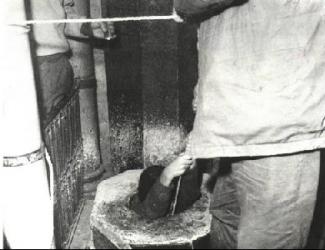

Left: Michal being lowered into the underground chamber through an orifice marked “B” on the map (see below). Right: One of the entrances to the caves below the Machpelah is via a small orifice situated next to the north wall of the the mosque used to lower candles into the underground chamber above the caves (see plan and cross section below).
The girl reportedly saw a long passageway which led to a stairway. She ascended the stairway but was prevented from going further by a wall blocking her way. Her description generally agrees with what was, until recently, the only other description of the underground passageways available to us, recorded by an anonymous medieval chronicler in 1119 AD. The Crusaders were then in possession of Hebron. On a particularly hot midsummer day, a monk stretched out on a cool stone near the cenotaph of Isaac (see plan below) when he felt a draft of cool air rising from a crack in the floor. Driven by curiosity he and his fellow monks pried loose the floor slab. To their surprise they discovered a vertical shaft, approximately 17 feet deep, that connected to a long corridor. At the end of the corridor they found a “fabulously crafted [room], round like a basilica.”4Miller 1985 (This was the same chamber Michal was lowered into in 1967.) Sensing a hollow space beneath the floor of this chamber, the monks pried up another floor stone and discovered a series of caves filled with bones!
The monks constructed a steep set of steps at the place where they had found the vertical shaft near Isaac’s cenotaph (marked “A” on the plan below). This stairway enabled Christian pilgrims to visit the newly discovered underground chamber and caves. The entrance was subsequently blocked up after the area was captured by Arab forces commanded by Saladin.
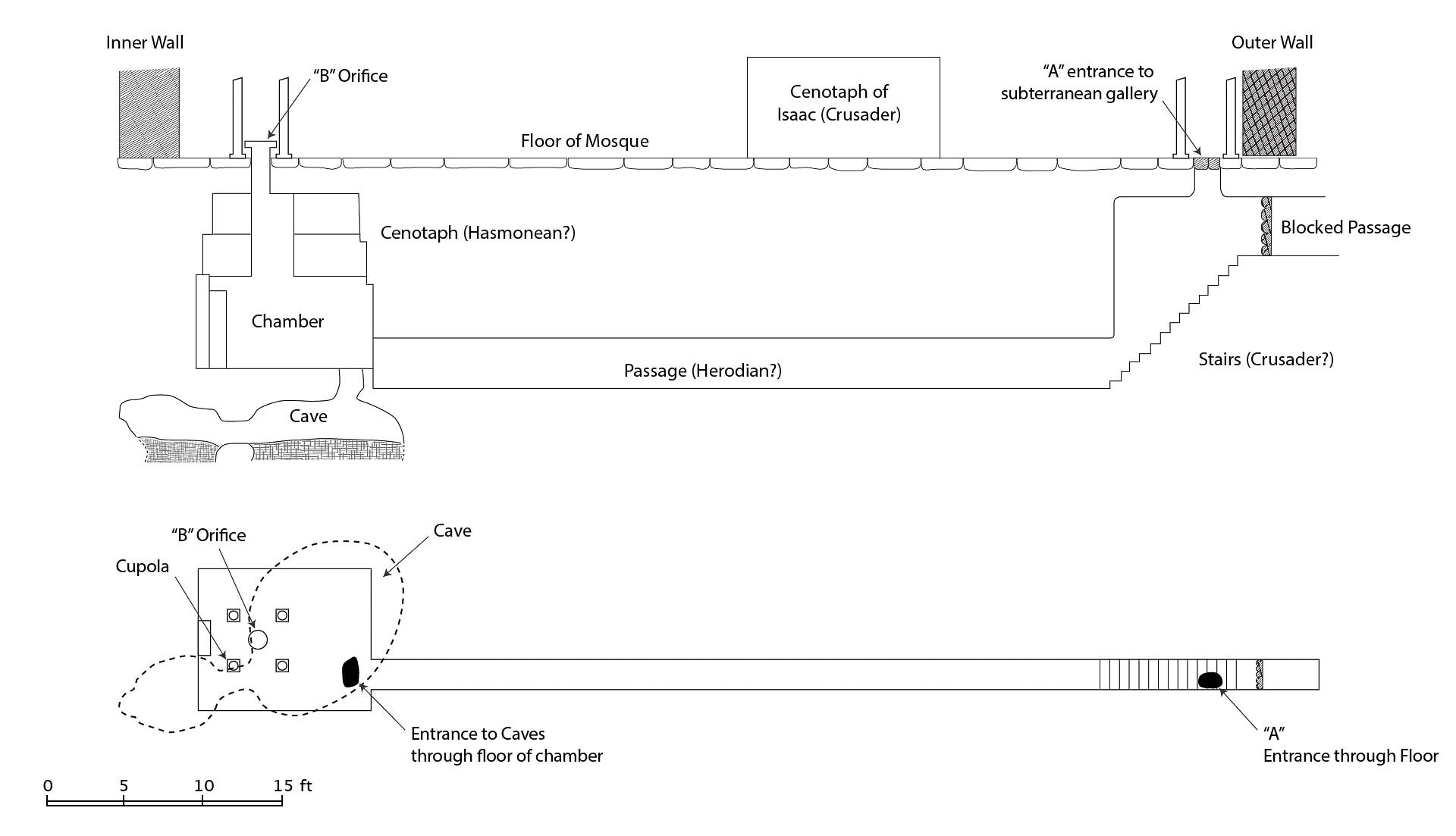
Since only limited investigations have been conducted, we have only fragmentary reports of what lies beneath Machpelah.
The medieval chronicle remained the sole testament to the existence of caves beneath Machpelah until one night in September of 1981 a group of local Israelis successfully pried loose the stone blocking entrance “A” without being detected. They followed the passage which led to the chamber beneath the orifice “B” through which Michal had been lowered some years earlier. Feeling around the floor of the chamber, they discovered the paving stone which covered the entrance to the caves below the chamber and thus gained entrance to the caves below. The caves were almost completely filled with silt, with just enough headspace to crawl around on all fours. The only objects visible on the surface were some pottery sherds and bones. The caves were visited several more times in the months that followed by officials from the Israeli Antiquity Authority and members of the Waqf—the Muslim authority in charge of the building. Although no archaeological excavations were conducted, some pottery recovered from the caves has since been published and dated to the Iron Age.5Arnon et al. 2020 The real discovery was not the pottery but the caves themselves. Evidently they were understood to be the burial place of the patriarchs at the time when Herod erected a monument over them.
Although we will probably never know for certain whether these are the caves of Machpelah mentioned in Genesis 23, the tradition supporting this identification is certainly very ancient. There is no reason why they could not date to the Early Bronze Age, when cave burials were common. The location of the caves “east of Mamre” and not far from Tell Rumeida, matches the description recorded in the Bible.
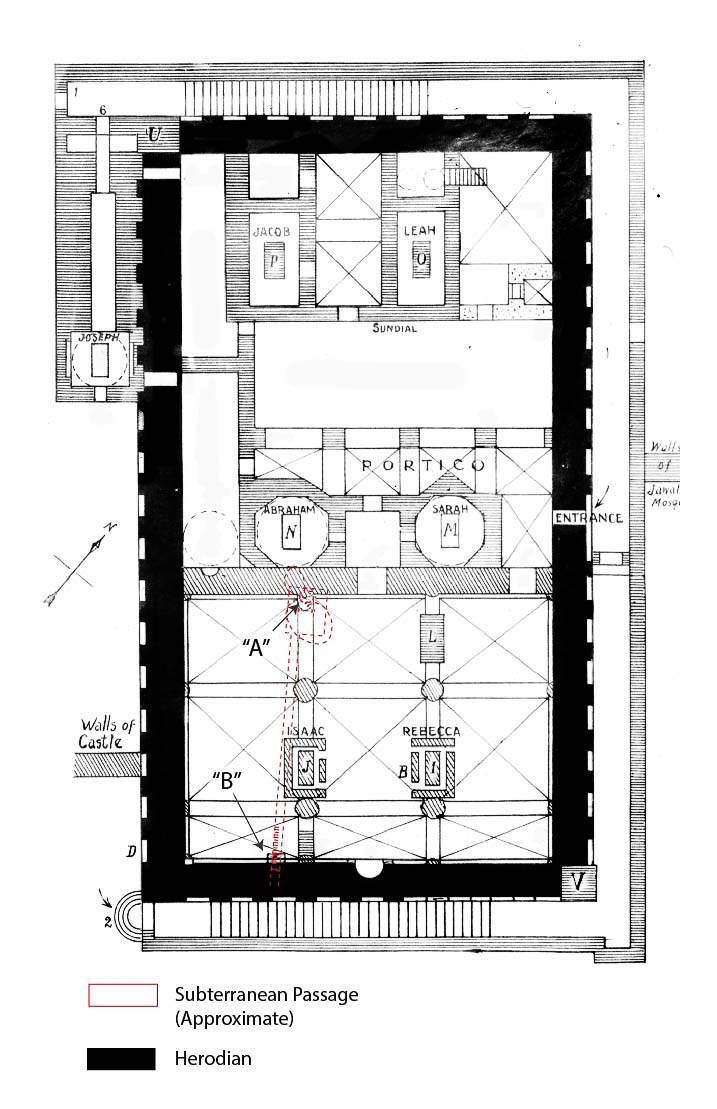
Today, the southern half of the building, including the cenotaphs of Jacob and Leah, are part of a Jewish synagogue while the cenotaphs of Isaac and Rebecca are part of a Muslim mosque. The cenotpahs of Abraham and Sarah are shared between them, with a wall separating the two.
The approximate location for the underground passage and cave are marked in red. The orifice through which Michal was lowered in the chamber above the caves is marked “A” while the entrance discovered by the monks is marked “B.”
Arnon, Noam, David Ben-Shlomo, Hans Mommsen. “Iron Age Pottery from the Cave of the Patriarchs at Hebron.” Israel Exploration Journal 70, no. 1 (2020): 49–63. Link
Foster, Benjamin. “Naram-Sin in Martu and Magan.” Annual Review of the Royal Inscriptions of Mesopotamia, no. 8 (1990): 25-44. Link
Hamblin, W. J.
Warfare in the Ancient Near East to 1600 BC: Holy Warriors at the Dawn of History.
London ; New York: Routledge, 2006. Link
Merrill, Selah. “The Cave of Machpelah.” The Old and New Testament Student 11, no. 6 (1890): 327–35. Link
“Patriarchal Burial Site Explored for First Time in 700 Years.” BAR. Routledge. July 10, 2024. Link
“Secrets of the Cave of the Patriarchs Exposed, Noam Arnon’s comprehensive doctoral dissertation proves that there is much more to the ancient site than meets the eye..” JNS. Routledge. July 10, 2024. Link
Westenholz, Joan Goodnick.
Legends of the Kings of Akkade : The Texts.
Pennsylvania: Pennsylvania State University Press, 1997.