
“Using his wisdom, the ruler will achieve great things… It is by him that the building of the holy house is to be done.” (Lines 19-22)1 Black 2006, 46
When Ernest de Sarzec began excavating Girsu (Tello), he handed his men pickaxes, arranged them in a single line across the site, and dug it “meter by meter.” On most sites, this method would not have worked very well since most artifacts lie deeply buried but at Tello “quite a large number of precious objects” were found this way, most notably “two large terracotta barrels” which de Sarzec found “buried at the foot of one of the tells.”1De Sarzec, Discoveries in Chaldea, pg. 5 These large clay cylinders are housed today in the Louvre. Although they were found them near the surface, they were originally buried beneath the foundation of the temple of Ningirsu. Their exposure at the foot of the tell was as a result of erosion.


The cylinders preserve the longest known text written in Sumerian.
The Dream
The cylinders recount how Ningirsu appeared to Gudea in a dream and commanded him to build the E-ninnu.
On that day, in a nocturnal vision, Gudea saw his master, lord Ningirsu. Ningirsu spoke to him of his house, of its building. He showed him an E-ninnu with full grandeur. Outstanding though his mind was, the message remained to be understood for him.2Lines 17-23 in Black 2004, 46
Struggling to understand what he had seen in his vision, Gudea journeyed to the temple of Nanshe, located at nearby Nigin. There he recounted for the goddess what he had seen in his dream.
In the dream there was someone who was as enormous as the heavens, who was as enormous as the earth. His head was like that of a god, his wings were like those of the Anzud bird, his lower body was like a flood storm. Lions were lying at his right and his left. He spoke to me about building his house, but I could not understand what he exactly meant, then daylight rose for me on the horizon.3Lines 101-109 in Black 2004, 47

Gudea with hands clasped in attitude of prayer.
Gudea also told Nanshe about two other figures he had seen in his dream. One was a woman carrying a silver stylus and a tablet engraved with beneficial stars; the other was a warrior who held a lapis lazuli tablet inscribed with the plan for the temple.
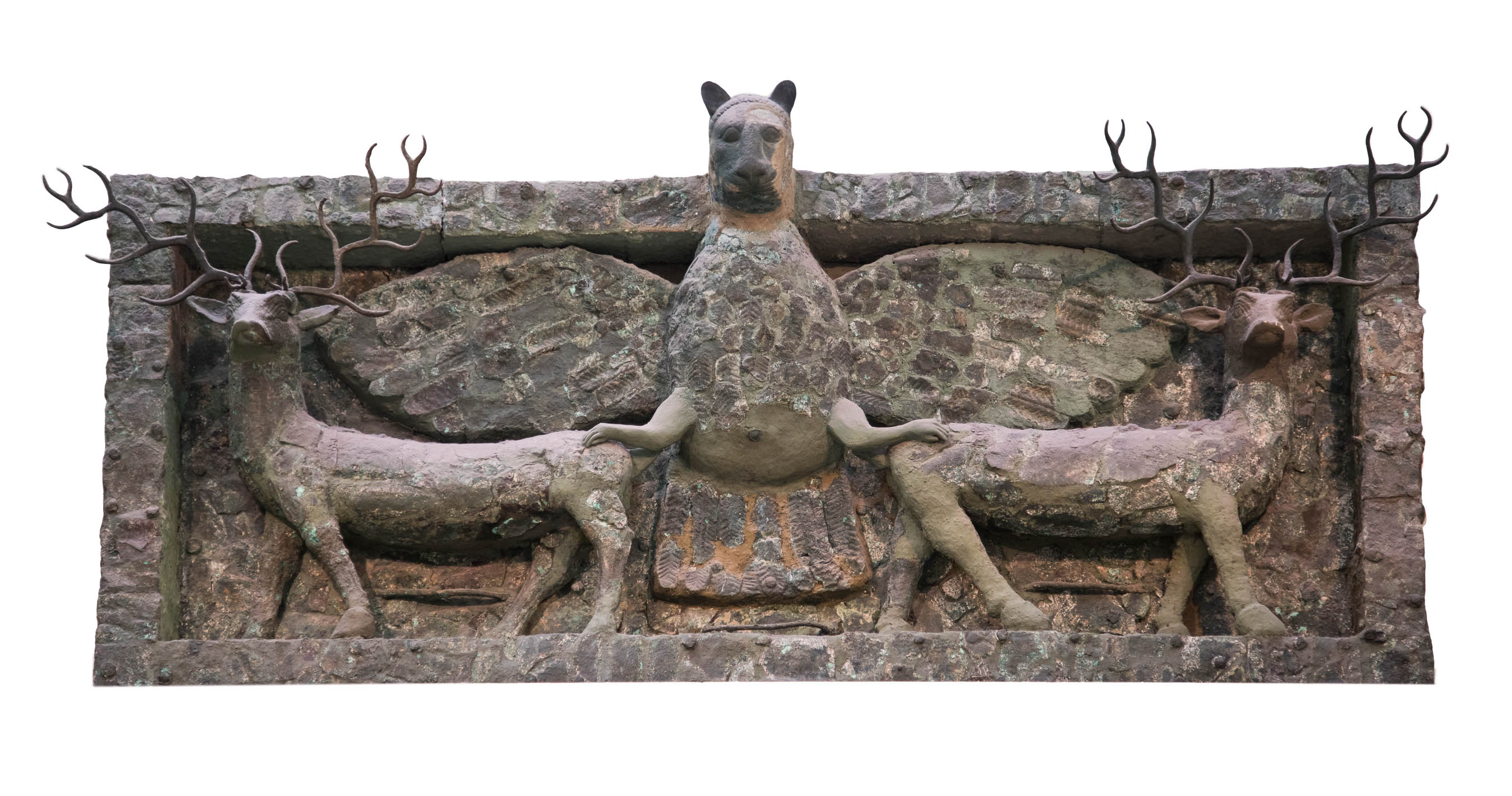
This large copper plaque once stood above the door of a temple in Eridu which dates to the Early Dynastic III period (c. 2500 BC). The design recalls to mind Gudea’s description of the “Anzud bird”:
“his wings were like those of the Anzud bird, his lower body was like a flood storm. Lions were lying at his right and his left.” (Lines 124-131)
The Interpretation
Nanshe offered the following interpretation for the dream recounted by Gudea:
His mother Nanshe answered the ruler: ‘My shepherd, I will explain your dream for you in every detail. The person who, as you said, was as enormous as the heavens, who was as enormous as the earth, whose head was like that of a god, whose wings, as you said, were like those of the Anzud bird, and whose lower body was, as you said, like a flood storm, at whose right and left lions were lying, was in fact my brother Ningirsu. He spoke to you about the building of his shrine, the E-ninnu.4Lines 124-131 in Black 2006, 48
The woman that Gudea saw carrying the silver stylus and the warrior he saw carrying a lapis lazuli tablet were the gods Nisaba and Nindub. They would reveal to Gudea the proper time and the perfect plan for constructing the temple. Nanshe advised Gudea to go and build a beautiful chariot for Ningirsu so that the god would bless his endeavors.
Let me advise you and may my advice be taken. Direct your steps to Girsu, the foremost house of the land of Lagash, open your storehouse up and take out wood from it; build (?) a chariot for your master…5Lines 152-154 in Black 2006, 48

A statue of Gudea inscribed with the plan for a building—probably the temple of Ningirsu.
Propitious Stars
Having built a chariot for Ningirsu as Nanshe instructed, Gudea began to make preparations for the construction of his temple. However he remained unsure as to when the building should commence. Under which stars should the temple be constructed? This time Gudea directed his prayer directly to Ningirsu.
My master Ningirsu, lord who has turned back the fierce waters, true lord, semen ejaculated by the Great Mountain, noble young hero who has no opponent! Ningirsu, I am going to build your house for you, but I lack an ominous sign. Warrior, you asked for perfection, but, son of Enlil, lord Ningirsu, you did not let me know your will as to how to achieve it.6Black 2004, 51
For a second time Ningirsu appeared to Gudea in a dream and showed him the “pure stars of heaven” under which Gudea was to build the house. Ningirsu promised that when Gudea drove the foundation pegs for the temple, then the god would travel to the north and “make the man with the giant wings, the north wind, bring you wind from the mountains.”7Lines 294-305, Black 2994, 51 Elsewhere, the moist north wind is likened to Anzu roaring on the horizons. Thus we see Ningirsu in his primary role as a storm deity. The primary function of his temple was to ensure the fertility of the land.
I will call up to heaven for humid winds so that plenty comes down to you from heaven and the land will thrive under your reign in abundance… Laying the foundations of my temple will bring immediate abundance: the great fields will grow rich for you, the levees and ditches will be full to the brim for you, the water will rise for you to heights never reached by the water before. Under you more oil than ever will be weighed in Sumer.8Lines 277-293 in Black 2004, 51
Black, J. A.
The literature of ancient Sumer.
Oxford, New York: Oxford University Press, 2004.
De Sarzec, Ernest, Leon Heuzey.
Discoveries in Chaldea.
Paris: Ernest Leroux, 1884-1900. Link