
is arguably finest Roman mosaic ever produced. It was found in one of the rooms adjacent to the banqueting hall (exedra) of a sprawling villa in Pompeii.
Pompeii was a desirable rural retreat for wealthy Romans seeking to escape the city. At a distance of 160 miles from Rome, it was close enough to Rome for a courier to carry an urgent message in a single day, but far enough away to discourage pestering clients from making what amounted to a three days journey. Excavations at Pompeii have revealed a number of grand villas with impressive courtyards and pleasant gardens. The grandest of them all was the so-called House of the Faun, named after a bronze statue of a faun found in its courtyard.
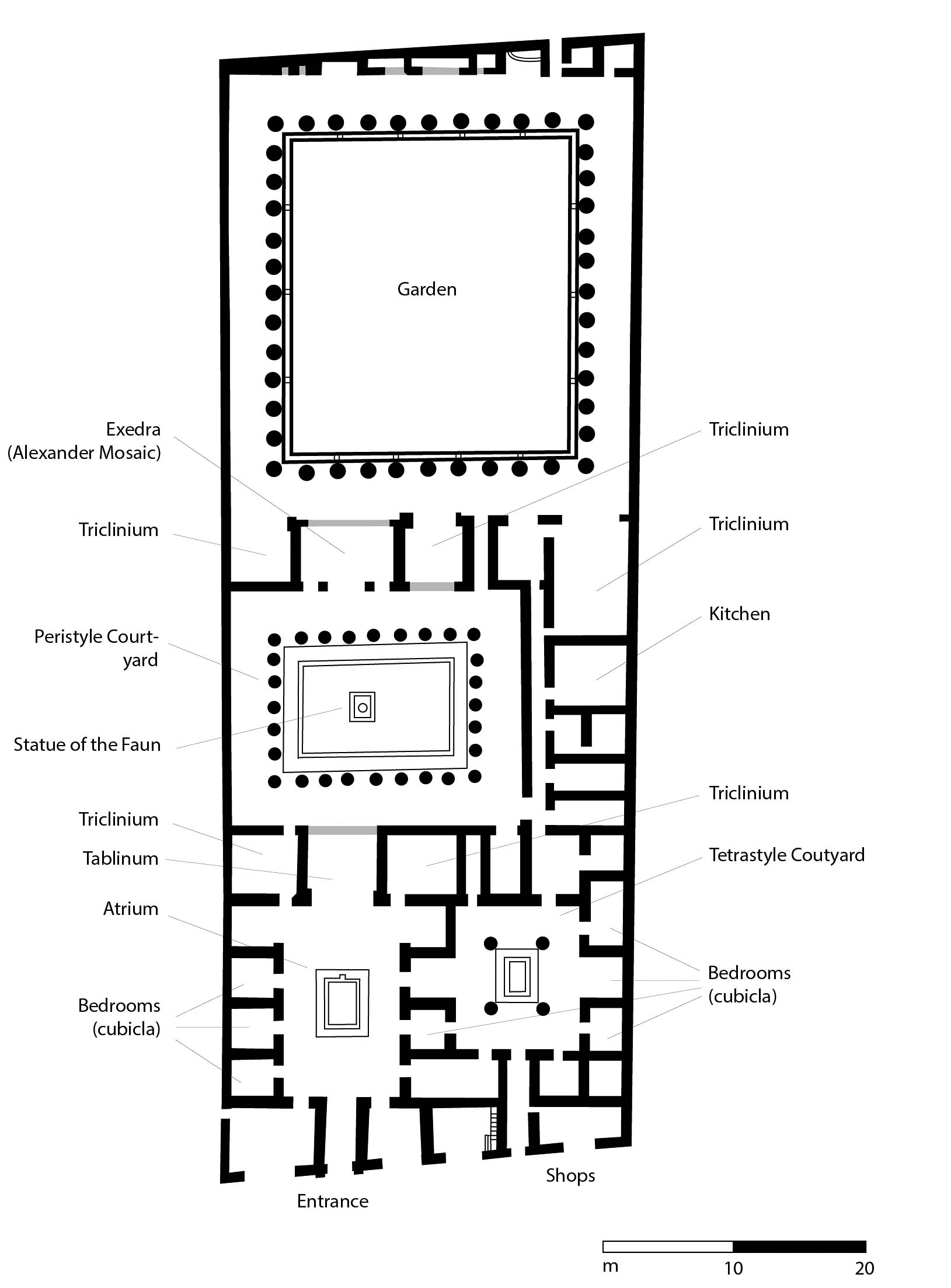
was built around a series open air courtyards. The smallest courtyard, or atrium, was located nearest the street. These were reserved for receiving guests while the inner courtyard, with its water fountain, shady colonnades and garden, was reserved for private parties.
The Patronage System
Roman society was built around patronage. Patrons offered money and protection to their clients. In exchange clients were obligated to perform certain duties and services. The courtyard or atrium of a house was where clients called on their patrons during the early morning salutatio. During these meetings a client would seek cash or some other favour in return for their vote or some other service. “You promise me three denarii”, moans Martial, “and tell me to be on duty in your atria, dressed up in my toga. Then I’m supposed to stick by your side, walk in front of your chair, while you go visiting ten widows, plus or minus…’ 1Beard 2008, 103
Public displays of charity like the one described by Martial were deemed necessary in a city where ones auctoritas (Lat. ‘authority’) was measured by the number of clients one had. Juvenal warned his fellow Romans that if they hired a lawyer who walked to court with less than eight people in his retinue then they should be prepared to lose their case!

A bronze statue of a faun once stood in a shallow fountain in the main courtyard of the villa.
The relationship between client and patron evolved during the Imperial period as wealth became concentrated into fewer and fewer hands. Whereas in former times a client preserved his honor, during the Imperial period clients were often treated as something less than slaves.
In his 3rd Satire, the poet Juvenal (early 2nd century AD) provides some insight into the patronage system of his day, lamenting that “respectable skills” no longer earn a man a decent income anymore.
There is no room in the city for respectable skills and no reward for ones efforts. Today my means are less than yesterday; come tomorrow, the little left will be further reduced.
The only people capable of getting ahead are those willing to let go of their honor and do the bidding of the wealthy elite.
…let those remain [in Rome] who are able to turn black into white, happily winning contracts for temple, river, harbor, for draining flooded land, and carrying corpses to the pyre-men who auction themselves beneath the owner’s spear… they are the sort that Lady Luck will take from the gutter and raise to the summit of worldly success, whenever she feels like having a joke.
Wanting no part of the corrupt administration, Juvenal discovers that there are no other opportunities open to an ambitious young man.
…none will get help from me in a theft; that’s why I never appear on a governor’s staff; you’d think I was crippled—a useless trunk with a paralyzed hand.
Juvenal despised the patronage system. Wealthy patrons were venal and self-absorbed while the poor were powerless to oppose them. “There’s many a thing a man won’t dare to say, while he’s wearing a coat that’s full of holes,” Juvenal laments, adding, “All we ask is that you treat us courteously.”2Satire V
Beard, Mary.
Pompeii: the life of a Roman town.
London: Profile Books, 2008. Link
Carcopino, J. R. M.
Daily life in ancient Rome: the people and the city at the height of the empire.
: Yale University Press, 2003.