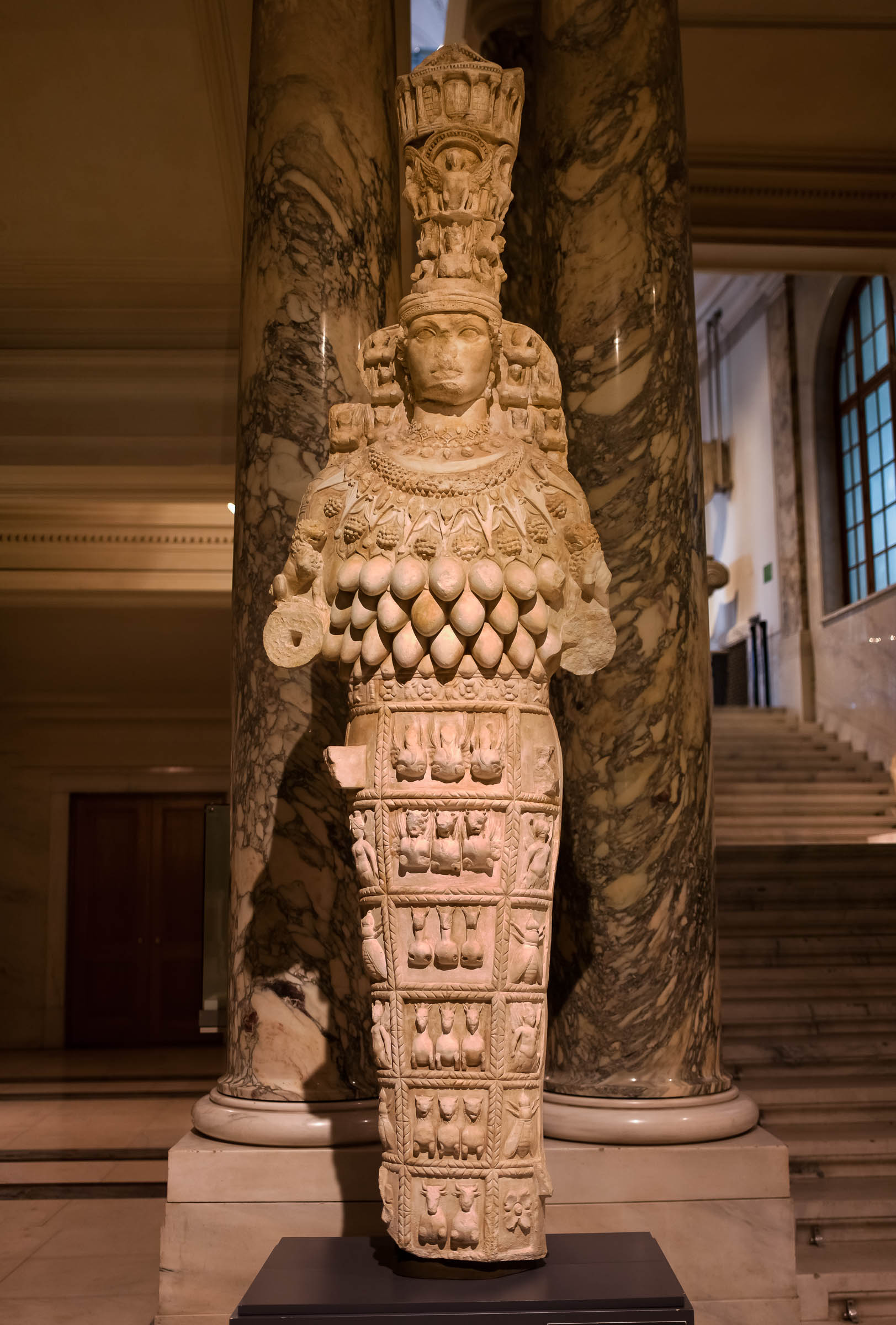
Although the temple of Artemis (Latin. “Dianna”) has long since disappeared, many copies of its cult statue remain. These do not look anything like the Roman Dianna, the virgin huntress, with which we are familiar from classical Greek and Roman sculpture. The cult statues of Artemis belong to a much older tradition which the Greek geographer Pausanias observed “is far more ancient still than the coming of the Ionians.” The body of the goddess is formed like a pillar with two lions perched on either arm, a type which may be traced back to Mycenae where the pillar of Hera is likewise flanked by lions.
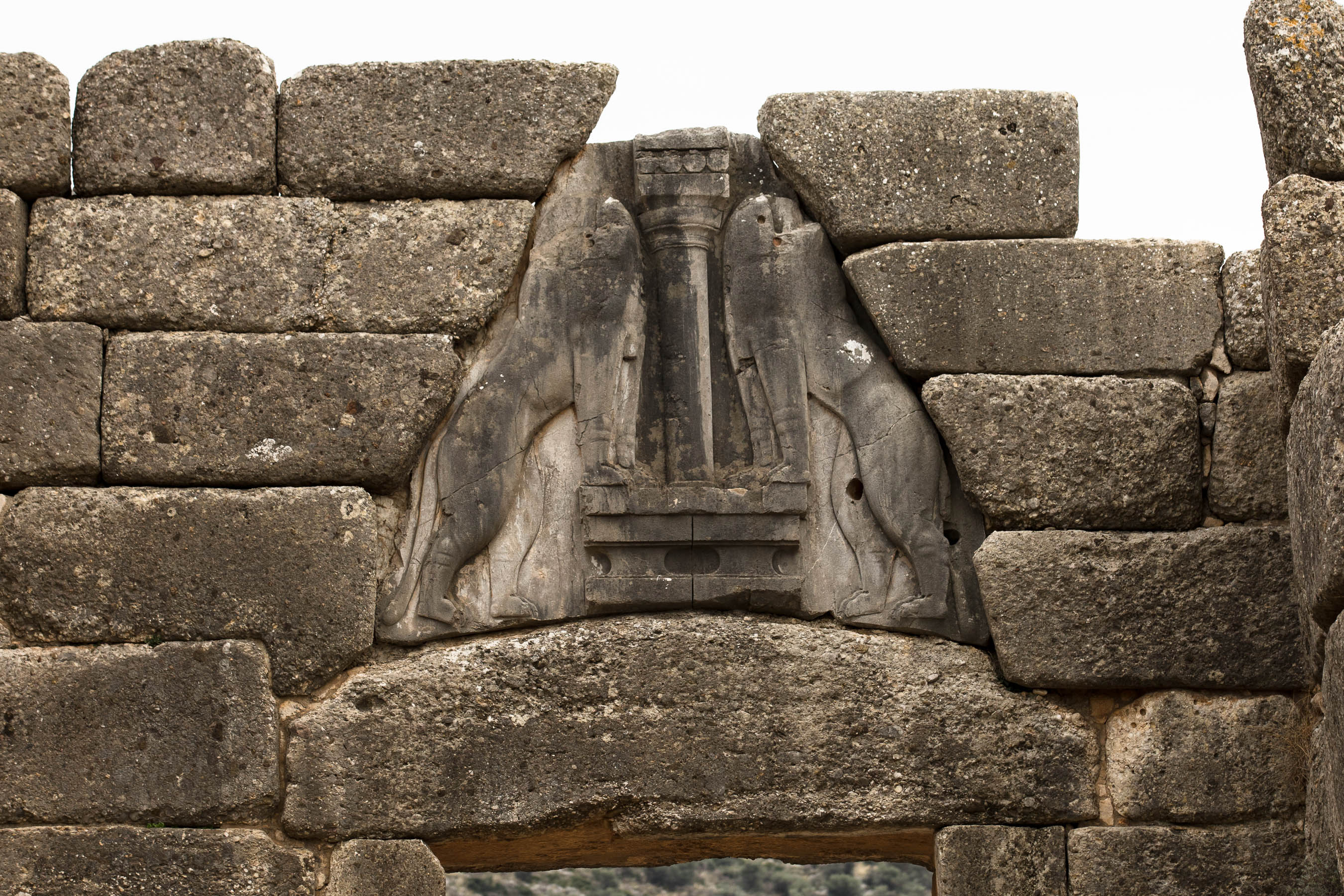
flanked by two lions. The pillar was the aniconic representation of Hera.
The dress of the goddess is emblazoned with sphinxes, wild animals, bulls, flowers, and honey bees; and she is shown with many “breasts” (there is no agreement as to the correct identification of these objects). The symbols of the goddess belong to her role of fertility goddess and reflect also her close relationship with wild animals. She is sometimes also shown with the symbols of the zodiac around her neck.
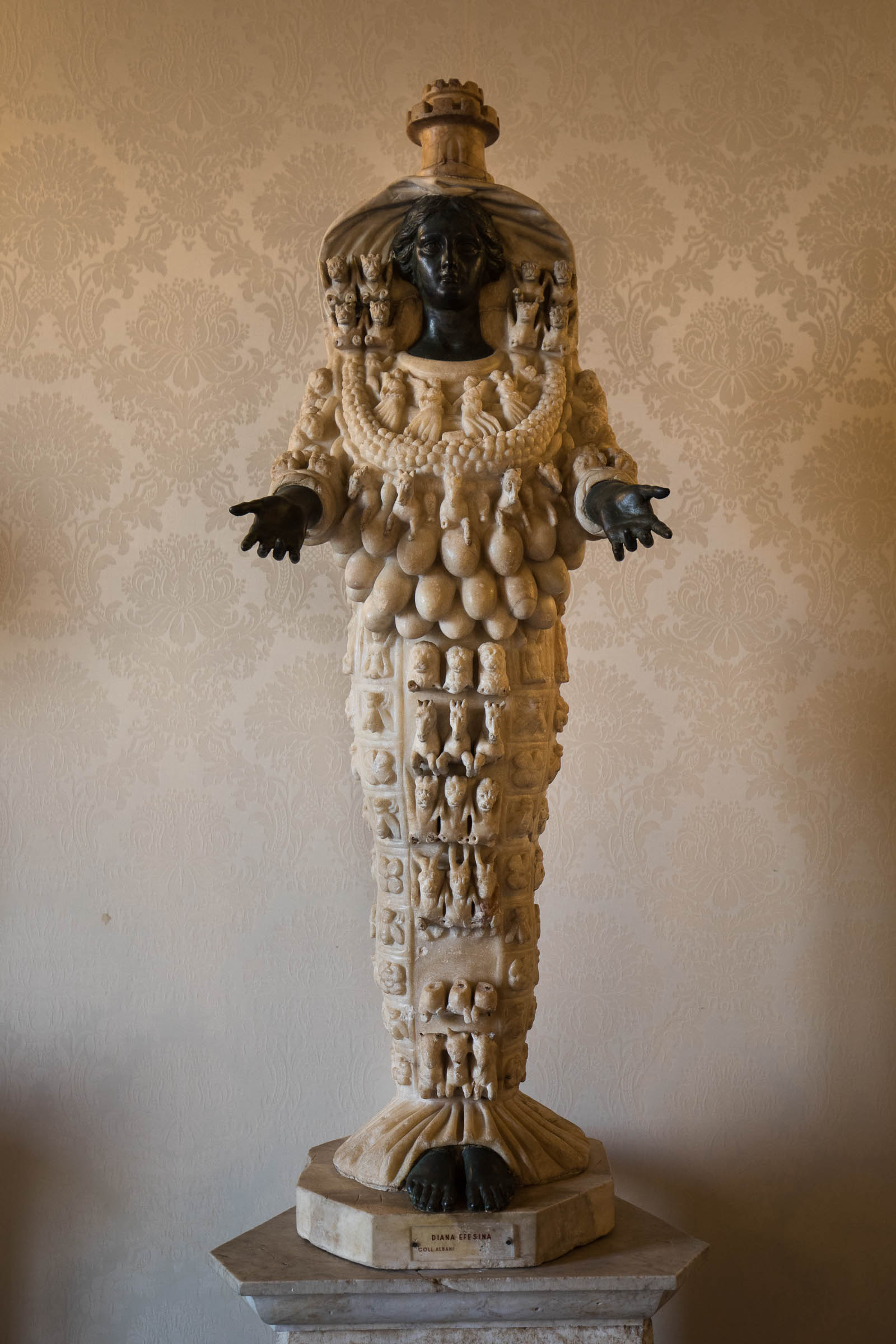
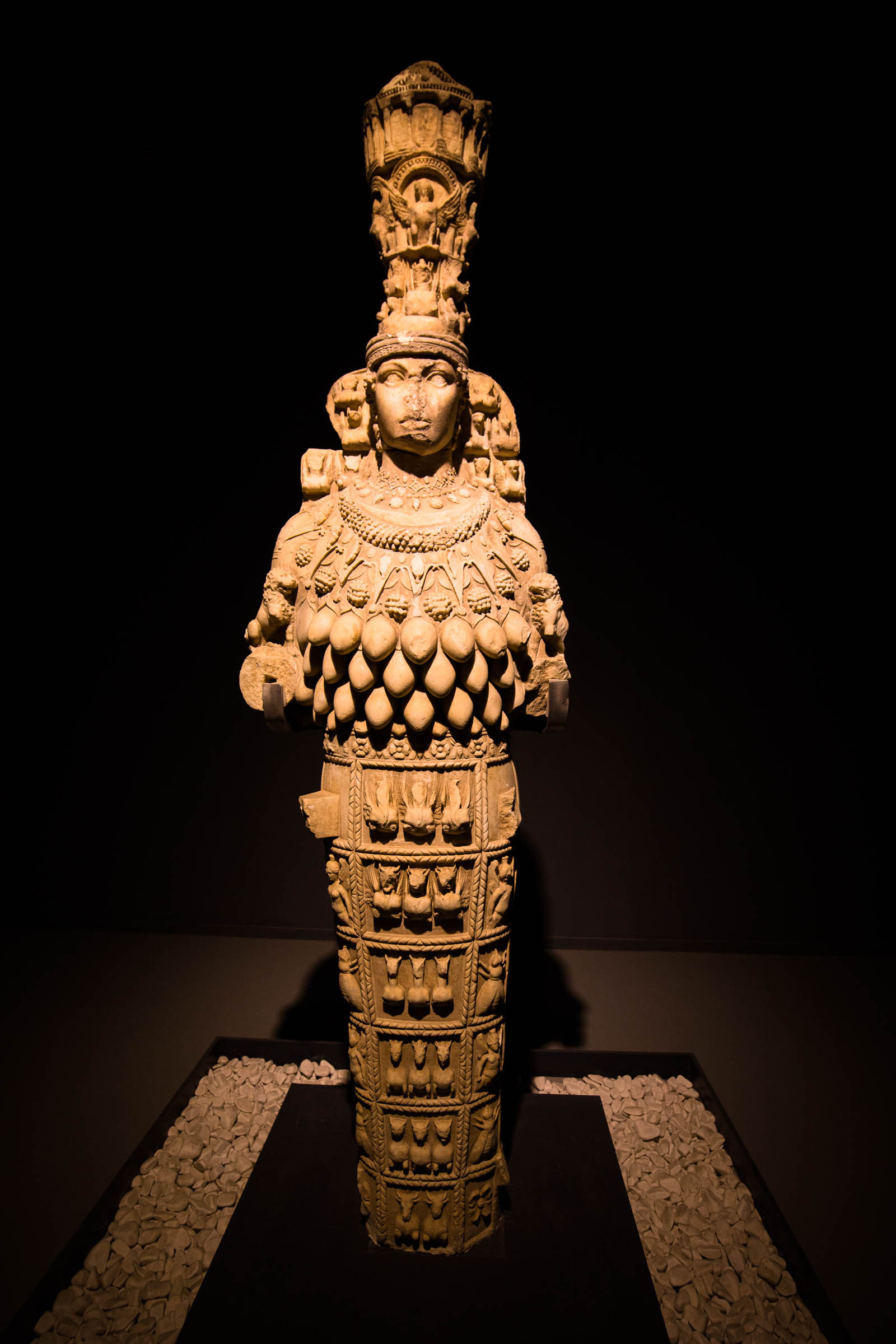
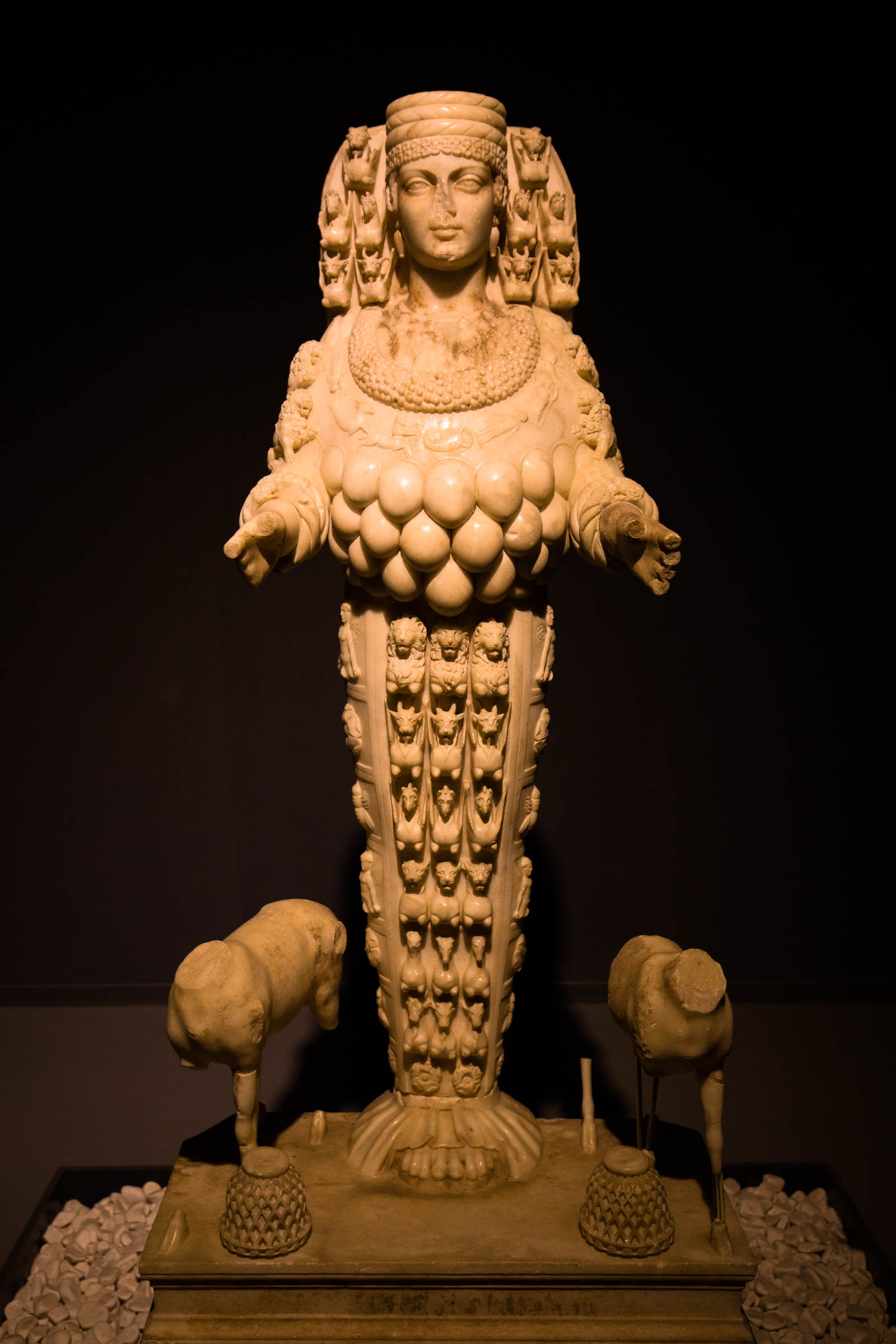
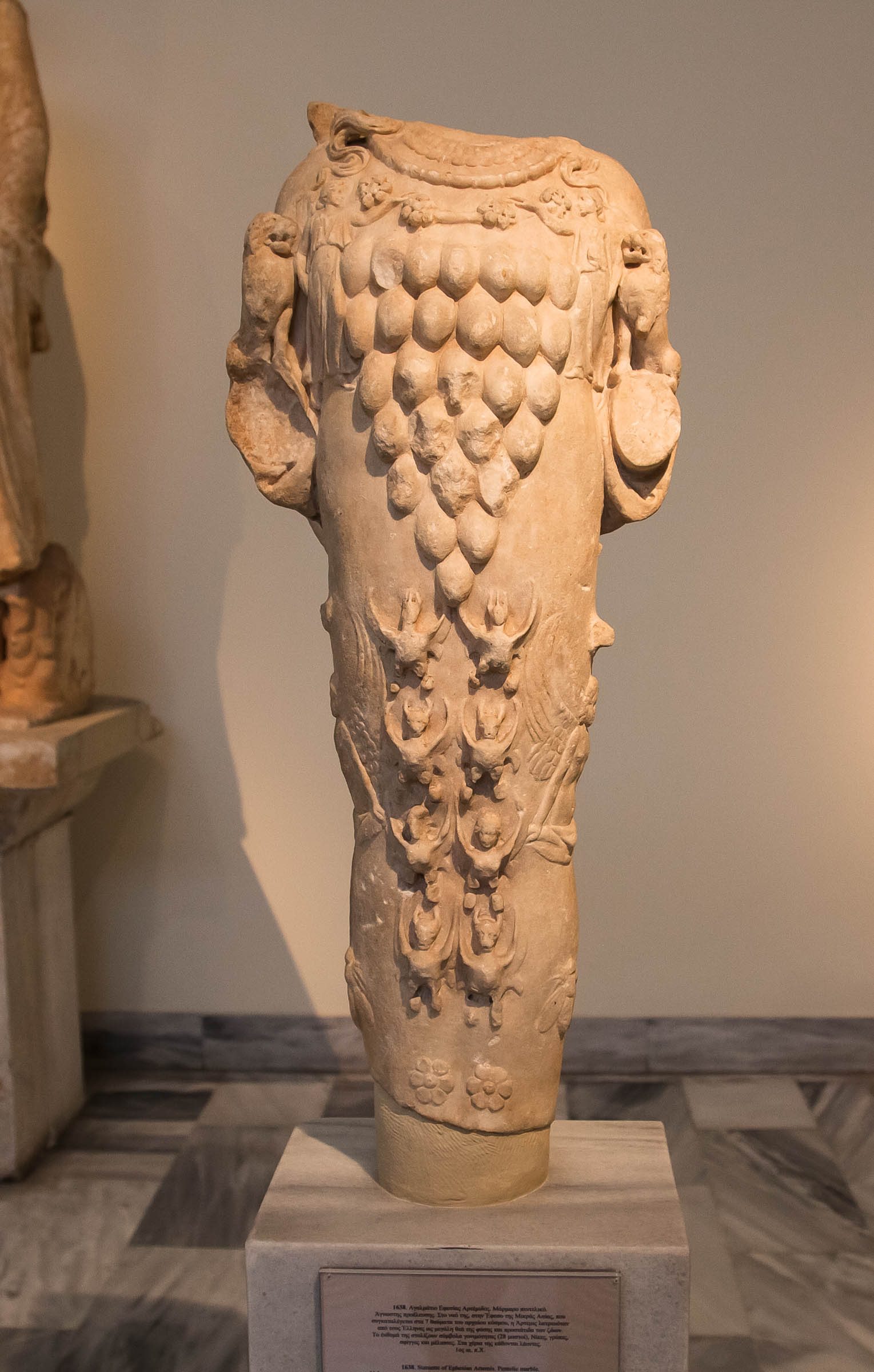
from across the Roman world.
The Birth of Artemis
According to Greek mythology, Hera became jealous when the beautiful Leto caught the eye of Zeus. Pursued from place to place, Leto finally managed to evade the jealous goddess by hiding in the grove of Ortygia near Ephesus. There she gave birth to the twins, Artemis and Apollo. Attending the birth were “the Kouretes,” armed men who banged their weapons against their shields in order to frighten Hera away.
The Greek geographer Strabo (63 BC – 24 AD) mentions having visited the grove at Ortygia during his travels. He says it was renown for its beautiful cypress trees and many shrines. These housed statues, some of them very old, whereas others were of more recent work. An annual festival was held in this grove during which the “college of Kouretes” offered certain “mystic sacrifices” and put on elaborate symposia (Greek. “drinking together”). Little else is known about the rituals associated with the worship of Artemis at Ephesus. Elsewhere, Strabo relates that the priests of Artemis were eunuchs known as Megabyzi—a term that seems to be of Persian origin (Geography 14.1.22-23). Based on the evidence from inscriptions found at Ephesus, we know that flutists, choral singers, and dancers participated in the festivals of the goddess. Little more can be said about the rituals and initiation rites of the goddess since they were a closely held secret.
Artemis of the Ephesians!
Artemis took on many guises in ancient Ephesus. She was “master of the beasts,” “queen of heaven,” “bestower of fertility,” and “bringer of good fortune.” But of all these titles, the most important was “Artemis of Ephesus,” the protectoress of her city. For this reason she is often shown with the walls of the city on her head. To secure her goodwill, wealthy citizens commissioned statues of the goddess for placement in her temples and shrines. According to an inscription engraved in a wall of the theater at Ephesus, a certain Caius Vibius Salutaris donated thirty-one solid silver statues to the cult of the goddess. The inscription further mandated that the statues should be carried in procession on festival days and placed in the theater at the commencement of public meetings.
Pausanius records that six words were faintly inscribed on the feet, girdle, and crown of the statue of the goddess. These are the famous “Ephesian Letters” that began to appear in magic papyri and amulets, beginning in the 3rd century BC and continuing until the 4th century AD.

No one seems know what these Greek words meant, not even the Ephesians themselves. They were spoken like a mantra. “Those who intoned them,” said Pausanius, “conquered in everything” (Pausanius, 131-132). Thus when an Ephesian boxer repeatedly defeated his Milesian opponent at the Olympian Games, he was discovered to be wearing a bracelet on his leg inscribed with the Ephesian Letters. Once the bracelet was removed, his opponent won the next three rounds. So too, those possessed by an evil spirit were counselled by the Ephesian magi to repeat the Ephesian Letters to themselves in order to cast it out (Plutarch, Moralia, 706E). These stories reveal something about the magic rituals associated with the worship of the goddess.
The Apostle Paul
The book of Acts recounts how the Apostle Paul came to Ephesus in the first century AD with a message that would ultimately collide with the cult of Artemis. The Ephesians, upon hearing Paul speak, carried their books of magic into the street and burned them. The manuscripts were valued at 50,000 silver pieces. A certain Demetrius “who made silver shrines for Artemis” warned his fellow craftsmen that their stock and trade was about to go up in smoke, together with those manuscripts, if something wasn’t done to stop it. The great goddess “whom all Asia and the world worship” was falling into disrepute. (Acts 19:24 ff.) When the people heard these words, they filled the theater in Ephesus and began to chant “Great is Artemis of Ephesus!” Paul was determined to go in and speak to the crowd as he had done once before at Jerusalem but was dissuaded by his friends. The town clerk was finally able to restore order by reminding the the people that Ephesus was a Roman city and that if they wished to bring a charge against Paul or his associates then they should take it up in court. Paul and Barnabus left the city for the time being but Paul would later address a letter to the church in Ephesus, which is now included among the letters of Paul preserved in the New Testament.

mentioned in the book of Acts. The theater we see today is an enlarged version of the one that existed there in Paul’s day.
McCown, C. C. “The Ephesia Grammata in Popular Belief.” Transactions and Proceedings of the American Philological Association 54 (1923): 128-140. Link
Murphy-O’Connor, J.
St. Paul’s Ephesus : Texts and Archaeology.
Collegeville, Minn.: Liturgical Press, 2008.
Rogers, G.M.
The Mysteries of Artemis of Ephesos : Cult, Polis, and Change in the Graeco-Roman World.
New Haven: Yale University Press, 2012. Link
White, A. W.
Performing Orthodox ritual in Byzantium.
Cambridge: Cambridge University Press, 2015.