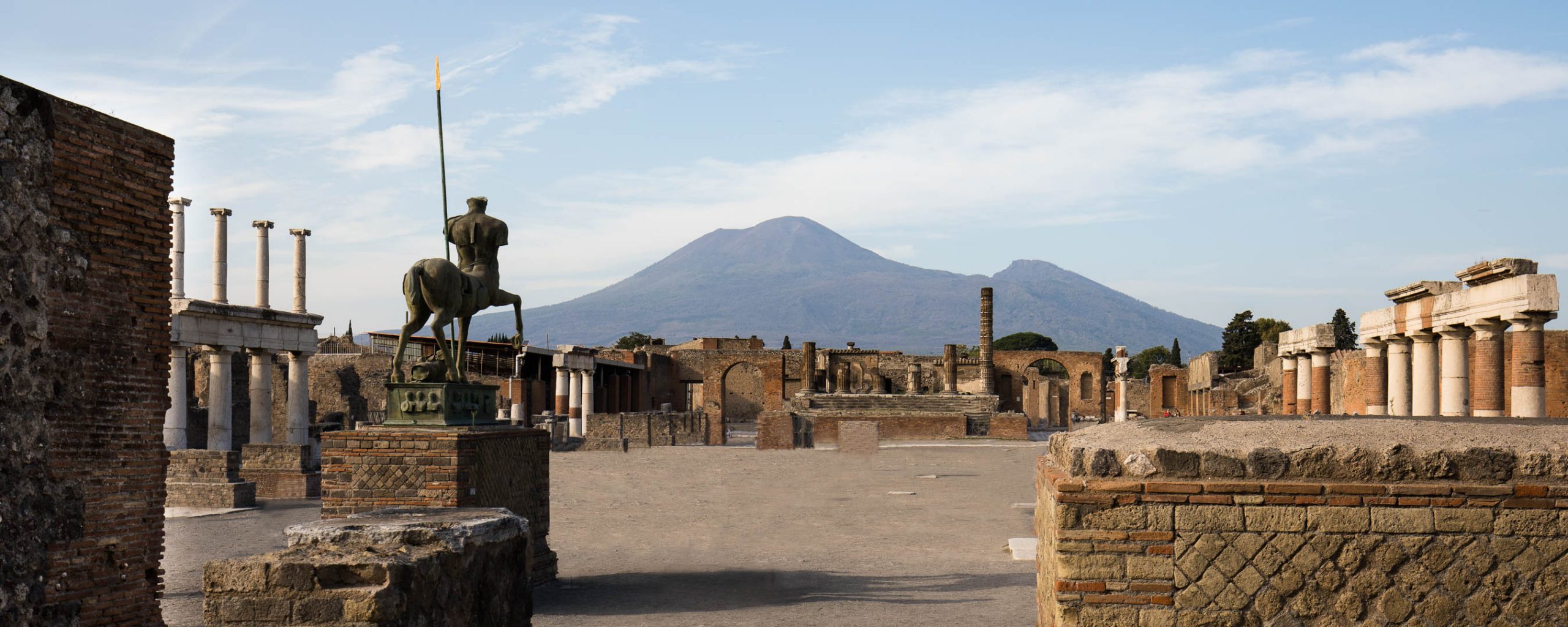
with Mount Vesuvius in the background.
Pompeii was situated in Campania, a region famous for its rich, volcanic soil and fine wine. The local population spoke Oscan, an Indo-European language related to Latin. A colony of Ionian Greeks were established nearby at Napoli (modern Naples) from as early as the 8th century BC. In the 4th century BC the region came under the control of the Samnites, a tribe from the mountainous region of central Italy, followed by the Romans, who defeated the Samnites in series of battles fought over the course of the 4th and 3rd centuries BC. From then on the native Oscans of Campania were made allies of Rome. They contributed soldiers for Roman military campaigns that extended Roman dominion throughout Europe and the Near East. Relations between the Romans and the natives of Campagnia took a turn for the worse when, in 90 BC, they joined with other Italian peoples to demand full Roman citizenship. The Roman senate refused this request, fearing that it would upend the balance of power in the capitol. This sparked the Social War (from socci which means ‘ally’) that raged across the Italian peninsula from 91-88 BC between Rome and its former allies. It was a particularly bloody war since Rome’s former allies were not a ragtag group of discontents but experienced soldiers. Although the Romans were victorious, the allies were nevertheless finally granted full Roman citizenship. This led to the rapid romanization of the Italian peninsula. Languages other than Latin quickly fell out of use, including the Oscan dialect spoken in Campania.
Pompeii had been a center of resistance during the Social War. As a reprisal, the Roman general, Lucius Cornelius Sulla, founded a Roman colony at Pompeii for the soldiers who had fought under him. As might be expected, this resulted in tension between the Oscan natives and the Roman colonists. However, it does not seem as though a permanent rift developed between the two peoples.1Beard 2008, 39-43 They shared in common a love for the theatre and games. Free from the restrictions imposed by more conservative elements in Rome, the citizens of Pompeii were the first to build a permanent stone theatre and amphitheatre in Italy. Pompeii also boasted four bath complexes, a large forum, temples to all the important deities and a few exotic ones, many luxurious villas, and a great many taverns and brothels.
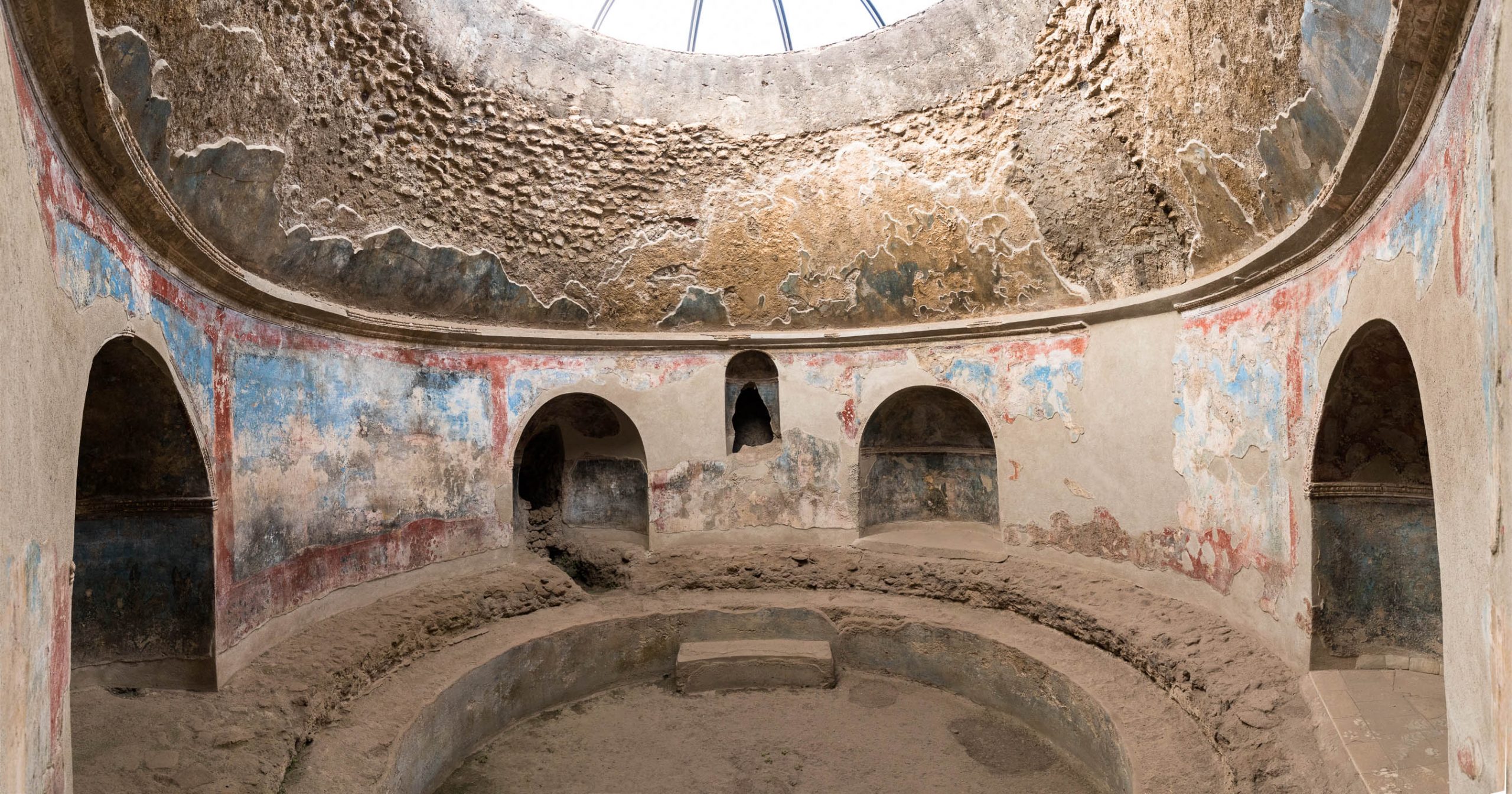
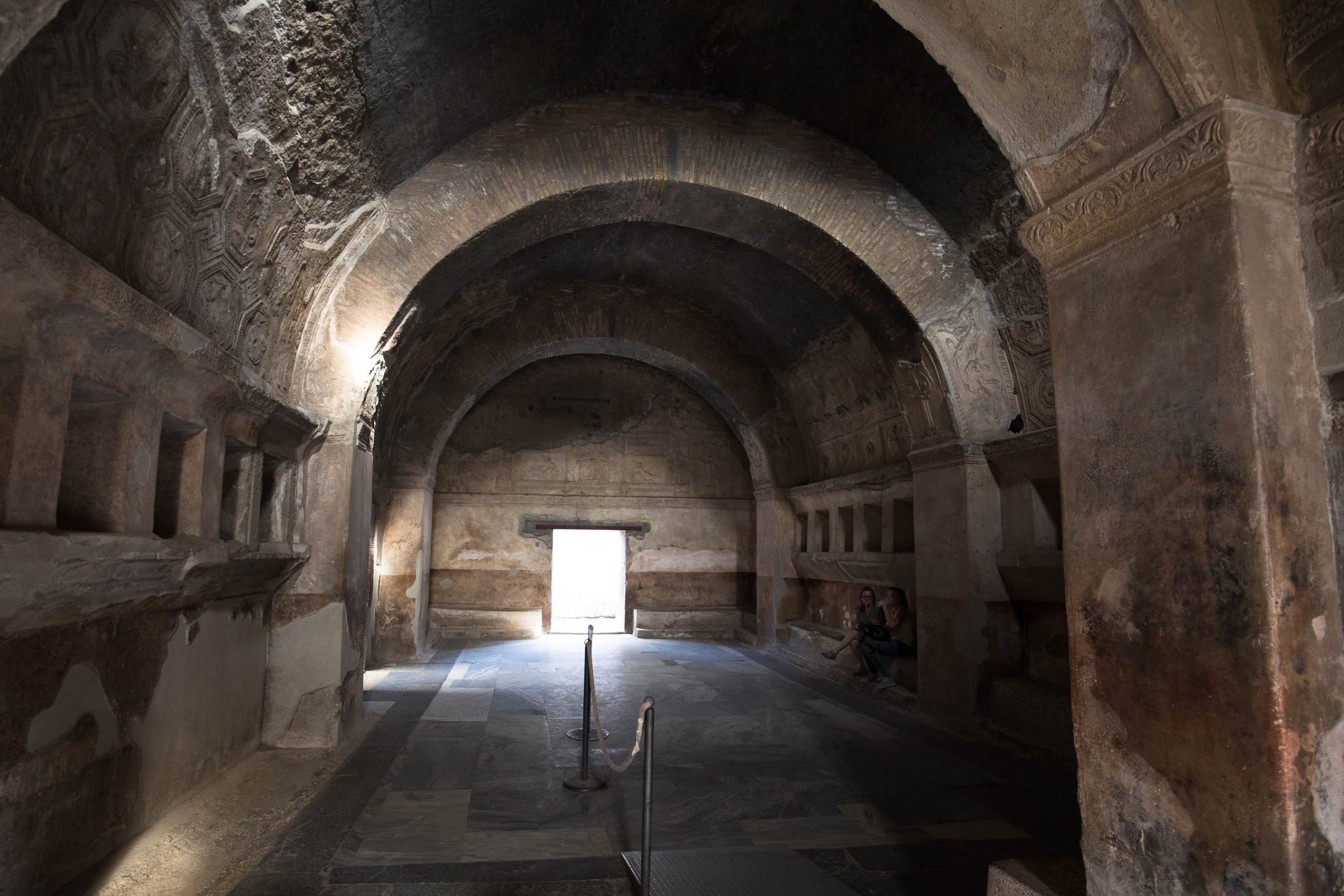
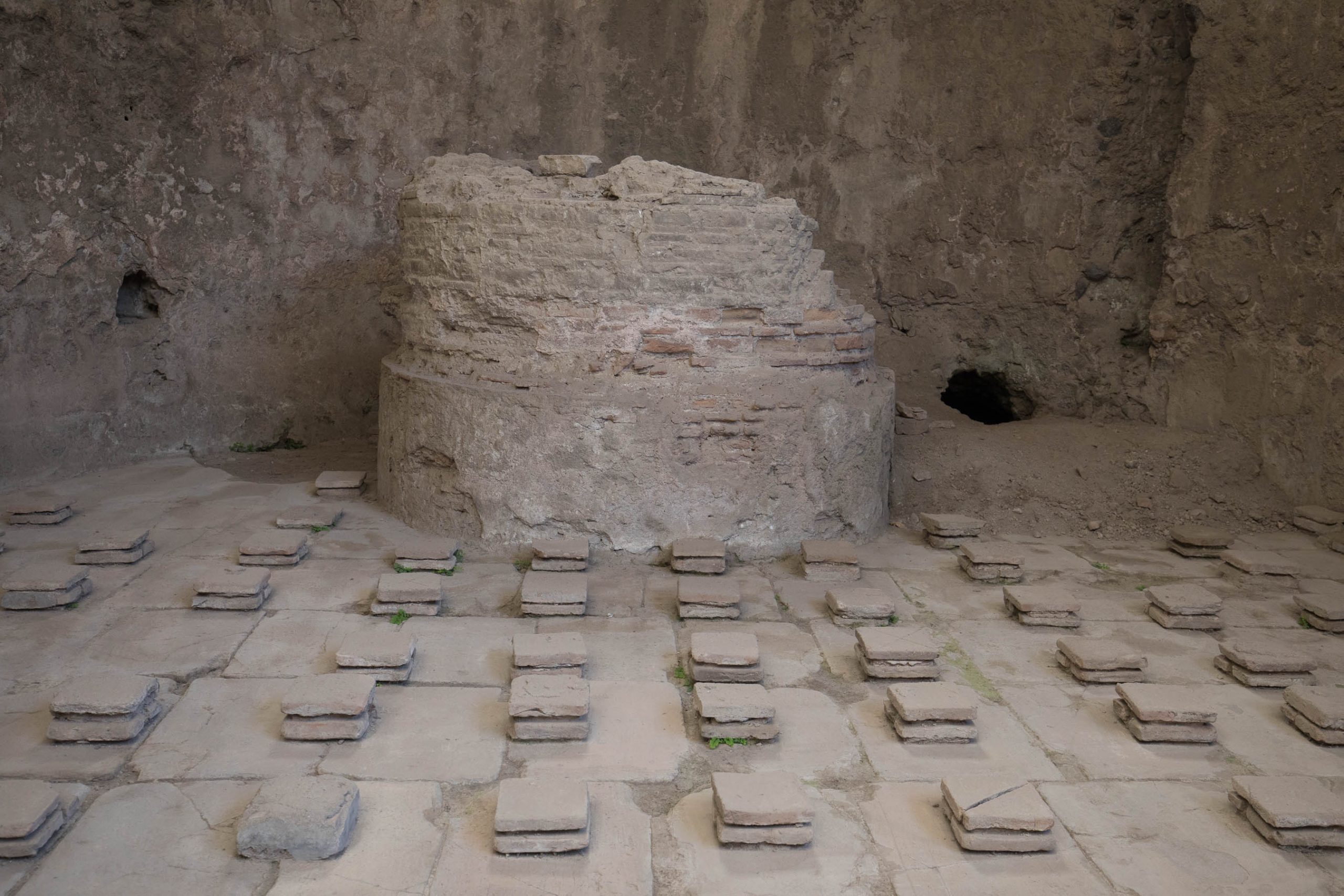

date to the 2nd century BC, one of the oldest Roman bath houses that has been excavated.

Pompeii boasted the first stone amphitheatre; constructed by the Roman colonists who settled at Pompeii.
The Forum
The Forum was the beating heart of the city. It was where business was transacted, court cases were heard, and religious ceremonies performed. It is also where citizens went to vote. Of the estimated 36,000 people living in the city and surrounding countryside (12,000 in Pompeii, 24,000 in countryside), perhaps only 7,500 were eligible to vote (2,500 in Pompeii and 5,000 in the countryside).2Beard 2008, 200 The rest were either slaves, women, or children.
The citizens of Pompeii seem to have taken an active interest in politics. Notices painted on the walls of houses announced their owners support for one candidate or another. The voting citizens of Pompeii divided themselves into various associations: the fullers, the mat-makers, the ointment-sellers, the fishermen, the Isis-worshipers, the millers, the chicken-keepers, etc. These associations voted as a bloc. “The millers support so and so for aedile,” reads one notice painted on a wall. As Mary Beard observes, politics in Pompeii was not about winning an argument or persuading someone to your point of view, rather it was about family connections, personal loyalty, and friendship.3Beard 2008, 190
There were two major offices open for election each year: aedile and duumvir. The position of aedile was a junior position concerned primarily with the maintenance of the cities buildings and roads. Many aediles could be elected each year but only two men were elected to the position of duumvir. These two officials, known as the duoviri, which is Latin for “two men,” acted as magistrates.
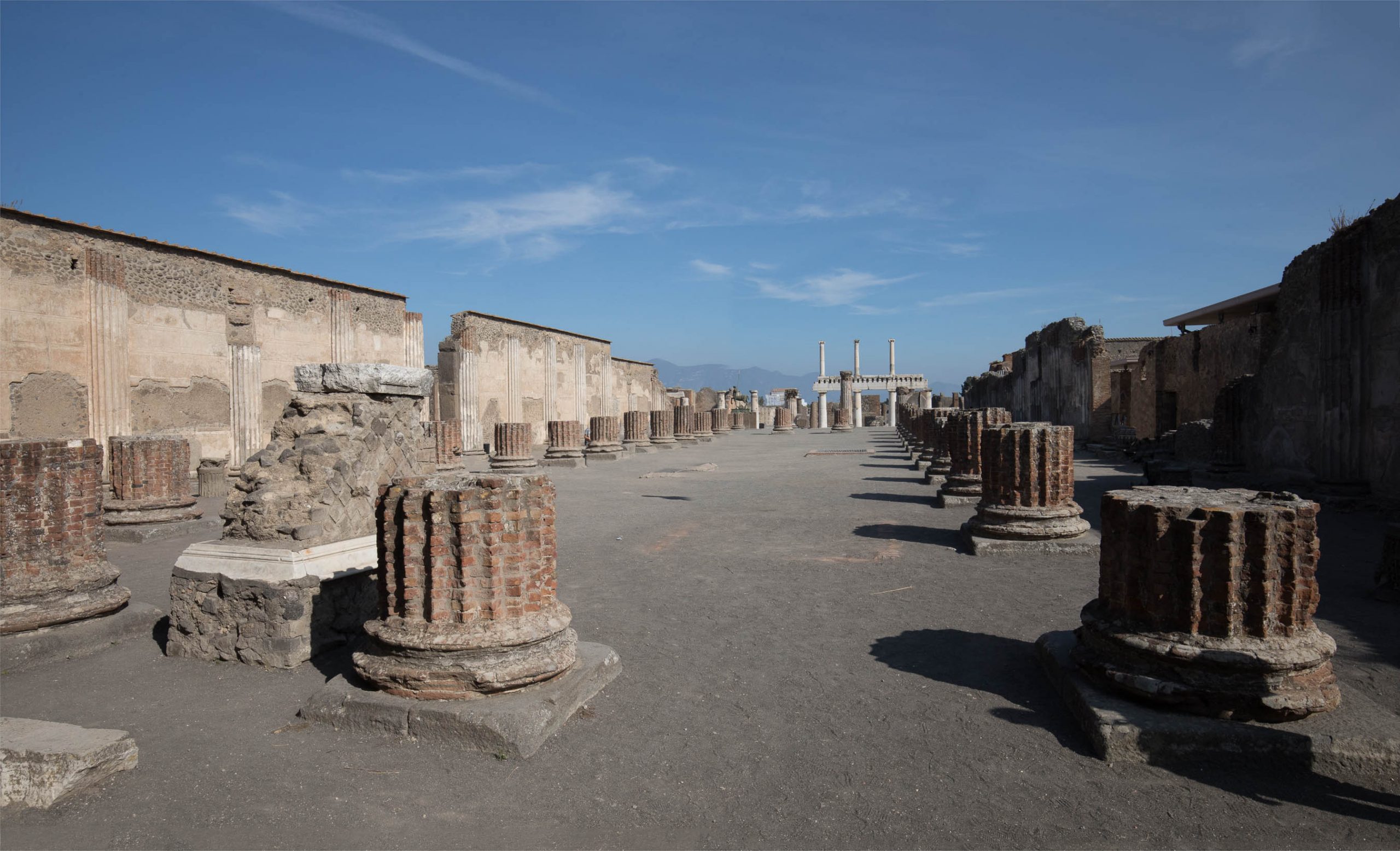
This assembly hall was divided by colonnades into a main hall and two side isles. It is one of the earliest examples of a basilica, a form of building that would later be adopted by Christians for their churches.
Anyone running for office of duumvir in Pompeii needed to have a minimum of 100,000 sesterces. This was a lot of money, although hardly comparable to the 1,000,000 sesterces needed to run for the Senate in Rome! Candidates running for office had to prove that they had sufficient funds for no less than four full days of ‘spectacles’. The tomb of Aulos Clodius Flaccus boasts that upon his election to duumvir he provided entertainment that included a parade, bullfights, boxing matches, musical shows, and, to cap off the event, a star performance by Pylades. Such shows could be quite costly. One notice painted onto a Pompeiian wall advertises that Cnaeus Alleius Nigidus Maius paid 10,000 sesterces of his own money for gladiatorial combat. Of course, political office also had its perks. According to one Roman law tablet found in a Spanish city, a duumvir was entitled to two lictors, one servant, two scribes, two messengers, a clerk, a crier, a haruspex, and a flute-player. The law further specified that each lictor was to be paid 600 sesterces, each scribe1200 sesterces, each servant 700 sesterces, etc. No mention is made of how much the flute player was paid.
Beard, Mary.
Pompeii: the life of a Roman town.
London: Profile Books, 2008. Link