
The first several centuries of the second millennium (1950-1750 BC) was a remarkably stable period in the history of Anatolia during which trade flourished. Anatolia was at that time ruled by petty kings and chieftains who welcomed trade with Assyrian merchants. The Assyrian merchants, in turn, did not intrude on the prerogatives of the local ruler. Whatever disputes arose were settled through established diplomatic channels and local courts. The period is marked by the establishment of numerous Assyrian trading colonies known as “karums.” The period is therefore known as the Assyrian Colony Period.
Initially, trade in Anatolia was conducted between private individuals rather than heads of state. However, as trade increased, so did the amounts of money involved. Local rulers began to vie with each other for control of trade routes resulting in sporadic warfare and disruption of trade. Thus the merchant, Idi-Istar, wrote to his colleague, Assur-nada, informing him that he would not be sending a shipment of copper.
I have not gone to Wahsusana for there is revolt in the land of Burushattum and Wahsusana.1Bryce 1998, 34
What seems to have begun as a skirmish escalated into pitched battle that ultimately led to the destruction of the largest of the Assyrian trading colonies, Karum Kanesh (karum = trading colony). Known to the Assyrians as Kanesa or Nesa, the city was attacked by a coalition of kings from the north.2According to the Anitta Inscription (see below), the city was attacked by Uhna, the ruler of the northern kingdom of Zalpa, and perhaps also by the king of Hatti. Bryce 1998, 34 A record of this attack is preserved in the Anitta Inscription of which we will have more to say shortly. Archaeologists digging at Kanesh found evidence of this destruction which they date to sometime around the middle of the 19th century BC (c. 1850 BC). Kanesh would be rebuilt and trade would continue to flourish until the middle of the 18th century (c. 1750 BC) when trade was permanently disrupted by an emerging threat in the region—the Hittites.

Kanesh was destroyed c. 1850 BC, probably by a coalition of northern kings led by Uhna, king of Zalpa. The palace of Warsama pictured above belongs to the next phase of occupation.
The Hittites
Although the origins of the Hittites will probably never be fully known, one theory has them migrating into Anatolia sometime towards the end of the 3rd millennium BC (c. 2200 BC). The Hittites were, according to this theory, just one of a number of other groups of Indo-European speaking peoples who migrated from the central Asian steppes to regions as far afield as India and Europe, and Anatolia. Today, the Indo-European language group remains the largest and most widely distributed language family, encompassing the Slavic, Greek, Germanic, Romance, Indian, and Iranian language groups.

Hittite belongs the large family of Indo-European languages.
The earliest instance of the Hittite language in Anatolia is preserved in the Cappadocian Tablets discovered at Kanesh which, although they are written in Akkadian, nevertheless preserve some old Hittite words. The oldest complete Hittite inscription dates probably hundred years later. Known as the Anitta Text, it is a copy of a text which was probably composed towards the end of the Assyrian Colony Period and thus contemporary with the Cappadocian Tablets.
The Anitta Inscription
According to the Anitta Text, Kanesh (referred to as Nesa in the inscription) was conquered by a Hittite king named Pithana who resided in Kussara, a city which was probably located somewhere east of Kanesh.
The king of Kussara came down from the town in great force and took Nesa in the night by storm. He seized the king of Nesa, but inflicted no harm on the inhabitants of Nesa. Instead, he made them his mothers and fathers.3Bryce 1998, 37
Pithana’s son, Anitta, continued the wars of conquest until all of central Anatolia was under Hittite control. Anitta built a palace in Kanesh, which has since been excavated. One of the most exciting discoveries from this palace was a bronze dagger inscribed with the name of Anitta.
the Palace of Anitta, the King
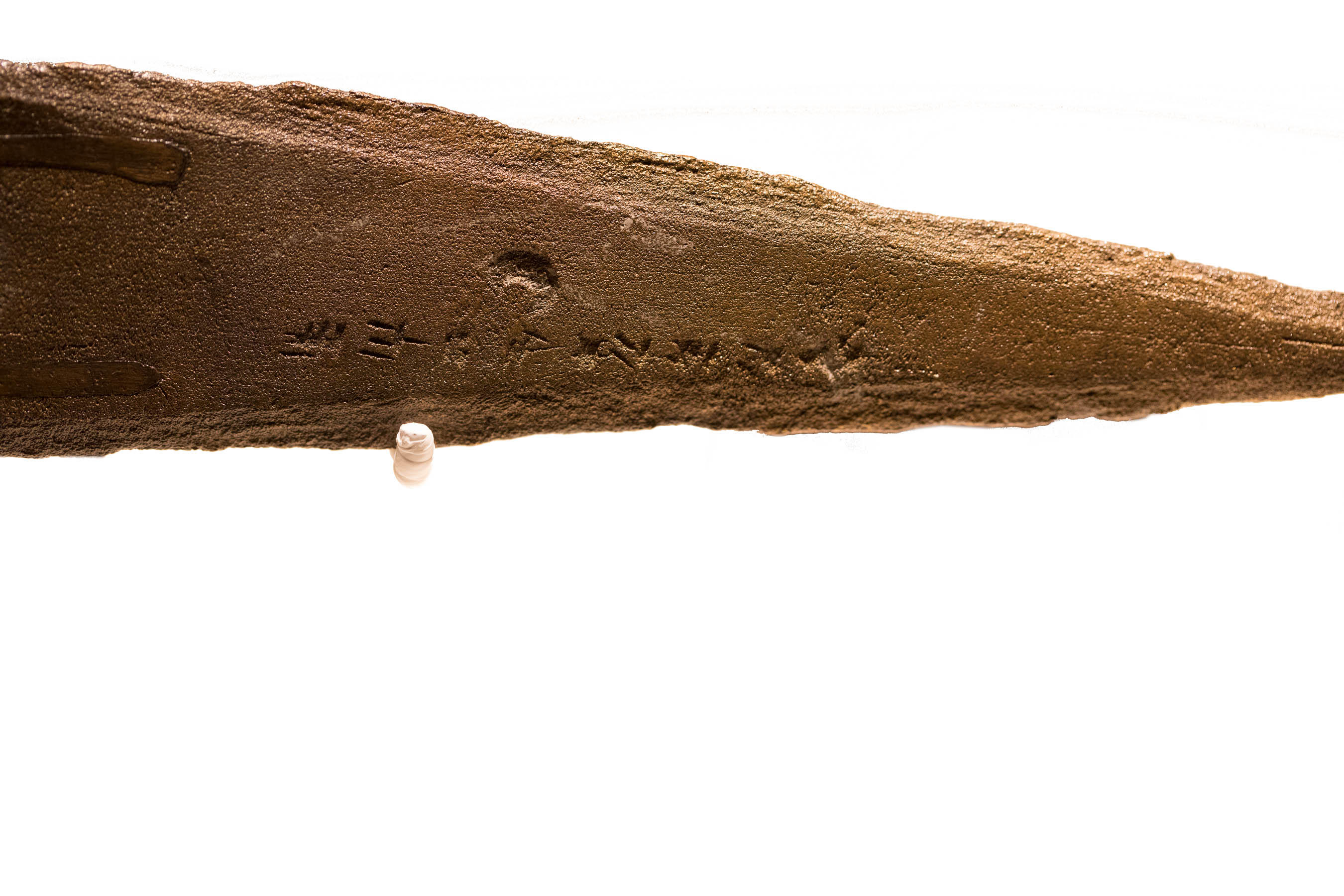
written in Akkadian on a bronze dagger discovered in a palace at Kanesh.
Hattusa
One of the cities conquered by Anitta was the city of Hattusa, an important center for trade located in central Anatolia. Although Anitta pronounced a curse on anyone who tried to rebuild the city, the city was nevertheless rebuilt by one of his descendants, named Labarna in Hittite texts. Not only would Labarna rebuild the city, he would make it the capital of his kingdom and even change his name to “Hattusili.” Thus he refers to himself in his inscriptions as:
“Hattushili, the Great King, King of Hattusha, the man from Kushshar.”4Bryce 1998, 19
The transfer of the capitol from Kanesh (Nesa) to Hattusa c. 1650 BC marks the beginning of the Old Hittite kingdom.
Bryce, T.
The Kingdom of the Hittites.
Oxford, New York: Clarendon Press; Oxford University Press, 1998. Link