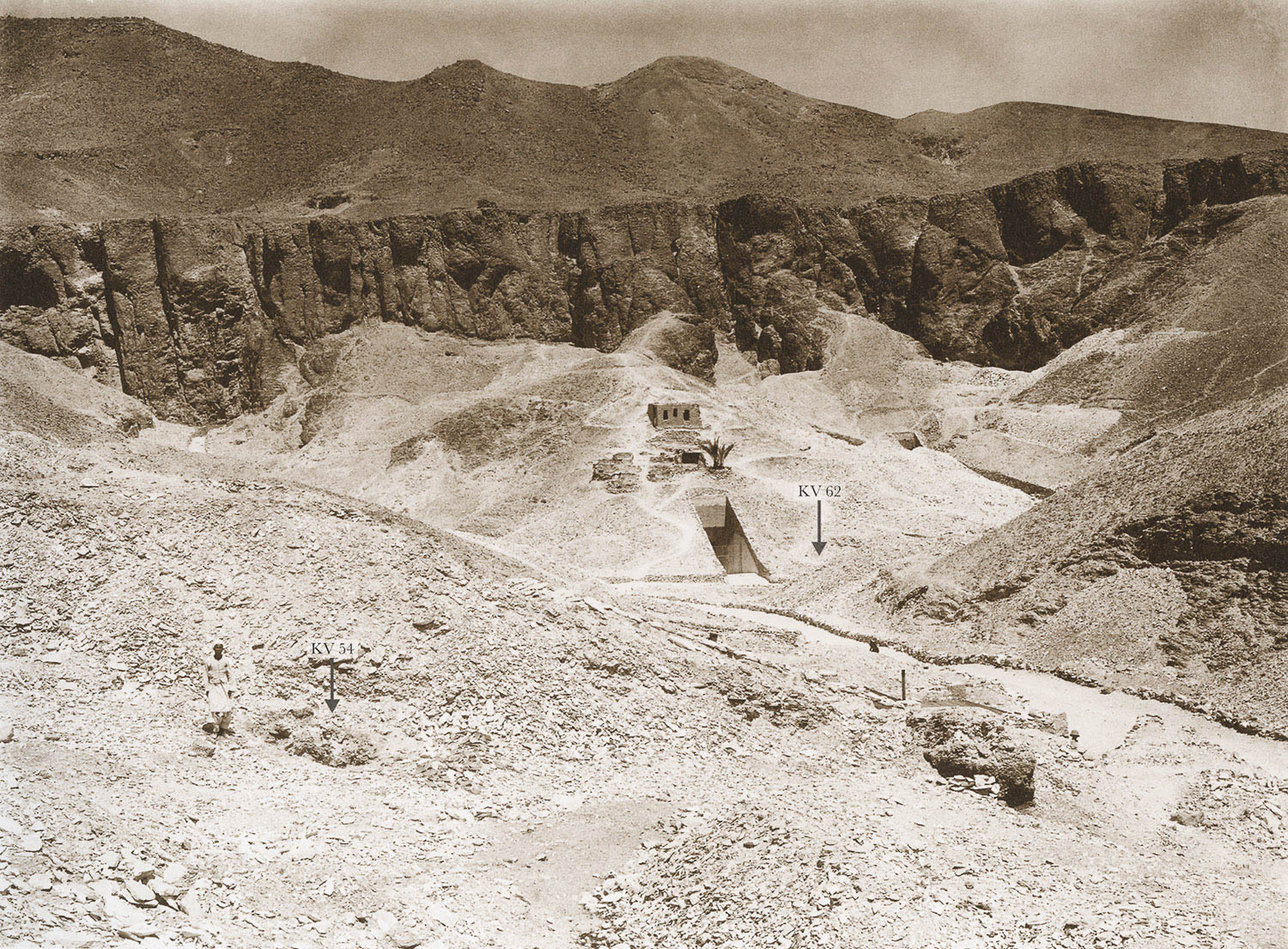
The arrow label KV 62 marks the location where the tomb of Tutankhamen was discovered.
Harry Burton (1879–1940): The Pharaoh’s Photographer, The Metropolitan Museum Archives.The story of the discovery of the tomb of king Tutankhamen is the story of a wealthy, fast-car-loving, British aristocrat meets a down-and-out, hard-nosed archaeologist. Lord Carnarvon was an earl, the owner of a great estate (of Downton Abbey fame). He married the illegitimate daughter of Alfred Rothschild which added considerably to his fortune. In contrast, Howard Carter was born into a family of modest means. His father was an artist and an illustrator. Carter learned how to draw from his father, a skill that would eventually earn for him a position on the staff of the famous archaeologist, Sir Flinders Petrie. He worked his way from illustrator to Chief Inspector of Antiquities. But his career hit the skids when he took a principled, but unpopular, side in a dispute that ultimately led to his resignation. Although Howard continued to live in Egypt, he was reduced to taking occasional jobs as a portrait artist and freelance illustrator. He was right back to where he started!
Lord Carnarvon met Howard Carter when he came to Egypt to rest and recuperate after an auto accident. With money to spend, he approached the unemployed archaeologist to see if he would be willing to supervise an excavation in Egypt. Howard readily agreed and suggested that they dig in the Valley of the Kings. This was by no means an obvious choice of location for a new excavation. By this time, archaeologists had been combing the valley for tombs for decades. Although it had produced many exciting discoveries, these had tapered off in recent years. There didn’t seem to be much of anything left to find. But Carter suspected that at least one tomb waited to be found. He based this belief on the recent discovery of some loose items inscribed with the name of a certain obscure pharaoh named Tutankhamen whose tomb, Carter deduced, must be located somewhere nearby.
Carter and Carnarvon were finally granted permission to dig in the Valley of the Kings in 1914. But after five long years of digging, and a world war, Carter had very little to show for his effort. Lord Carnarvon told Carter that he could pledge funding for just one more season of digging. So Carter decided to focus on an area at the bottom of the valley, under the ruins of an ancient workman’s village, that no one had excavated before. In November of that year, 1922, Carter’s men made the first momentous discovery, a set of steps leading down to what they presumed must be a tomb. Shortly thereafter a door came into view with an intact seal! Carter ordered his men to fill in the hole. He cabled Carnarvon with the exciting news. Several months later, in February of 1923, with Carnarvon standing by his side, Carter chiseled a hole through the door of the tomb, just large enough to see inside by the light of a candle. Carter vividly recounts the moment when he peered inside:
“I inserted the candle and peered in. At first I could see nothing, the hot air escaping from the chamber causing the candle flame to flicker, but presently, as my eyes grew accustomed to the light, details of the room within emerged slowly from the mist, strange animals, statues, and gold – everywhere the glint of gold. I was struck dumb with amazement, and when Lord Carnarvon inquired anxiously, ‘Can you see anything? it was all I could do to get out the words, ‘Yes, wonderful things.'”
It was a well deserved reward for so many years of diligent labour!
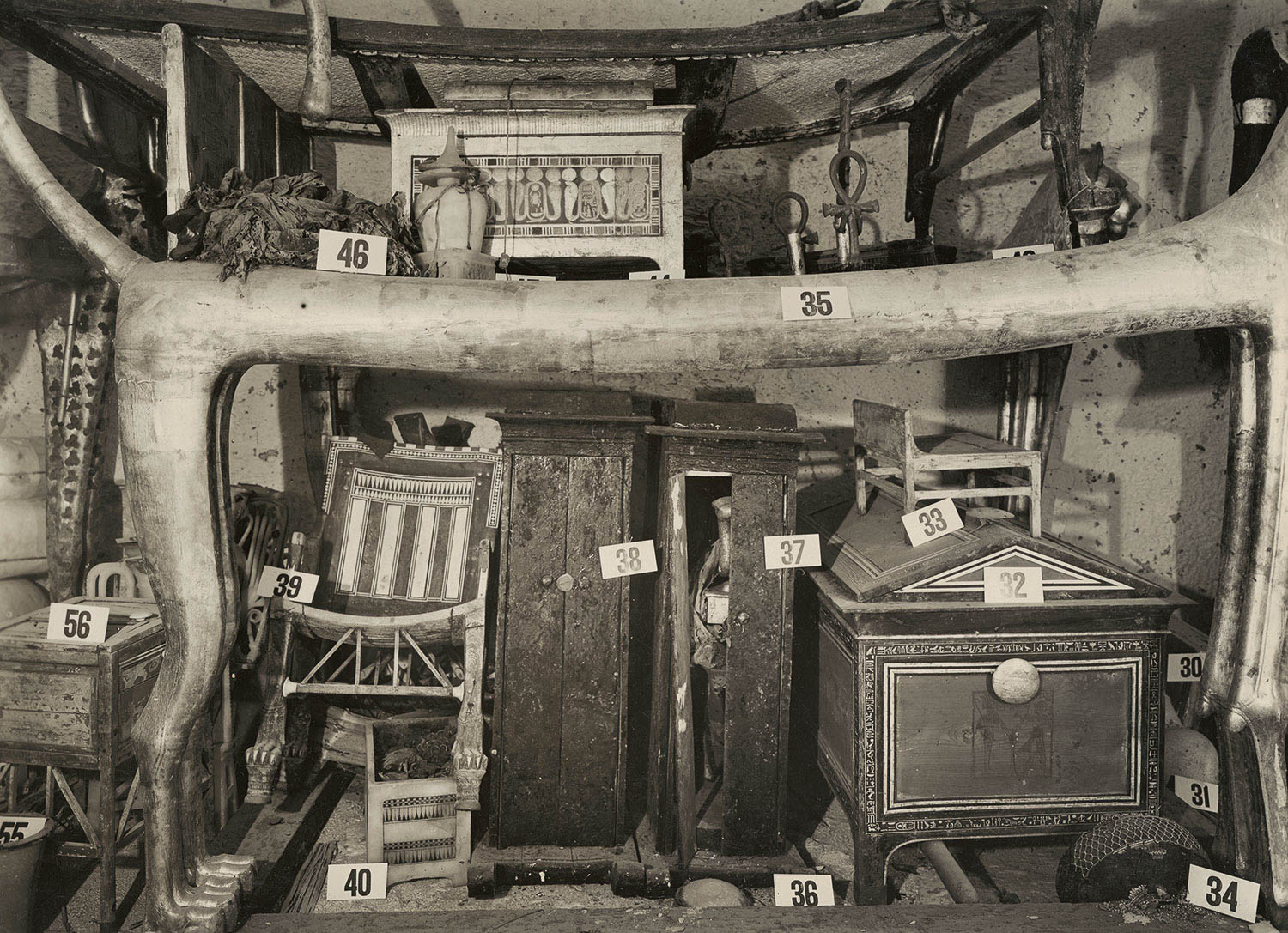
piled to the ceiling of the tomb. They were gilded with gold and inlaid with ivory and precious stones. “Everywhere the glint of gold,” wrote Carter.
The Antechamber
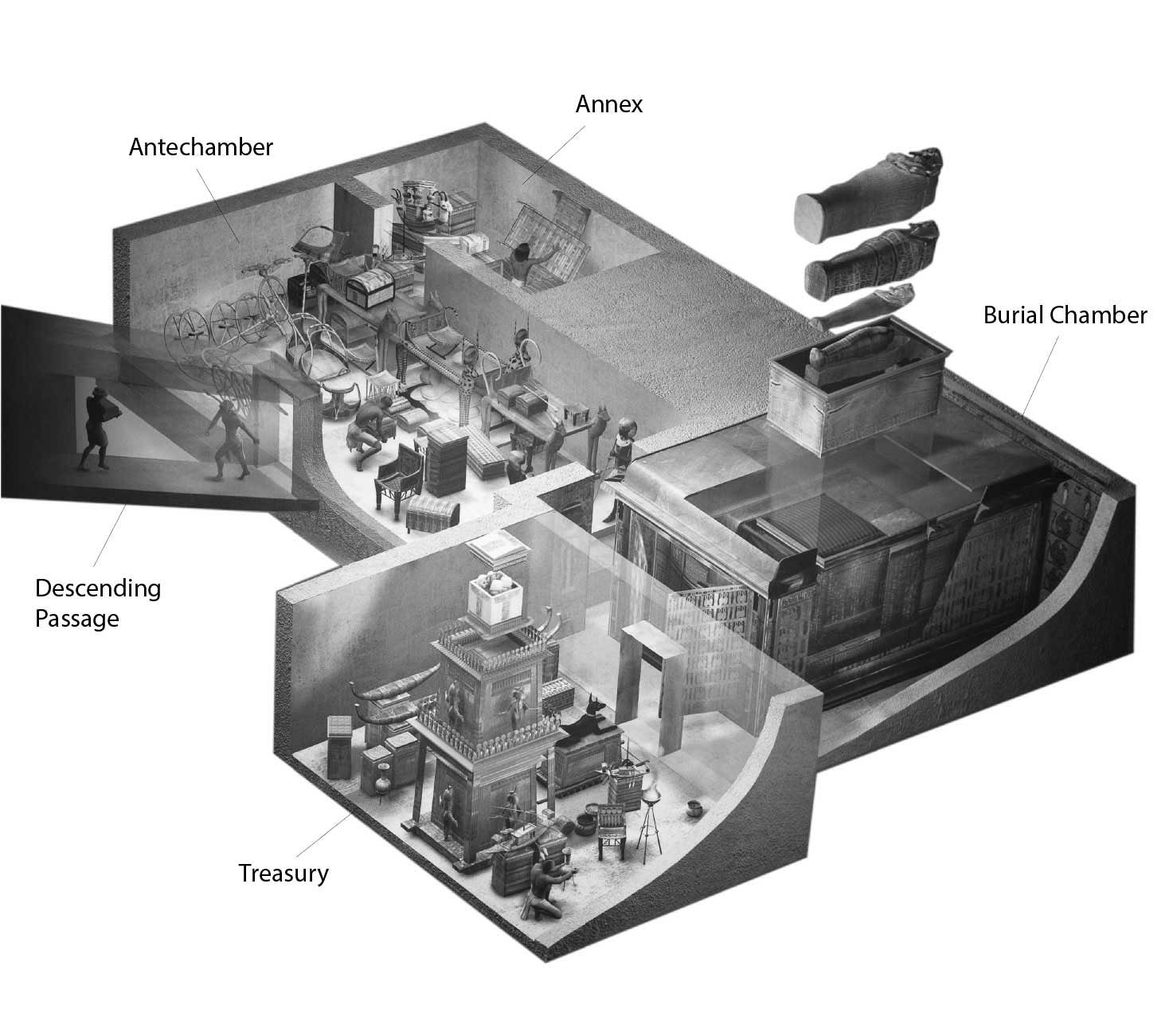
The tomb itself was divided into four chambers: the entrance chamber, the tomb chamber, and two side chambers. All of these were packed full of finely crafted grave goods. Never had anything approaching the richness of this tomb been seen before nor has anything like it been found since. And yet, Tutankhamen was a relatively unimportant pharaoh, and his tomb was unusually small. We can only imagine what the burials of the more powerful pharaohs must have contained. No wonder Homer, when he spoke of Thebes, chose to highlight the proverbial wealth of that great city:
“…in Egyptian Thebes the heaps of precious ingots gleam, the hundred-gated Thebes.” The Illiad
This description of Thebes fits very well with what we have learned about that city during the bronze age—and especially the 18th dynasty.
The Burial Chamber
The burial chamber contained a giant golden box that must have been assembled piece by piece inside the tomb. Inside this box was another box, and another… four boxes in total surrounded the stone sarcophagus that contained the royal mummy. The mummy itself was protected by another three coffins. The whole assembly has often been compared to a set of nesting dolls. The dismantling of these brittle boxes represented Carter’s most difficult task. It took an entire season to peel back the panels of wood and the coffins that protected the mummy until, at last, the final coffin was ready to be pried apart. Here again, is how Carter described the moment when he opened the last coffin:
The light shone into the sarcophagus. A sight met our eyes that at first puzzled us. It was a little disappointing. The contents were completely covered by fine linen shrouds. We rolled back those covering shrouds, one by one, and as the last was removed a gasp of wonderment escaped our lips, so gorgeous was the sight that met our eyes: a golden effigy of the young boy king, of most magnificent workmanship, filled the whole interior of the sarcophagus.”
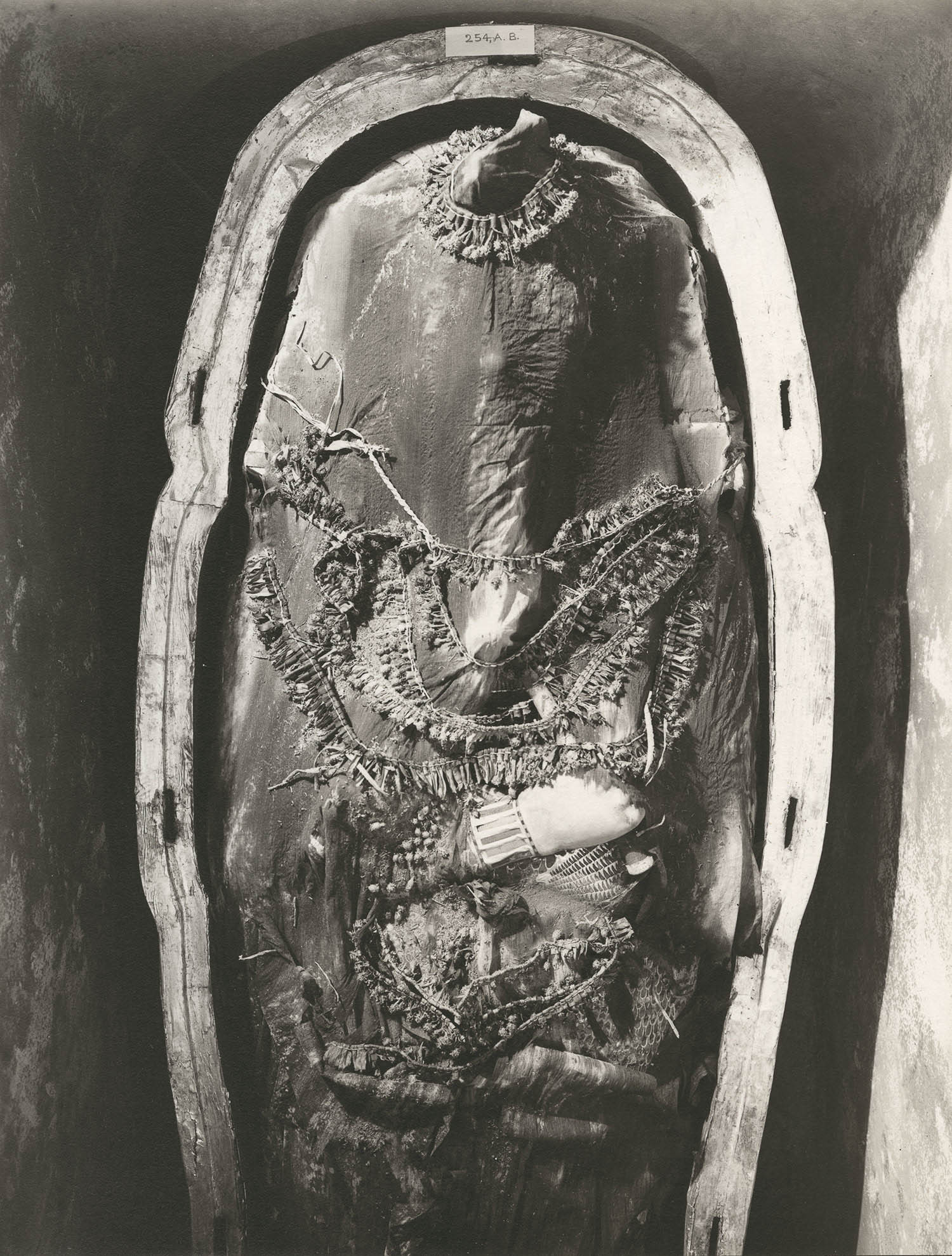

before the shroud was removed, and after.
Statues of the Pharaoh
Many statues of Tutankhamen were found inside his tomb. One statue has the pharaoh standing on a papyrus raft ready to hurl his harpoon at a hippopotamus, the symbol of the god, Seth, harbinger of death and chaos. Another statue shows the pharaoh riding a black panther, an animal associated with the night and the underworld.
The Egyptians believed that human beings were endowed with a life force or ‘ka’ that needed a physical resting place once the person died. The tomb served this need, as did the mummy, and the statues placed inside his tomb. As Romer points out, the Egyptians did not create sculptures simply for the joy of creating works of art. They created them as receptacles for the persons ‘ka’, his life force. Without this statue, the life force would cease to exist. This is why an Egyptian sculptor was called “he who keeps alive.” 1Romer 2001
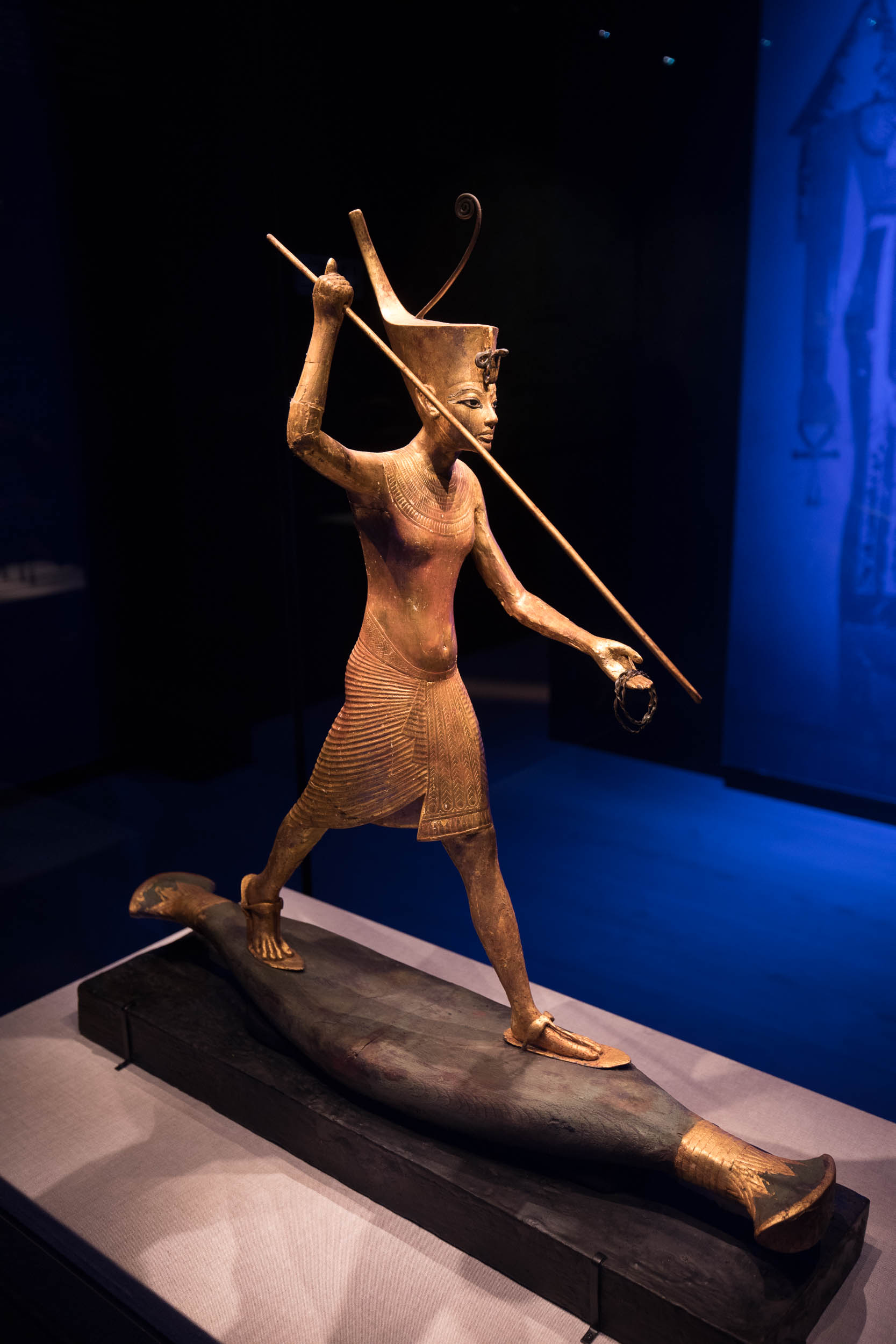
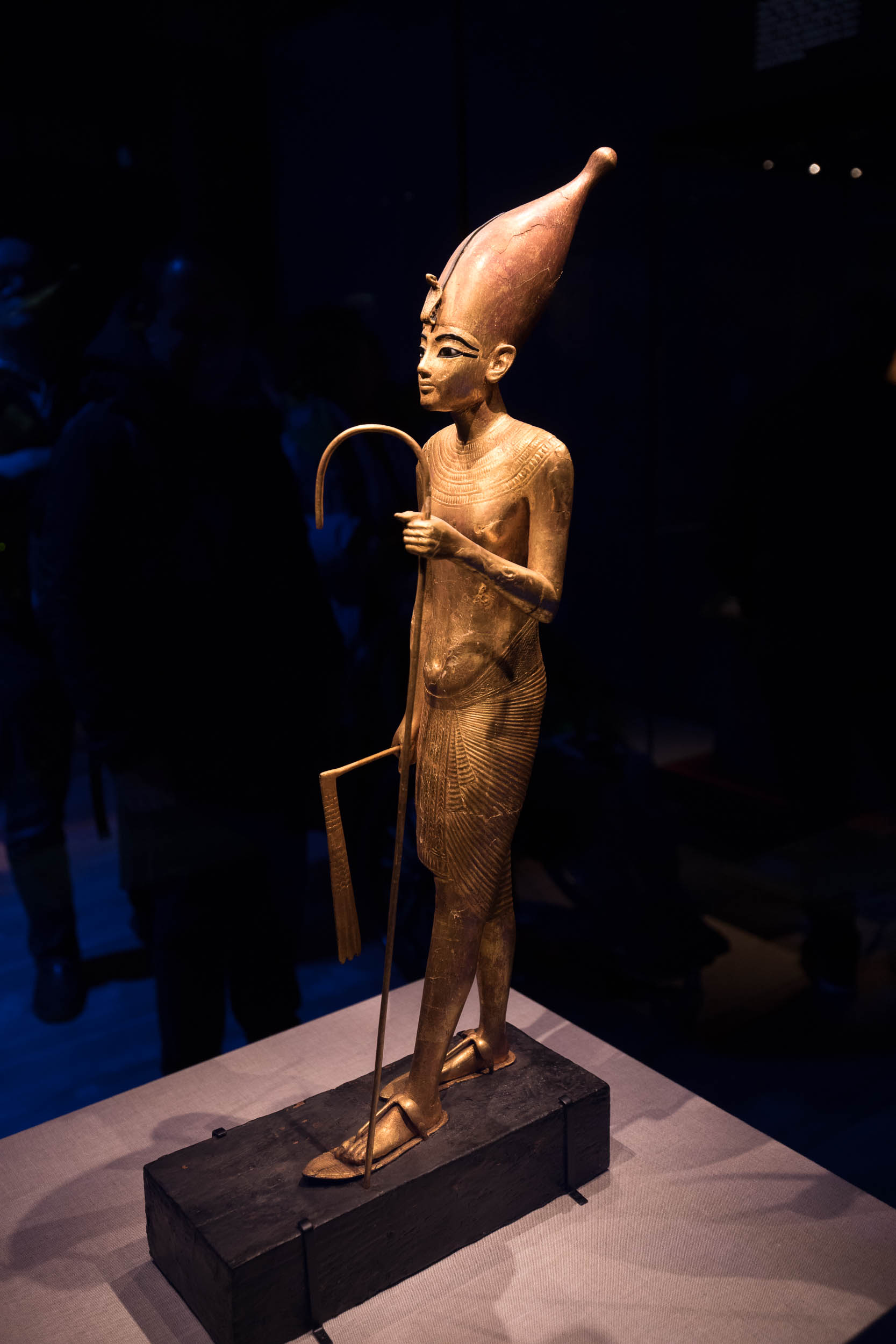
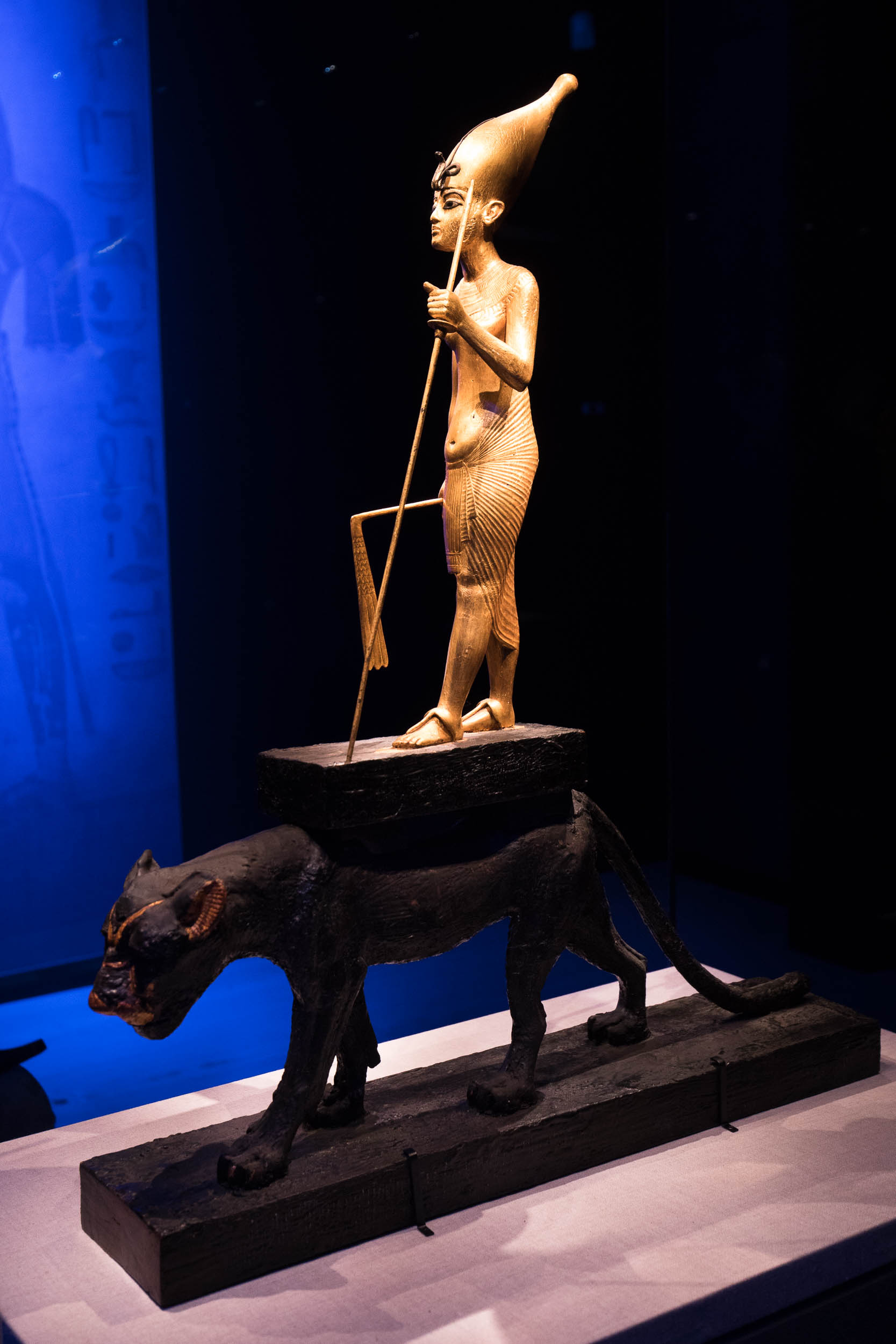
fromn the tomb of Tutankhamen.
The Saatchi Gallery, London; on loan from the Grand Egyptian Museum, Cairo. arcHarry Burton (1879–1940): The Pharaoh’s Photographer
Romer, J. (2001). The Valley of the Kings. London, Phoenix Press.
Boxes & Chairs

The first objects to greet Carter and Carvaron when they entered the tomb were a collection of exotic tables shaped in the form of animals, wooden chests and chairs. Harry Burton

Everything is carefully fitted together and secured with wooden pegs. The ability to cut and smooth wood with such precision without the aid of steel tools is a testament to the great skill of Egyptian craftsmen.
This box contained instruments used to ‘bring to life’ the mummy of the pharaoh.
Vessels
[wpgb_grid id=”34″]
Alabaster vessels discovered in Tutankhamen’s tomb.
Jewelry
[wpgb_grid id=”26″]
Jewelry made from lapis lazuli (dark blue), carnelian (orange), and turquoise (light blue). The feature the sun disc either pushed along by the scarab beetle or carried on the head of the falcon. The falcon grasps in its claws the symbols of life and eternity.
The Egyptians observed how the scarab beetle scurried across the desert floor pushing a ball of dung along with its hind legs until it found a suitable resting place. Some time later, the ball of dung would break open and young beetles would emerge. For the ancient Egyptians, this represented the powerful forces of self-generation from which the universe emerged. In an imaginitive leap, the Egyptians identified the ball of dung with the sun, which also represented the powers of generation. In Egyptian mythology, the beetle pushes the sun disc over the eastern horizon at the beginning of each day. The pharaoh sought to tap into these mysterious powers. This is why the sun disc and the scarab feature so prominently on the items found within the tomb.
Harry Burton (1879–1940): The Pharaoh’s Photographer
The arrow label KV 62 marks the location where the tomb of Tutankhamen was discovered.
Harry Burton (1879–1940): The Pharaoh’s Photographer, The Metropolitan Museum Archives.The story of the discovery of the tomb of king Tutankhamen is the story of a wealthy, fast-car-loving, British aristocrat meets a down-and-out, hard-nosed archaeologist. Lord Carnarvon was an earl, the owner of a great estate (of Downton Abbey fame). He married the illegitimate daughter of Alfred Rothschild which added considerably to his fortune. In contrast, Howard Carter was born into a family of modest means. His father was an artist and an illustrator. Carter learned how to draw from his father, a skill that would eventually earn for him a position on the staff of the famous archaeologist, Sir Flinders Petrie. He worked his way from illustrator to Chief Inspector of Antiquities. But his career hit the skids when he took a principled, but unpopular, side in a dispute that ultimately led to his resignation. Although Howard continued to live in Egypt, he was reduced to taking occasional jobs as a portrait artist and freelance illustrator. He was right back to where he started!
Lord Carnarvon met Howard Carter when he came to Egypt to rest and recuperate after an auto accident. With money to spend, he approached the unemployed archaeologist to see if he would be willing to supervise an excavation in Egypt. Howard readily agreed and suggested that they dig in the Valley of the Kings. This was by no means an obvious choice of location for a new excavation. By this time, archaeologists had been combing the valley for tombs for decades. Although it had produced many exciting discoveries, these had tapered off in recent years. There didn’t seem to be much of anything left to find. But Carter suspected that at least one tomb waited to be found. He based this belief on the recent discovery of some loose items inscribed with the name of a certain obscure pharaoh named Tutankhamen whose tomb, Carter deduced, must be located somewhere nearby.
Carter and Carnarvon were finally granted permission to dig in the Valley of the Kings in 1914. But after five long years of digging, and a world war, Carter had very little to show for his effort. Lord Carnarvon told Carter that he could pledge funding for just one more season of digging. So Carter decided to focus on an area at the bottom of the valley, under the ruins of an ancient workman’s village, that no one had excavated before. In November of that year, 1922, Carter’s men made the first momentous discovery, a set of steps leading down to what they presumed must be a tomb. Shortly thereafter a door came into view with an intact seal! Carter ordered his men to fill in the hole. He cabled Carnarvon with the exciting news. Several months later, in February of 1923, with Carnarvon standing by his side, Carter chiseled a hole through the door of the tomb, just large enough to see inside by the light of a candle. Carter vividly recounts the moment when he peered inside:
“I inserted the candle and peered in. At first I could see nothing, the hot air escaping from the chamber causing the candle flame to flicker, but presently, as my eyes grew accustomed to the light, details of the room within emerged slowly from the mist, strange animals, statues, and gold – everywhere the glint of gold. I was struck dumb with amazement, and when Lord Carnarvon inquired anxiously, ‘Can you see anything? it was all I could do to get out the words, ‘Yes, wonderful things.'”
It was a well deserved reward for so many years of diligent labour!
piled to the ceiling of the tomb. They were gilded with gold and inlaid with ivory and precious stones. “Everywhere the glint of gold,” wrote Carter.
The Antechamber
The tomb itself was divided into four chambers: the entrance chamber, the tomb chamber, and two side chambers. All of these were packed full of finely crafted grave goods. Never had anything approaching the richness of this tomb been seen before nor has anything like it been found since. And yet, Tutankhamen was a relatively unimportant pharaoh, and his tomb was unusually small. We can only imagine what the burials of the more powerful pharaohs must have contained. No wonder Homer, when he spoke of Thebes, chose to highlight the proverbial wealth of that great city:
“…in Egyptian Thebes the heaps of precious ingots gleam, the hundred-gated Thebes.” The Illiad
This description of Thebes fits very well with what we have learned about that city during the bronze age—and especially the 18th dynasty.
The Burial Chamber
The burial chamber contained a giant golden box that must have been assembled piece by piece inside the tomb. Inside this box was another box, and another… four boxes in total surrounded the stone sarcophagus that contained the royal mummy. The mummy itself was protected by another three coffins. The whole assembly has often been compared to a set of nesting dolls. The dismantling of these brittle boxes represented Carter’s most difficult task. It took an entire season to peel back the panels of wood and the coffins that protected the mummy until, at last, the final coffin was ready to be pried apart. Here again, is how Carter described the moment when he opened the last coffin:
The light shone into the sarcophagus. A sight met our eyes that at first puzzled us. It was a little disappointing. The contents were completely covered by fine linen shrouds. We rolled back those covering shrouds, one by one, and as the last was removed a gasp of wonderment escaped our lips, so gorgeous was the sight that met our eyes: a golden effigy of the young boy king, of most magnificent workmanship, filled the whole interior of the sarcophagus.”
before the shroud was removed, and after.
Statues of the Pharaoh
Many statues of Tutankhamen were found inside his tomb. One statue has the pharaoh standing on a papyrus raft ready to hurl his harpoon at a hippopotamus, the symbol of the god, Seth, harbinger of death and chaos. Another statue shows the pharaoh riding a black panther, an animal associated with the night and the underworld.
The Egyptians believed that human beings were endowed with a life force or ‘ka’ that needed a physical resting place once the person died. The tomb served this need, as did the mummy, and the statues placed inside his tomb. As Romer points out, the Egyptians did not create sculptures simply for the joy of creating works of art. They created them as receptacles for the persons ‘ka’, his life force. Without this statue, the life force would cease to exist. This is why an Egyptian sculptor was called “he who keeps alive.” 1Romer 2001
fromn the tomb of Tutankhamen.
The Saatchi Gallery, London; on loan from the Grand Egyptian Museum, Cairo. arcHarry Burton (1879–1940): The Pharaoh’s Photographer
Romer, J. (2001). The Valley of the Kings. London, Phoenix Press.
Boxes & Chairs
The first objects to greet Carter and Carvaron when they entered the tomb were a collection of exotic tables shaped in the form of animals, wooden chests and chairs. Harry Burton
Everything is carefully fitted together and secured with wooden pegs. The ability to cut and smooth wood with such precision without the aid of steel tools is a testament to the great skill of Egyptian craftsmen.
This box contained instruments used to ‘bring to life’ the mummy of the pharaoh.
Vessels
[wpgb_grid id=”34″]
Alabaster vessels discovered in Tutankhamen’s tomb.
Jewelry
[wpgb_grid id=”26″]
Jewelry made from lapis lazuli (dark blue), carnelian (orange), and turquoise (light blue). The feature the sun disc either pushed along by the scarab beetle or carried on the head of the falcon. The falcon grasps in its claws the symbols of life and eternity.
The Egyptians observed how the scarab beetle scurried across the desert floor pushing a ball of dung along with its hind legs until it found a suitable resting place. Some time later, the ball of dung would break open and young beetles would emerge. For the ancient Egyptians, this represented the powerful forces of self-generation from which the universe emerged. In an imaginitive leap, the Egyptians identified the ball of dung with the sun, which also represented the powers of generation. In Egyptian mythology, the beetle pushes the sun disc over the eastern horizon at the beginning of each day. The pharaoh sought to tap into these mysterious powers. This is why the sun disc and the scarab feature so prominently on the items found within the tomb.